

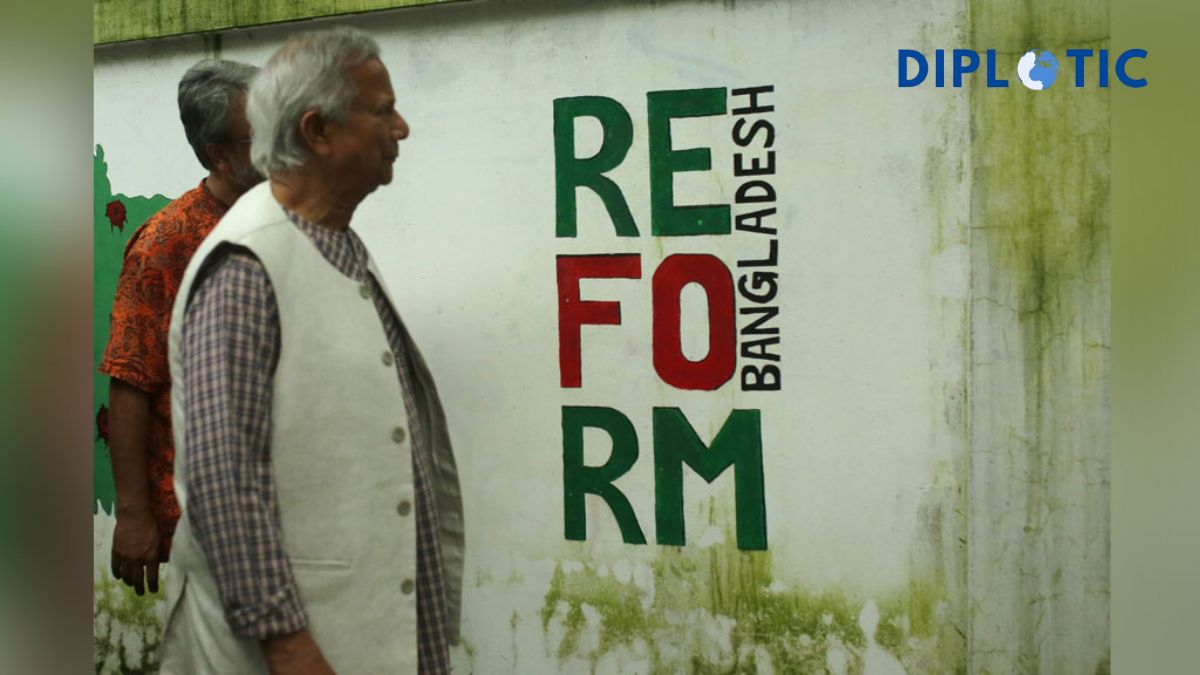
In Bangladesh’s current political discourse, two words dominate public imagination: “morality” and “reform.” Dr. Muhammad Yunus rose to power, wrapped in both, and was hailed as a symbol of ethical governance and moral credibility. For many, his leadership promised a clean break from coercive politics, corruption, and authoritarian habits.
Yet, only months into this experiment, a troubling question has emerged:
Can moral authority substitute for statecraft?
Morality Without Policy
States are not governed by virtue alone. They are governed by clear policy, decisive authority, and institutional control. The central failure of the Yunus government lies precisely here: high moral standing paired with an alarming absence of policy clarity.
On critical national issues, the government’s position remains vague. Decisions are delayed, responsibility is diffused, and authority appears suspended. What Bangladesh is experiencing is not a transition; it is administrative paralysis.
A government exists, but governance does not.
The NGO Mindset Problem
Dr. Yunus’s lifelong engagement with NGOs and donor-driven institutions earned him global admiration. But governance is not development work. NGOs negotiate, consult, delay, and seek consensus. States, especially fragile ones, must decide, enforce, and lead.
Running a country of 170 million people with an NGO mindset where confrontation is avoided and firmness is treated as moral failure is a strategic error. In politics, appeasing everyone often results in satisfying no one, while empowering the most aggressive actors.
Who Is Actually Running the State?
Perhaps the most dangerous consequence of weak governance is power ambiguity.
Who truly governs Bangladesh today?
Is it the formal government?
The bureaucracy?
International stakeholders?
Or political actors operating in the shadows of indecision?
This uncertainty erodes institutional confidence. When authority is unclear, the state becomes directionless and history teaches us that vacant power is never left unoccupied. It is seized by forces far less accountable.
Decline as a Political Choice
Law and order is weakening. Economic confidence is deteriorating. Foreign policy lacks assertiveness. These are not isolated failures they form a pattern.
The uncomfortable truth is that decline is not always accidental. Often, it is the result of strategic inaction. Avoiding hard decisions may appear morally neutral, but in reality, it is a political choice one that systematically weakens the state.
Inaction, in this context, has become governance.
The Danger of Moral Neutrality
Neutrality is often sold as wisdom. But when a government refuses to take a position, neutrality turns into complicity. A state cannot afford moral ambiguity when confronting disorder, extremism, or institutional decay.
Governments are not judged by intentions but by outcomes. Saying “we stand above politics” does not absolve a state from its responsibility to protect order, uphold law, and confront threats.
History Is Unforgiving
Bangladesh’s political history is ruthless in its judgment. Weak governments are not remembered kindly regardless of how ethical their leaders appeared.
Dr. Yunus may remain a respected global figure, but history will ask him a far harsher question:
Did he strengthen the state or preside over its quiet erosion?
Final Word
Bangladesh stands at a critical crossroads. Decline is no longer a risk; it is a choice.
A state survives on decisiveness, not virtue signaling. Morality may inspire trust, but policy and authority sustain nations.
Without a backbone of firm decisions, even the most well-intentioned leadership cannot prevent collapse. A state without direction does not drift, it decays.




