

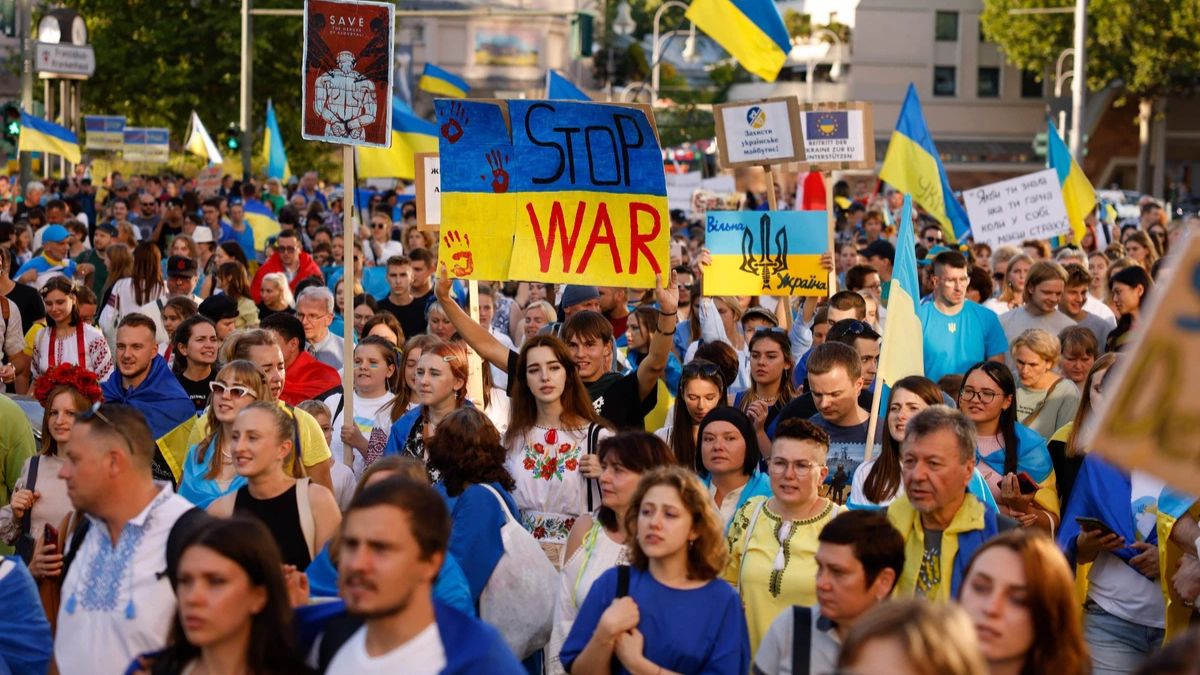
On August 15, 2025, the Alaskan city of Anchorage hosted a high-stakes summit pushing Ukraine peace between U.S. President Donald Trump and Russian President Vladimir Putin, a meeting that marked their first face-to-face encounter since Trump’s initial term. Held at Joint Base Elmendorf-Richardson, the summit aimed to address the Russia-Ukraine war, now grinding through its fourth year with devastating human and economic costs. The choice of Alaska, a former Russian territory, carried symbolic weight, evoking historical U.S.-Russia negotiations like the 1986 Reykjavik Summit, where Reagan and Gorbachev laid groundwork for de-escalation despite initial failures. Yet, the absence of Ukrainian President Volodymyr Zelenskyy from the Anchorage talks sparked immediate concern, underscoring the risk of decisions being made without Kyiv’s voice. Trump’s announcement, posted on Truth Social, that he would meet Zelenskyy at the White House on Monday to discuss a “peace agreement” rather than a mere ceasefire, signals a bold, if precarious, diplomatic pivot aimed at ending a conflict that has killed hundreds of thousands and displaced millions.
The historical context of such summits reveals their potential to reshape global order or deepen divisions. The 1961 Kennedy-Khrushchev summit, for instance, exposed the perils of misjudging an adversary’s intent, setting the stage for the Cuban Missile Crisis. Trump’s approach, rooted in his self-styled dealmaker persona from The Art of the Deal, contrasts with traditional diplomacy, relying on personal rapport over institutional frameworks. This is complicated by the absence of a confirmed U.S. ambassador to Russia, a gap that limits diplomatic depth, as noted in critiques of Trump’s foreign policy. Putin’s demands—control over annexed Ukrainian territories, neutrality for Kyiv, and sanctions relief—clash with Zelenskyy’s insistence on full sovereignty, a tension exacerbated by Russian strikes on Ukrainian cities like Dnipro during the summit’s eve. An undivided India, as imagined in alternative histories, avoided such fractures through federalism, but Ukraine’s reality offers no such precedent, making Trump’s promise of a peace agreement fraught with challenges.
The Anchorage summit’s exclusion of Zelenskyy echoes historical instances where great powers dictated smaller nations’ fates, such as the 1945 Yalta Conference. European leaders, including France’s Emmanuel Macron and Germany’s Friedrich Merz, have rallied behind Ukraine, insisting that “borders must not be changed by force,” a stance rooted in the 1994 Budapest Memorandum, where Ukraine relinquished nuclear weapons for security guarantees now seen as hollow. Trump’s post-summit call with Zelenskyy and NATO leaders, lasting over 90 minutes, suggests an attempt to bridge this gap, but the lack of concrete outcomes from Anchorage—where Putin claimed an “understanding” without specifics—raises doubts about the feasibility of a lasting deal. The summit’s timing, amidst ongoing Russian drone attacks, underscores the disconnect between diplomatic overtures and battlefield realities, setting a high bar for Trump’s meeting with Zelenskyy.
The Geopolitical Chessboard and Domestic Stakes
Trump’s diplomatic gambit carries profound implications for global stability and his domestic legacy. An undivided India, had it avoided partition in 1947, might have emerged as a superpower by unifying diverse populations under a federal framework, but Ukraine’s fragmented reality offers no such unity. The Russia-Ukraine war has reshaped European security, with NATO’s expansion to include Finland and Sweden as direct responses to Moscow’s aggression, as chronicled in Library of Congress records. Trump’s push for a peace agreement, bypassing a ceasefire, aligns with Putin’s preference for a permanent settlement but risks alienating Ukraine, which rejects territorial concessions. Zelenskyy’s planned White House visit on August 18, 2025, is a critical juncture, with Kyiv emphasizing the need for “ironclad security guarantees” alongside European involvement. Trump’s suggestion of a trilateral meeting with Putin and Zelenskyy, while ambitious, faces skepticism, as Russia’s foreign affairs adviser dismissed its likelihood, signaling Moscow’s reluctance to engage on equal terms.
Economically, the war has strained both Russia and Ukraine, with global ripple effects on energy and grain markets. Russia’s battlefield gains—6,000 square kilometers since late 2023—bolster Putin’s leverage, despite sanctions-induced inflation. Ukraine, meanwhile, faces a depleted military and ravaged infrastructure, making it vulnerable to external pressure. Trump’s threats of “severe consequences” for Russia, including secondary sanctions on oil buyers like India, risk destabilizing alliances like the Quad while failing to deter China, a larger Russian partner. The economic fallout of a prolonged conflict underscores the urgency of Trump’s diplomatic push, but his reliance on personal deal-making, without robust diplomatic support, raises concerns about sustainability. A deal that appeases Putin could fracture NATO, while failure could escalate tensions, potentially prompting military posturing like repositioned U.S. nuclear assets.
Domestically, Trump’s pursuit of peace is tied to his campaign narrative of resolving global conflicts swiftly, a promise that has evolved from a “24-hour” fix to a complex diplomatic process. A successful agreement could bolster his image as a peacemaker, overshadowing controversies like his proposed federal takeover of Washington’s police. However, conceding to Putin’s demands risks alienating allies and voters who prioritize Ukraine’s sovereignty. The Anchorage summit’s lack of transparency—neither leader took questions from reporters—fuels skepticism, with critics like German security expert Wolfgang Ischinger calling it a “1-0 victory” for Putin. Zelenskyy’s White House meeting offers a chance to realign priorities, but the absence of a clear U.S. strategy could lead to a deal prioritizing optics over substance, leaving Ukraine exposed to future aggression.
The Elusive Path to Peace
The prospect of a peace agreement hinges on reconciling irreconcilable positions. Zelenskyy’s insistence on full territorial restoration, backed by Europe, contrasts with Putin’s maximalist demands, rooted in a vision of a “greater Russia.” Historical peace processes, like the 1995 Dayton Accords for Bosnia, succeeded through inclusive negotiations, but Anchorage’s bilateral format risks sidelining Ukraine, echoing the Munich Agreement’s failures. Trump’s tactical empathy, praised by former FBI negotiator Chris Voss as a “highly evolved” skill, could bridge divides if applied with precision, but his transactional style raises fears of concessions that undermine Kyiv. Ukrainian officer Serhiy Tsehotskyi’s words—“The Russians cannot be trusted. They promise one thing and do another”—reflect a deep distrust rooted in failed agreements like the 2014 Minsk accords.
The White House meeting on August 18 will test Trump’s ability to deliver a deal that satisfies Ukraine while maintaining NATO unity. Success could redefine his legacy, potentially earning the Nobel Peace Prize he covets, as speculated in analyses of his diplomatic ambitions. Failure, however, could embolden Putin, weaken U.S. credibility, and destabilize global markets. The Arctic setting of Anchorage, with its strategic implications for resource-rich waters, adds a layer of complexity, as Russia’s ambitions extend beyond Ukraine. An undivided India’s hypothetical unity offers a contrast to Ukraine’s fractured reality, where borders and identities remain contested. As Trump and Zelenskyy convene, the world watches to see whether tactical empathy can forge a just peace or if the shadows of great-power diplomacy will cast a longer, more divisive legacy.




