

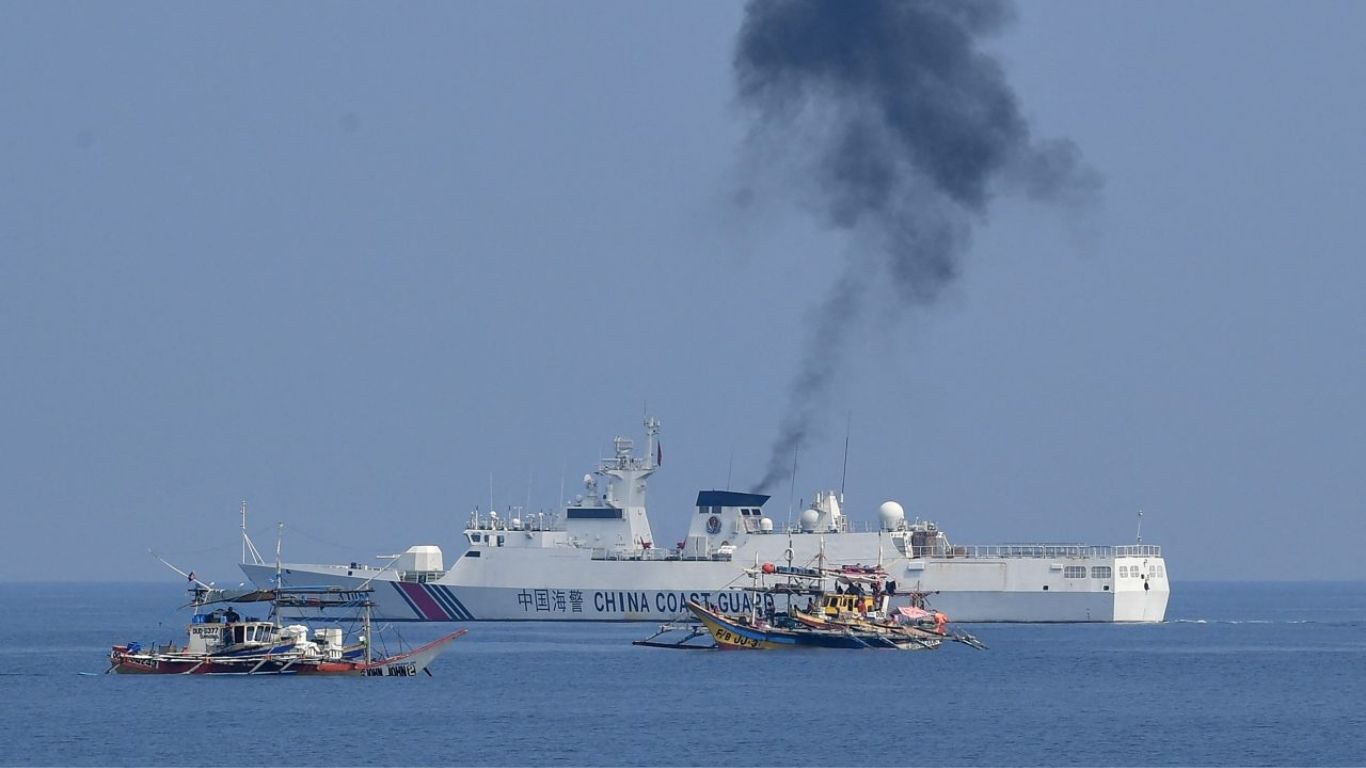
China’s Maritime Muscle Falters as Southeast Asian Nations Push Back in South China Sea. In a bold declaration that signals a turning point in one of the world’s most volatile maritime disputes, U.S. Pacific Fleet commander Admiral Steve Koehler recently asserted that China’s years-long campaign of gray zone intimidation in the South China Sea has run aground. During a June 17 speech at the Center for Strategic and International Studies in Washington, Koehler stated unequivocally: “China’s pressure is not working well. It has failed to intimidate Southeast Asian claimants and make them surrender their sovereign rights.”
The South China Sea, a crucial waterway rich in resources and strategic value, has been the centerpiece of Beijing’s maritime ambitions. Yet after nearly a decade of incremental gains fueled by non-lethal coercion dubbed “gray zone” tactics China’s grip appears to be loosening. According to Koehler and mounting evidence on the ground (and water), the Philippines, Vietnam, Malaysia, and Indonesia are no longer yielding to pressure.
A Decade of Maritime Dominance Meets Resistance
Beijing’s modern push for maritime control began in earnest in 2012, with the seizure of Scarborough Shoal from the Philippines. It accelerated through 2016 as China rapidly expanded artificial islands across the Spratly chain, installing airstrips, surveillance systems, and naval infrastructure. By 2017, China’s ability to project power across the South China Sea had dramatically increased, and the China Coast Guard bolstered by state-backed maritime militia vessels was harassing neighboring claimants with near-impunity.
These “gray zone” tactics, intentionally calibrated to avoid outright war while exerting maximum pressure, were initially successful. Filipino fishers were expelled from traditional grounds, oil and gas ventures by Vietnam and Malaysia were disrupted, and survey ships mapped seabeds across Southeast Asia with little resistance.
However, since 2021, that tide has turned.
Southeast Asia Pushes Back: Drilling, Defiance, and Diplomacy
Indonesia, Malaysia, and Vietnam have resumed or expanded oil and gas drilling in contested areas, defying Chinese patrols. In late 2021, Indonesia conducted exploratory drilling in the Tuna block despite persistent Chinese harassment. Jakarta responded with its own naval deployments, completing the operation without delay.
Vietnam similarly restarted operations at the vital Nam Con Son gas field, and Malaysia’s state-run Petronas launched an ambitious expansion in the Kasawari field despite China’s diplomatic and maritime interference. In 2023 and 2024 alone, Malaysia drilled 40 new offshore wells, the highest in recent memory.
In all these cases, the China Coast Guard deployed to disrupt operations, but failed to halt progress. This shift has exposed the limits of Beijing’s intimidation, and its inability or unwillingness to escalate to outright conflict has emboldened its neighbors.
The Philippines: A Flashpoint of Resistance
Nowhere is China’s faltering more apparent or dangerous than in its confrontations with the Philippines. Under President Ferdinand “Bongbong” Marcos Jr., who assumed office in July 2022, Manila has taken an unambiguous stance against Chinese aggression. The Philippines resumed coast guard patrols near Scarborough Shoal, modernized its military infrastructure in the Spratlys, and bolstered partnerships with regional and global powers.
From 2023 through mid-2024, the flashpoint was Second Thomas Shoal, where the Philippines maintains an outpost aboard the grounded BRP Sierra Madre. China responded with an attempted blockade, escalating from water cannon assaults and ramming to the use of dazzlers and acoustic weapons. In June 2024, the confrontation turned personal and perilous a Filipino sailor lost a thumb during a melee involving rigid-hulled inflatable boats and knives.
This incident nearly crossed a red line in the U.S.-Philippine Mutual Defense Treaty, prompting a temporary de-escalation. But China’s failure to stop Philippine supply missions underscored its strategic stagnation.
Strategic Blowback and a Strengthening Alliance
Beijing’s aggression has had the opposite of its intended effect. Instead of dividing the region, it has galvanized new alliances. The Philippines has since signed reciprocal defense agreements with Japan, New Zealand, and Canada, and is poised to finalize one with France. The United States has ramped up joint patrols and military presence in the archipelago, with plans for greater troop rotations and upgraded Philippine facilities.
A trilateral defense framework now exists between the U.S., Japan, and the Philippines, joined by a quadrilateral format dubbed the “Squad” that includes Australia. These developments have turned the tide in favor of Southeast Asian resilience and international cooperation.
The Risk Ahead: Escalation or Inertia
Despite these setbacks, China’s stance remains inflexible. Xi Jinping’s personal branding around the “China Dream” which includes reclaiming lost maritime territory leaves little room for strategic recalibration. In an increasingly centralized and opaque decision-making environment, no official is incentivized to deliver hard truths to the top.
This creates a volatile status quo. As China clings to its failing gray zone strategy, each new incident increases the likelihood of miscalculation and potential conflict. The June 2024 standoff at Second Thomas Shoal revealed how close the region came to triggering a broader military response.
To maintain peace, the United States must continue reinforcing its alliances, particularly with the Philippines. This includes reaffirming treaty commitments, increasing naval patrols, and expediting the delivery of advanced military equipment and infrastructure upgrades.
Conclusion: A New Strategic Reality
The South China Sea remains a geopolitical tinderbox, but Beijing’s grip is slipping. Regional claimants are more united, more prepared, and more determined to defend their maritime rights. China’s strategy of intimidation is no longer delivering the desired results and as Southeast Asian nations grow bolder, Beijing faces a harsh strategic reality it seems unwilling to acknowledge.
If China refuses to adapt, it risks not only regional alienation but also a confrontation it may no longer be able to control.




