

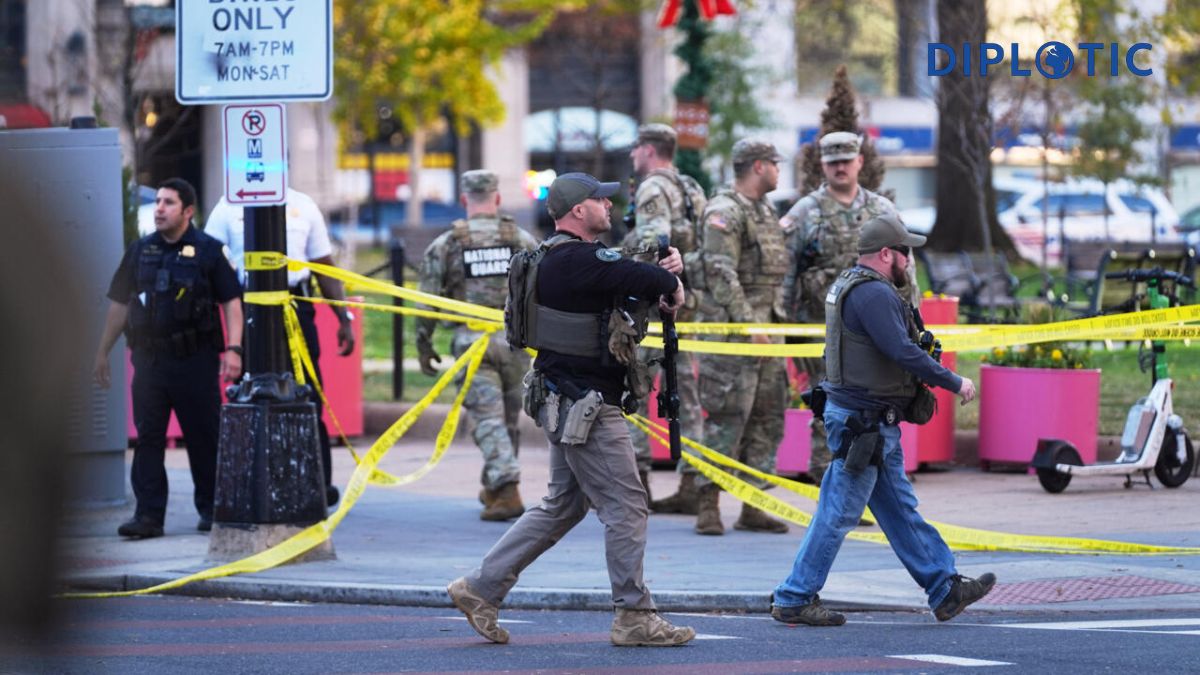
A brazen ambush on two National Guard members near the White House shook Washington, D.C.’s busy retail district. The tragic attack has reignited debate over security, military deployment, and public safety in the capital.
Heart of the Capital Shattered: Shooting Near White House Rocks D.C. Retail District
On the afternoon of November 26, 2025, around 2:15 p.m. Eastern, a bustling downtown Washington, D.C., retail and business corridor erupted into chaos. What is usually a crowded area of commuters, tourists, and office workers became the scene of a shocking attack: two uniformed members of the West Virginia National Guard were shot just two blocks from the White House, near the Farragut West Metro station.
Eyewitnesses described hearing multiple rounds and the frantic sound of people running for cover. One guard member collapsed near a bus stop; another was struck after the suspect allegedly seized the woman’s weapon and resumed firing. Local employees, shoppers, and lunch-break pedestrians dove for safety as law enforcement flooded the scene. In what officials have called a “targeted ambush,” the suspect was subdued and taken into custody. The man is being treated in hospital; the two guardsmen were transported to nearby trauma centers.
From Patrol to Tragedy: How Routine Turned Deadly
These National Guard members had been deployed to D.C. as part of a broader “Safe and Beautiful” mission ordered in August 2025, when the federal government mobilized roughly 2,200 Guard troops to assist with crime prevention and security assignments across the capital. On November 26, they were assigned to high-visibility foot patrols — part of efforts to show a reassuring presence in tourist-heavy downtown corridors. Ironically, the patrol intended to deter violence became the scene of one of the capital’s most disturbing shootings in recent years.Despite prior internal memos warning that the deployment could attract “violent extremists, issue-motivated groups and lone actors,” few envisioned such an immediate, direct assault.
Tragedy Confirmed: One Guard Member Dead, Another Fighting for Life
By November 27, confirmation came: 20-year-old Guardswoman Sarah Beckstrom succumbed to her wounds, becoming the first fatality from the deployment. The other 24-year-old Staff Sgt. Andrew Wolfe remains in critical condition. Their units belong to the West Virginia National Guard.
Authorities described the attack as “brazen” and “calculated.” According to prosecutors, the suspect first fired on Beckstrom; when she collapsed, he seized her weapon and shot Wolfe. Multiple rounds, reportedly 10 to 15, were fired in total.
The suspect has been identified as Rahmanullah Lakanwal, a 29-year-old Afghan national who entered the U.S. under the post-Afghanistan evacuation program. He was shot during the altercation and is now hospitalized under police guard. Federal and local agencies are investigating motive, including whether this was an act of terrorism.
A Retail District Paralyzed: Business, Tourism & Public Confidence Shaken
Moments after the shooting, downtown Washington’s retail, café, and commuter traffic came to an abrupt halt. Office workers ducked into shops and restaurants; tourists near Farragut Square froze, shocked by the violence. A sense of vulnerability spread; many asked if the city remained safe.
Local business owners expressed alarm. For them, D.C.’s downtown had long been bustling with commerce and tourism. Now, the echo of gunshots so close to the corridors of commerce threatens public confidence and could have ripple effects on holiday-season foot traffic, retail revenue, and traveler perception of D.C. as a safe destination.
Public sentiment, already mixed over the continued presence of military troops in civilian neighborhoods, seems poised to shift. Where once the Guard’s presence was pitched as reassuring, some residents and business owners may now view it as a magnet for danger.
Government Response: Surge of Forces, New Scrutiny, Tough Questions
In the wake of the shooting, the federal government acted quickly. On the orders of Pete Hegseth, head of the Defense Department, an additional 500 National Guard troops are being deployed to Washington, D.C.
Yet the tragedy has intensified scrutiny on the mission. Critics point out that a federal judge recently ruled the deployment unlawful, a controversial decision originally slated for December 11, unless overturned on appeal. The attack, they argue, highlights the risks of mixing uniformed military personnel with civilian law-enforcement duties on American soil.
Local officials have pledged full cooperation with prosecutors. Muriel Bowser, Mayor of Washington, D.C., described the shooting as a “targeted attack” and vowed a thorough investigation, pledging support for victims’ families and sanctioning any responsible parties “to the fullest extent of the law.”
What This Means and What’s at Stake for the Capital
The shooting near the White House in a corridor packed with civilians and shoppers is a stark reminder that no place is immune to violence. For D.C., it punctures the illusion of downtown as a secure zone. The implications extend far beyond the tragedy of two Guardsmen.
- Public Safety & Perception: Residents, workers, and tourists may rethink routines, with less foot traffic, more caution, and a greater sense of safety while commuting or shopping downtown.
- Security Strategy Under Question: Reliance on military deployment in civilian areas may face renewed criticism. The risk of infiltration or lone-actor violence in uniformed patrols may provoke calls for reevaluation of Guard assignments.
- Economic Impact: Restaurants, retailers, and service-industry businesses in D.C.’s downtown may suffer as visitors avoid perceived danger zones. Holiday-season commerce could take a hit.
- Political Fallout: Amid ongoing debates over civil-military boundaries, this incident may strengthen arguments for limiting Guard deployment or at least restructuring it more cautiously.
- National Discourse on Immigration & Resettlement: Given the suspect’s background, public and political focus may intensify on policies related to refugee vetting and asylum programs, potentially influencing national policy debates.
Mourning Honor And the Challenge Ahead
The death of Sarah Beckstrom, barely out of high school and newly deployed to defend the nation’s capital, has renewed calls for honoring the sacrifices made by those who wear the uniform. Governor Patrick Morrisey ordered flags flown at half-staff in West Virginia and called on citizens to observe a moment of silence.
But grief alone won’t restore confidence. Washington’s leaders now face a critical task: balance the need for security with civil liberties, rebuild public trust, and safeguard the city’s vibrant commercial heart without turning it into a militarized zone.
As investigations continue, one thing is clear: the fatal shooting near the White House has jolted Washington, D.C., out of complacency. The city must now wrestle with hard questions about safety, strategy, and the very meaning of security in a capital that prides itself on both openness and vigilance.




