

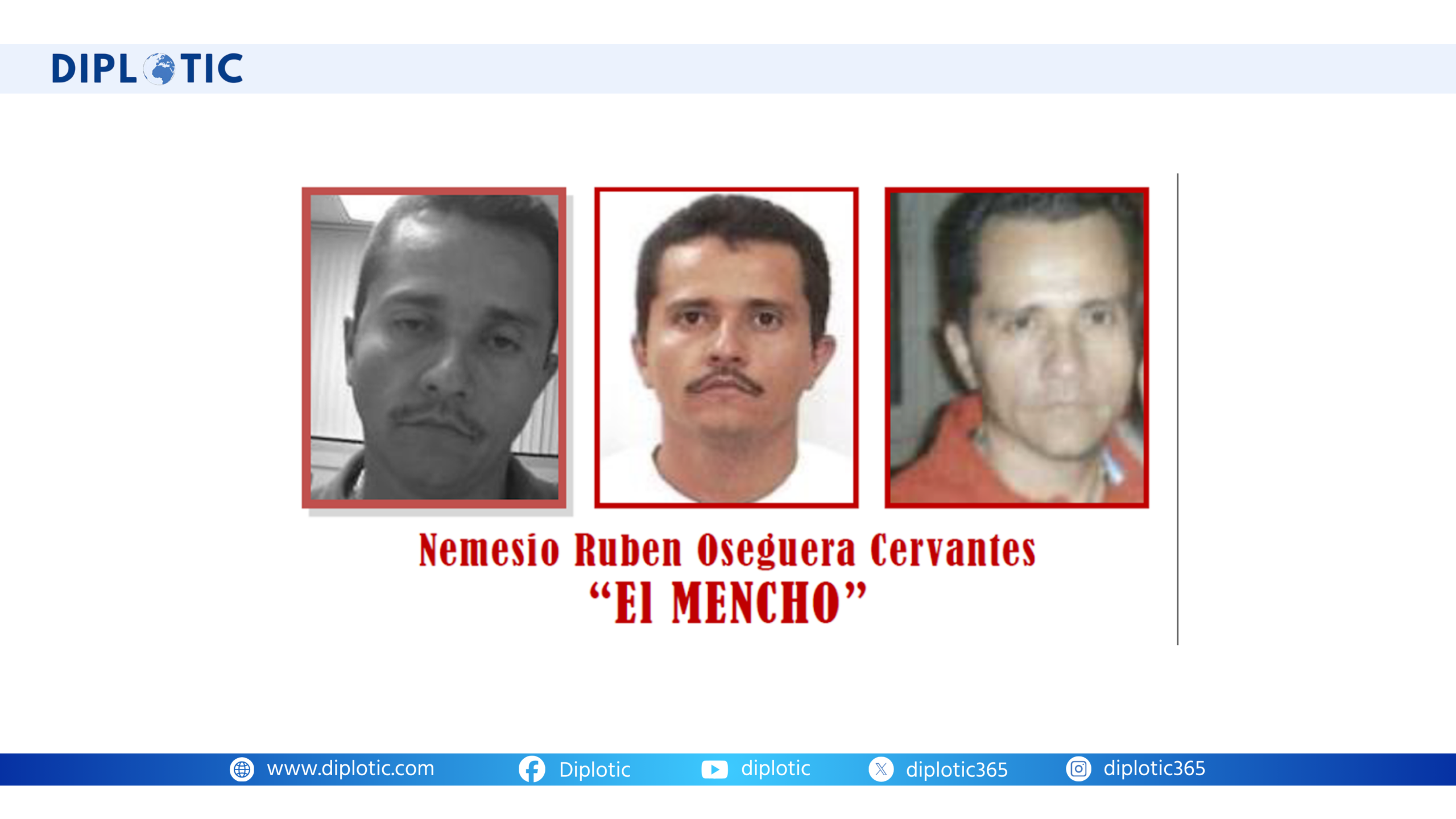
In the early hours of February 22, 2026, Mexican special forces launched an operation that would reshape the landscape of organized crime in the Americas. Their target was Nemesio Rubén Oseguera Cervantes, better known as “El Mencho,” the elusive leader of the Jalisco New Generation Cartel (CJNG) and Mexico’s most wanted man . Tracked through a romantic partner to his hideout in the rural town of Tapalpa, Jalisco, El Mencho met his end in a firefight that left him mortally wounded. He died aboard a military helicopter en route to Mexico City . What followed was a wave of violence unlike anything Mexico has seen in years—coordinated cartel attacks across at least 20 states, roadblocks on 85 highways, burning vehicles, stranded tourists, cancelled flights, and a death toll that climbed past 70 within days . But the implications of El Mencho’s death extend far beyond Mexico’s borders. As the leader of an organization designated a foreign terrorist group by the United States and a key player in a transnational drug network reaching as far as Southeast Asia, his elimination sends shockwaves through global crime syndicates. This is the story of how one man’s death has triggered chaos, reshaped geopolitics, and raised urgent questions about the future of international security.
Who Was El Mencho and How Did He Build His Empire?
To understand what his death means, one must first understand the man himself. Born in 1966 to a poor rural family in Michoacán, El Mencho began his working life in the fields before seeking fortune in the United States . His American journey was not one of immigrant success but of petty crime. He was arrested multiple times in California in the 1980s, and in 1992, he and a brother were caught arranging a heroin transaction with undercover police in San Francisco. After serving a multi-year sentence, he was deported to Mexico in the late 1990s .
Back home, El Mencho took an unexpected turn: he became a police officer in Jalisco for a period, a common pathway for cartel infiltration of local law enforcement . He eventually joined the Milenio Cartel, and when that organization fractured around 2009, the Jalisco New Generation Cartel was born . Under his leadership, CJNG grew from a regional player into one of the most powerful and feared criminal organizations in the Western Hemisphere. According to Insight Crime, the cartel now operates in at least 28 of Mexico’s 32 states . It pioneered terrifying tactics: launching explosives from drones, installing land mines, and staging brazen attacks on the military, including downing a helicopter with a grenade launcher in 2015, killing at least nine service members . The U.S. State Department offered a $15 million reward for information leading to his capture, and in February 2025, the Trump administration designated CJNG a foreign terrorist organization . Until his death, El Mencho operated with an air of invincibility, so furtive that many of his closest associates had never even met him in person .
How Did the Operation Unfold and What Was the Immediate Aftermath?
The operation that killed El Mencho was the result of painstaking intelligence work. Mexican authorities tracked a romantic partner to his hideout in Tapalpa, a picturesque town in the mountains of Jalisco . When special forces moved in on Sunday morning, they immediately came under heavy fire. Eight of El Mencho’s security guards were killed in the initial assault . The cartel leader fled into a wooded area with two bodyguards, where a second firefight left them all seriously wounded. They were airlifted out along with an injured soldier, but El Mencho and his guards died during the flight to Mexico City . In a separate location, soldiers also killed another high-ranking cartel member who had been coordinating violence and offering bounties for every soldier killed .
The cartel’s response was swift and devastating. Within hours, members launched coordinated attacks across the country. Mexico’s Security Secretary Omar García Harfuch reported that 25 National Guard members were killed in six separate attacks in Jalisco alone . Overall, at least 30 cartel members were killed in clashes with security forces, and one civilian also lost their life . The violence spread to at least 16 states, with roadblocks on 85 highways in 11 states . In some towns, cartel members threw spikes and nails onto tarmac; in others, they commandeered buses and vehicles, torching them in the middle of roads . Banks and local businesses were set alight. In many communities, streets were deserted as authorities told residents to seek shelter in their homes .
The economic disruption was severe. In Guadalajara, one of the host cities for the 2026 FIFA World Cup, 1,000 tourists found themselves stranded overnight at the city’s zoo after violence made travel impossible . Families with small children and elderly members slept in buses, wrapped in blankets, as police guarded the area . Flights were cancelled at the resort city of Puerto Vallarta, with airlines including United, American, Air Canada, and WestJet suspending operations . A concert by US singer Kali Uchis was cancelled. The US State Department issued a security alert urging citizens in affected areas to shelter in place, listing Jalisco, Baja California, Quintana Roo, and Nayarit as high-risk—including popular tourist destinations like Cancun . Canada, the United Kingdom, and India followed with their own travel advisories .
By Monday, authorities claimed that most roadblocks had been cleared and that traffic on major routes was returning to normal . Mexico deployed an additional 2,500 to 10,000 troops to affected areas to restore order . But the message from the cartel was unmistakable: even without their leader, they retained the capacity to paralyze the country.
Why Did Mexico Decide to Strike Now, and What Role Did the US Play?
The timing of the operation was no accident. Multiple factors converged to make February 2026 the moment when Mexico’s government finally moved against its most wanted man. For years, under former President Andrés Manuel López Obrador, Mexico had pursued a policy of “hugs not bullets”—avoiding direct confrontation with cartels. According to security analyst David Saucedo, López Obrador’s government had El Mencho in its sights at least twice with US intelligence support but decided against operations, knowing they would trigger the kind of narcoterrorism that erupted on Sunday .
President Claudia Sheinbaum, who took office in October 2024, has taken a different approach. Analysts describe the operation as a “decisive” break from her predecessor’s security policy . The move carried significant risk, especially with Mexico co-hosting the World Cup in just over four months . But Sheinbaum faced intense pressure from Washington. President Donald Trump has repeatedly threatened to deploy US troops on Mexican soil to battle cartels, whom he labels “terrorists.” The operation gave Sheinbaum a powerful card to play: proof that Mexico can act decisively, with Mexican boots only, while still cooperating closely on intelligence .
The intelligence cooperation was indeed extensive. Mexican Defense Secretary Ricardo Trevilla acknowledged that US agencies provided “complementary information” that helped locate El Mencho . A US-led Joint Interagency Task Force focused on cartel intelligence assembled detailed dossiers for the Mexican government . But officials on both sides stressed that no US forces participated in the actual raid—a crucial distinction for Mexican sovereignty . The White House promptly praised the operation, with Ambassador Ron Johnson stating that “bilateral cooperation has reached unprecedented levels” .
For Sheinbaum, the operation represents her “most resonant triumph” since taking power, according to journalist José Reveles . It signals to Washington that Mexico can handle its own security challenges while reducing pressure for unilateral US intervention. But it also places her government in a delicate position: having struck a major blow, Mexico must now manage the fallout.
What Happens Next Within the Cartel and Across Mexico’s Criminal Landscape?
The death of El Mencho creates a power vacuum that will not remain empty for long. Unlike traditional hierarchical cartels, CJNG operates more like a franchise system, with dozens of semi-autonomous cells that may shift alliances or compete for control . This structure could lead to internal fragmentation, but it also means the organization is resilient. As former DEA chief Mike Vigil put it, “It’s not good enough to kill or capture one of the drug lords” . Mexico must now exploit the chaos to dismantle cartel infrastructure.
The risk extends beyond internal succession battles. Rival organizations, particularly the Sinaloa Cartel, which has been locked in its own violent conflict with CJNG for years, may sense weakness and move to reclaim lost territory . This could trigger a new wave of inter-cartel warfare precisely as the government is already stretched thin fighting on multiple fronts. The military is currently engaged in an 18-month campaign against the Sinaloa Cartel that has left thousands dead or disappeared . Security analyst David Saucedo warned of a potential “total war against the Mexican state” as cartels retaliate and compete .
The violence may also reshape the political calculus for Sheinbaum. While her operation was bold, it has already cost dozens of lives among security forces. The question is whether Mexican voters and the international community will view this as a necessary price for breaking the cartel’s aura of invincibility or as a destabilizing escalation.
How Does This Affect Global Drug Networks, Including in Asia?
El Mencho’s reach extended far beyond the Western Hemisphere. Recent investigations have revealed a disturbing nexus between Mexican and Chinese cartels operating in Asian waters. In November 2024, the Indian Coast Guard seized 6,000 kilograms of methamphetamine valued at approximately $720 million from a fishing trawler in the Andaman and Nicobar Islands—the first concrete evidence that Mexican cartels were active in the region . Intelligence officials determined that the consignment was moved by CJNG in coordination with a Chinese syndicate led by Tse Chi Lop, known as the “Chinese El Chapo” .
This Mexico-China drug nexus had become a major concern for Indian agencies already battling the Dawood Ibrahim syndicate backed by Pakistani intelligence. Officials noted that the methamphetamine smuggled by CJNG was of exceptionally high quality, commanding premium prices in Southeast Asian markets . The intended destinations included not just India but Thailand and other Southeast Asian nations, with the Andaman Sea serving as a transit corridor.
El Mencho’s death deals a significant blow to this partnership—at least temporarily. Indian intelligence officials expressed relief, noting that the role of international players in the region would likely decrease for the time being . The connection between El Mencho and Tse Chi Lop had given them control over an estimated 70 percent of the Asia-Pacific drug trade . With one half of that alliance eliminated, the operations of the Chinese syndicate may face disruption as they scramble to secure new supply sources. This represents a rare victory for counter-narcotics efforts in a region where the drug trade has exploded in recent years.
What Does This Mean for US-Mexico Relations and the Fentanyl Crisis?
For the United States, El Mencho’s death is both a victory and a test. CJNG has been the primary exporter of fentanyl—the synthetic opioid driving an overdose crisis that claims over 70,000 American lives annually. Mike Vigil, the former DEA chief, predicted that El Mencho’s death would “have an impact on the flow of fentanyl and methamphetamine coming into the United States, at least temporarily” . Disrupting the cartel’s command structure may create short-term supply shocks, but as Vigil notes, the organization’s infrastructure remains intact. Without sustained pressure, new leaders will emerge and supply chains will re-establish.
The operation also strengthens the hand of those in Washington who argue for cooperation over confrontation. Trump has repeatedly threatened tariffs and unilateral military action against Mexican cartels. By demonstrating that Mexican forces can achieve major results with US intelligence support, Sheinbaum has made the case that partnership is more effective than intervention . David Mora of the International Crisis Group observed that Sheinbaum is “providing a win that is legible for Trump, but also stating that Mexican troops can do it” . Whether this will be sufficient to restrain those in Washington pushing for more aggressive measures remains to be seen.
The coming weeks will be critical. If Mexico can capitalize on the chaos within CJNG to dismantle its leadership structure and disrupt fentanyl production, the operation may be remembered as a turning point. If the cartel quickly consolidates under new leadership and resumes operations with renewed violence, El Mencho’s death may prove to be merely a symbolic victory.
What Are the Broader Lessons for International Security?
El Mencho’s death offers several lessons for the global fight against organized crime. First, it demonstrates that even the most elusive kingpins can be found—but only with sustained intelligence cooperation across borders. The US-Mexico collaboration that made this operation possible, from satellite imagery to human intelligence, represents a model that could be replicated elsewhere .
Second, it highlights the resilience of modern cartels. CJNG’s franchise-like structure means that removing a single leader, however powerful, does not dismantle the organization. As Mike Vigil warned, “Mexico needs to take advantage of this chaos within the cartel to go after its infrastructure” . Without that follow-through, the victory will be short-lived.
Third, the global reach of cartels is expanding. The Mexico-China nexus operating in Indian waters demonstrates that organized crime is no longer confined by geography or traditional rivalries . Cartels form strategic alliances across continents, sharing supply chains and distribution networks. Countering them requires equally global cooperation.
Fourth, the violence following El Mencho’s death underscores the costs of confronting cartels. Twenty-five National Guard members dead, tourists stranded, flights cancelled, and communities terrorized—these are the immediate consequences of a successful operation. Governments must weigh these costs against the long-term benefits of disrupting criminal networks.
Finally, the episode reveals how domestic politics and international pressure shape counter-narcotics strategy. Sheinbaum’s decision to strike now was influenced by US pressure, World Cup planning, and her desire to distinguish herself from her predecessor . These factors are rarely discussed in public but profoundly affect when and how operations occur.
As the sun rises over Guadalajara and Puerto Vallarta, the streets are slowly returning to normal. Flights are resuming, tourists are being bused from zoos back to hotels, and businesses are cautiously reopening . But beneath the surface calm, a new chapter in Mexico’s long war against cartels has begun. El Mencho is dead, but the organization he built endures. Rivals are circling. Successors are maneuvering. And in Washington, policymakers are watching closely to see whether Mexico can translate this tactical victory into strategic gain.
For the millions of people whose lives are touched by the drug trade—as consumers, as victims, as law enforcement officers, as farmers caught between cartels and government—the death of one man changes little by itself. But if it marks the beginning of a sustained campaign to dismantle the infrastructure of organized crime, it could be remembered as a turning point. If not, it will be just another chapter in an endless cycle of violence, where kingpins fall and are replaced, and the killing continues. The choice now lies with President Sheinbaum and her government: will they seize this moment, or will it slip away like so many before?




