

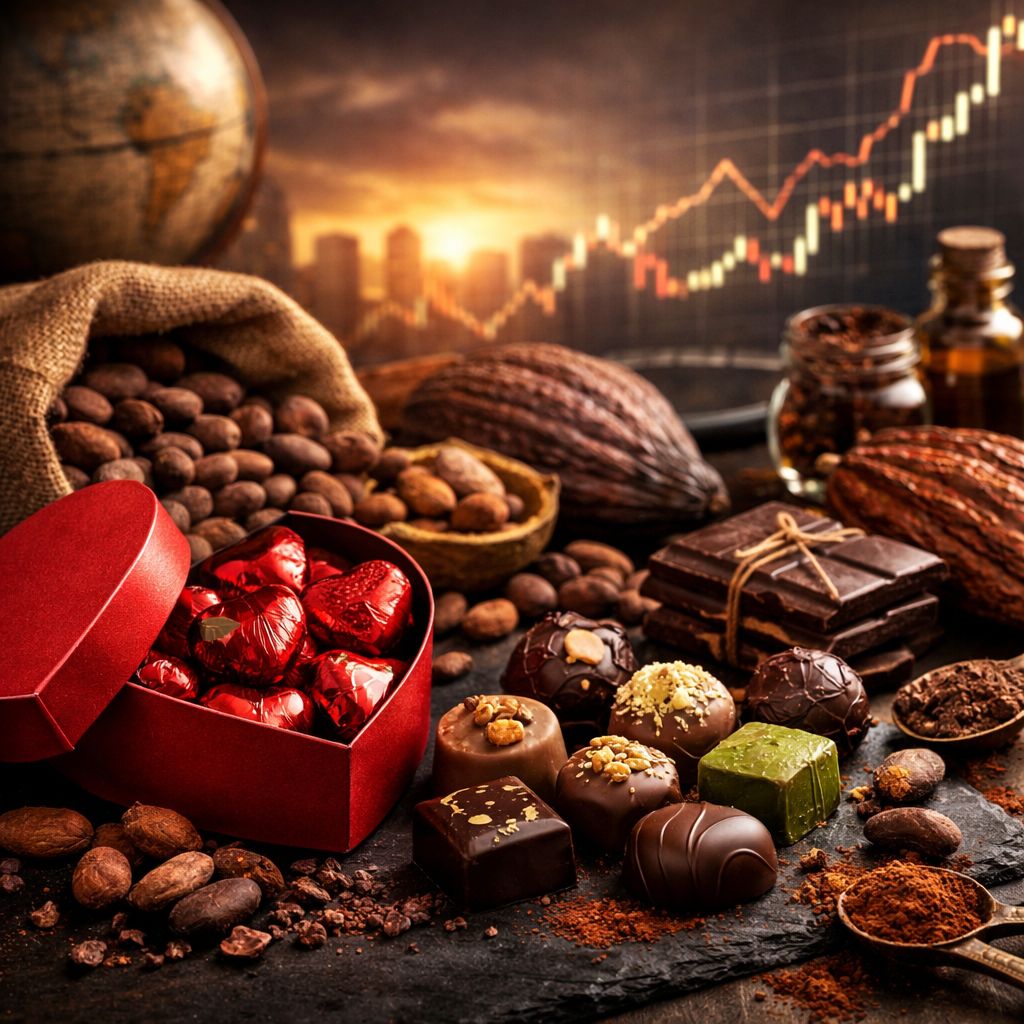
Every Valentine’s Day, chocolate returns to center stage — wrapped in red boxes, tied with ribbons, and carrying the same old promise of romance. But behind the sweetness, the global chocolate industry is quietly changing. Rising cocoa prices, climate disruptions, and shifting consumer tastes are turning chocolate from an everyday treat into a modern luxury.
More Than Just a Valentine’s Gift
For the majority of us, Valentine’s Day would not be the same without chocolate.It’s the safest gift because it’s simple, well-known, and nearly always appreciated. In February, the shelves of any supermarket are brimming with heart-shaped boxes and limited-edition flavours that are meant to express “I love you” without using words.
Every year on Valentine’s Day, about 58 million pounds of chocolate are bought in the US alone. Over $20 billion is spent on the event overall. On the surface, Valentine’s Day appears to be the most significant event for the chocolate industry.However, Valentine’s Day is only one part of a much larger story for chocolatiers, particularly in places like Jakarta.
Valentine’s Is a Spike, Not a Season
Local chocolate brands in Jakarta say February brings a quick burst of excitement — but it doesn’t define their year. Sales may jump sharply on February 13 and 14, but the effect disappears almost as quickly as it arrives.
By comparison, Christmas and Eid are far more important. These holidays stretch over weeks, not days, and involve a wider circle of gifting. People buy chocolate for family members, colleagues, business partners, and friends. Offices place bulk orders. Gift baskets multiply.
Valentine’s creates a short-lived rush. End-of-year holidays create real stability.
For many brands, Valentine’s is less about profit and more about visibility. It’s a chance to release special packaging, test new flavors, and remind customers that they exist. Think of it as a showcase, not a lifeline.
Chocolate Is Starting to Act Like Fashion
One of the most interesting shifts in the industry is how chocolatiers now think about their products. Chocolate is no longer treated as a timeless food. It’s becoming more like fashion.
Just as clothing brands release seasonal collections, chocolate brands now design products around trends, moods, and cultural moments. Valentine’s, Ramadan, Christmas, Lunar New Year — each comes with its own flavors, colors, and packaging styles.
Chocolate has become visual. It needs to look good on Instagram. It needs a story. It needs limited editions and “drops” that create urgency.
In other words, chocolate is no longer just something you eat. It’s something you experience.
A More Sophisticated Sweet Tooth
At the same time, people’s taste is changing.
Milk chocolate still dominates, but more consumers are moving toward darker, more complex flavors. Ten years ago, most buyers didn’t care about cocoa percentages. Today, many can tell you the difference between 60%, 70%, and 85%.
People want to know where the beans come from. They care about origin, fermentation, roasting, and tasting notes. Chocolate is starting to feel more like coffee or wine — something you learn to appreciate, not just consume.
This has pushed brands to expand beyond simple bars. Now you see bonbons, chocolate cookies, spreads, drinks, and desserts. You see collaborations with matcha, kunafa, sea salt, chili, even cheese.
Chocolate is no longer just sweet. It’s creative.
The “Healthier” Chocolate Myth
There’s also a health angle — or at least the illusion of one.
No one really believes chocolate is healthy. But dark chocolate has gained a reputation for being “less bad.” Less sugar. More cocoa. Antioxidants. It feels easier to justify.
So people don’t buy chocolate anymore just to satisfy cravings. They buy it as a controlled indulgence. A small reward. Something premium, not something cheap.
This mindset supports higher prices and smaller portions. People would rather eat one good piece of chocolate than a whole cheap bar.
And that’s exactly where the industry is heading.
The Cocoa Crisis Nobody Talks About
Behind all these lifestyle changes is a much bigger problem: cocoa is becoming scarce.
Between 2022 and 2024, global cocoa prices more than tripled. In some cases, they went up four times. The reason? Climate change.
Extreme weather has damaged crops in West Africa, especially in Ivory Coast and Ghana, which produce more than half of the world’s cocoa. Heavy rain, droughts, and plant diseases have destroyed yields.
Less cocoa + same global demand = exploding prices.
For chocolatiers, this is devastating. Ingredients now cost far more than before, but customers cannot afford equally dramatic price increases.
So brands are stuck in the middle.
Why Chocolate Is Quietly Becoming a Luxury
Instead of raising prices too aggressively, many chocolatiers are adapting in smarter ways. They create smaller products. Mini bars. Bonbons. Bite-sized desserts. Same quality, less quantity. Others diversify. They sell chocolate drinks, ice cream, or café items to spread risk.
In order to survive, some people take on lower profit margins and absorb the losses.All of this suggests that the cost of producing chocolate has increased.Therefore, it can no longer be sold for a low price. Chocolate is gradually entering the luxury market—not because it wants to, but because it must.
Even Cocoa Countries Feel the Pressure
You might think countries like Indonesia would be safe, since they produce cocoa themselves. But even local brands feel the global pressure.
Indonesia is one of the world’s top cocoa producers, but international buyers are now competing for the same beans. Foreign companies are willing to pay more, pushing prices up even for local suppliers.
So Indonesian chocolatiers end up paying global prices, even when they source locally.
The global market decides everything.
Creativity Is No Longer Optional
In this environment, creativity is survival.
Brands need strong stories. Ethical sourcing. Beautiful design. Unique flavors. Limited editions. Café experiences. Social media presence.
They are no longer just selling chocolate.
They are selling identity, lifestyle, and emotion.
The product matters — but the narrative matters just as much.
So What Does Valentine’s Really Mean Now?
Valentine’s still matters. Chocolate will probably always be the most reliable romantic gift.
But its role has changed.
For consumers, it feels simple: buy a box, make someone smile.
For chocolatiers, it represents something far more complex: rising costs, fragile supply chains, and an industry trying to stay afloat in uncertain times.
That red box on the shelf carries more than love.
It carries climate change, global economics, and shrinking margins.
The Sweet Illusion
Chocolate still sells a fantasy — romance, comfort, pleasure.
But behind that fantasy is a tougher truth. Cocoa is harder to grow. Prices are unstable. The industry is under pressure.
What used to be an everyday snack is becoming a carefully chosen treat.
And maybe that’s why chocolate still feels special.
Because in a world where everything is mass-produced and disposable, chocolate is slowly becoming rare again.
Not just something you eat.
Something you savor.




