

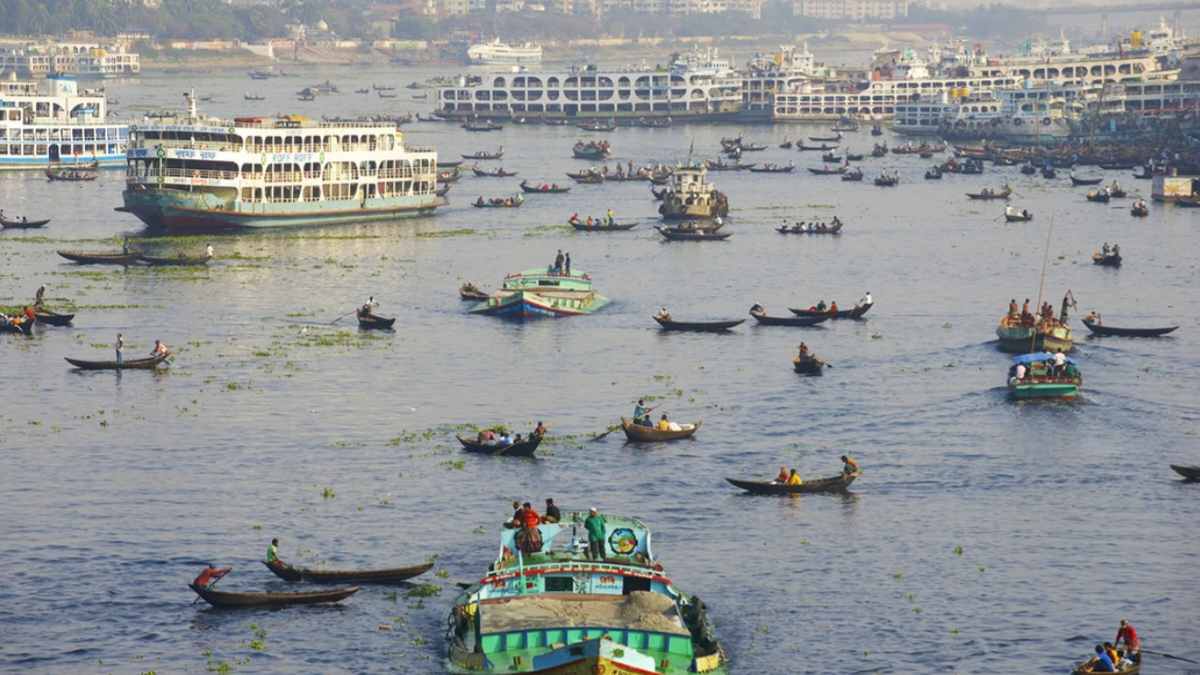
It was truly an epoch-making event when a court in India granted the river Ganges the status of a “legal entity.” Long before this, New Zealand’s parliament passed a landmark bill declaring the Wanganui River as a “legal entity.”
However, what a bench of the High Court of Bangladesh achieved was groundbreaking. Headed by Justice Moinul Islam and Justice Ashraful Kamal, the joint bench issued a verdict on a writ petition that extended “legal entity” status to all the rivers in Bangladesh. This extraordinary decision means rivers can now theoretically file cases against pollution, encroachment, and other harms.
A Legal Battle for Bangladesh’s Rivers
Of course, a river cannot practically file cases. Similar to how a corporation functions, the National River Conservation Committee (NRCC) is entrusted with this responsibility.
The writ petition was filed by Human Rights and Peace for Bangladesh (HRPB) and presented by advocate Manzil Morshed in 2016. The historic verdict, delivered on February 3, 2019, stands out globally. While India and New Zealand’s decisions applied to specific rivers—the Ganges in India and the Wanganui in New Zealand—the Bangladeshi court extended legal personhood to all its rivers, even though the original writ petition was focused on the Turag River.
The court outlined specific directives to be followed by relevant authorities. It also highlighted that there are 408 rivers in Bangladesh, though the exact number is debated. Alarmingly, the court cited data showing that over 63,000 encroachers exist across 64 districts—a fact corroborated by the NRCC.
In its judgment, the court invoked the public trust doctrine, a rarely discussed yet significant concept in environmental law. According to this doctrine, natural assets like rivers are public property, with the state acting as a trustee responsible for their protection. This principle aligns with intergenerational justice, emphasizing the state’s duty to preserve resources for future generations. The doctrine also supports the filing of writ petitions under Article 102(1) of the Constitution of the People’s Republic of Bangladesh for damages to public property.
This decision not only set a legal precedent but also reinforced environmental protection as a cornerstone of sustainable development in Bangladesh.
Lessons from China’s Rutai Canal Case
Here we can reference a widely discussed case from China, known as one of the costliest environmental compensation cases. In this case, six defendants—identified as polluters—were ordered to pay $26 million after it was proven they had dumped over 26,000 tonnes of acidic waste into the Rutai Canal and Gugaman River in Taizhou. This unprecedented decision, based on the ‘polluter pays principle,’ was mentioned in the High Court verdict. By this principle, every river in Bangladesh could theoretically claim compensation for pollution and encroachment. Given the severe state of pollution, it’s nearly impossible to find an unpolluted river in the country.
The writ petition has opened new horizons for the rivers of Bangladesh. If six polluters were fined $26 million in China, what could be the potential compensation from 63,000 encroachers and polluters in Bangladesh?
The 283-page-long verdict underscores the pivotal role of the National River Conservation Committee (NRCC). A draft bill is nearing finalization, which commendably includes provisions for a River Conservation Court (as detailed in Section 84 of the draft).
The State’s Role as Trustee Highlighted
A promising development is the appointment of Rizwana Hasan to the environment ministry following the historic July uprising. Her tested leadership in environmental conservation has already led to visible steps toward environmental restoration. However, the ministry is yet to address the draft NRCC bill comprehensively. Rizwana and her team face a substantial workload ahead.
The bench classified the verdict as a “continuous mandamus,” meaning its effect persists until all 17 directives are implemented.
With the public trust doctrine now legally recognized and reinforced by the High Court Division (HCD), there is hope that Bangladesh may witness compensation awards in favor of its rivers, treated as legal persons. As a trustee, the state must demonstrate resolve in addressing river encroachment. An independent nation must ensure the independence of its rivers.
The initial step could involve reclaiming encroached river portions through compensation awards. The responsibility now lies with the NRCC and the environment ministry to act decisively in this matter.




