

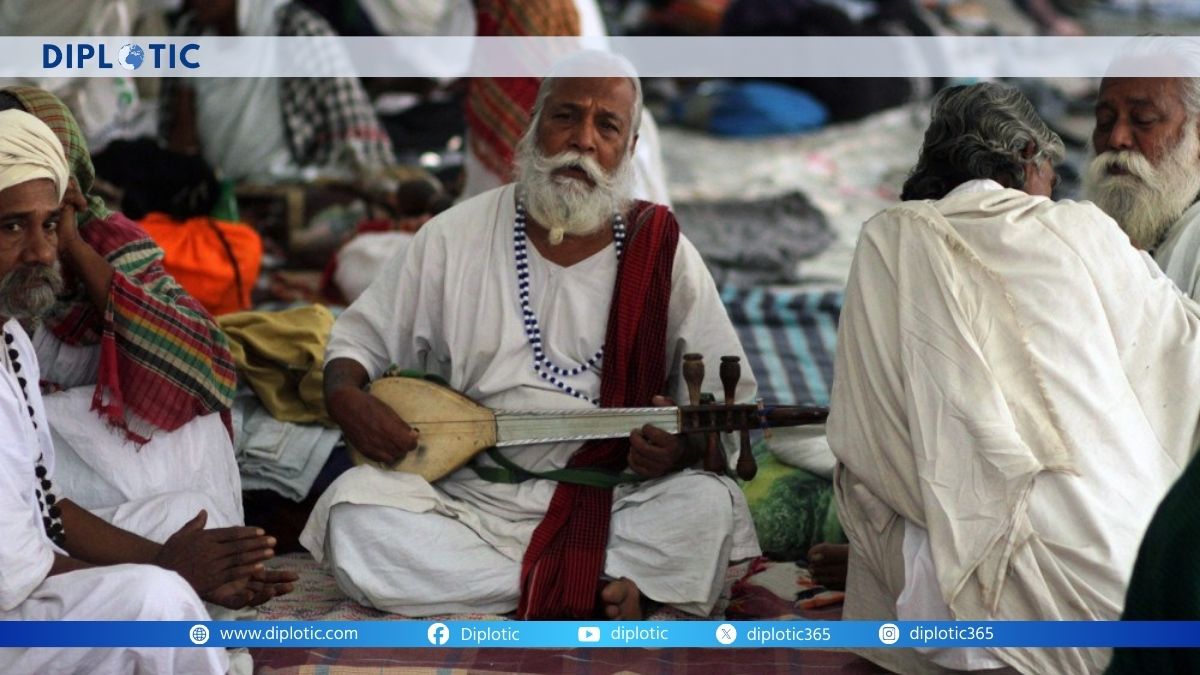
For decades, Bangladesh has been celebrated for its rich spiritual and musical heritage. Bauls, Boyatis, Fakirs, and other Sufi practitioners have wandered the countryside, sharing songs and teachings that blend devotion, philosophy, and social reflection. Their music and thought have shaped the cultural identity of the nation and attracted attention from scholars and visitors worldwide. Yet, the reality these artists face today tells a very different story. Despite their historic role, they are increasingly subjected to harassment, arrest, and even physical attack while the state appears to stand aside.
Recent developments have highlighted an alarming trend. In November 2025, Abul Sarker, a well-known Pala singer, was arrested on charges of “religious defamation” during a performance. His followers, many of whom gathered in protest, were met with violence. Videos from the scene show people fleeing in panic, some jumping into ponds to escape assaults. These incidents, rather than being isolated, fit a disturbing pattern that has intensified under the interim government. Attacks on Sufi shrines, sacred tombs, and spiritual centers have risen sharply, often led or condoned by extremist groups claiming to protect religious orthodoxy, including the so-called Tawhidi factions.
This wave of intimidation and suppression is not merely about individual disputes. It represents a broader cultural assault what some observers have called a “cultural counter-revolution” designed to marginalize pluralistic, spiritual, and artistic expressions in the country.
Cultural Heritage Under Siege: The Legal and Institutional Vacuum
The threats against Bauls and Sufi practitioners are compounded by the absence of protective laws or state action. In August 2024, the then interim government organized a consultation at the National Museum to discuss the role of the Ministry of Culture in a post-uprising Bangladesh. Experts, writers, and cultural activists were invited to propose reforms and initiatives. One key suggestion was the creation of a “National Heritage Protection Act,” designed to safeguard the shrines, ashrams, and performance spaces that have been central to spiritual and cultural education for centuries.
Such a law could provide legal protection to Bauls, Fakirs, and Sufi performers, ensuring that attacks, harassment, or arbitrary arrests are prevented. However, the proposal has yet to gain traction. Advisors and ministries who once entertained discussions on cultural protection are now absent, and no meaningful state-led effort has emerged to shield these communities.
Without legal safeguards, the most vulnerable groups bear the brunt of suppression. Cases like Abul Sarker’s demonstrate the system’s failure. Rather than arresting those who commit acts of violence, authorities have prioritized claims of religious offense, effectively criminalizing the very people who carry forward Bangladesh’s pluralistic cultural traditions. Observers note that when the state fails to act, social pressure and mob intimidation replace law and order, leaving communities exposed.
The legal vacuum is particularly dangerous in a political climate where extremist right-wing groups wield influence. Their attacks on shrines and performances are often violent, and the law offers little immediate protection. What should be an inclusive, pluralistic society where cultural and spiritual diversity thrives is being increasingly constrained by fear and harassment.
Patterns of Suppression: Attacks and Arrests Across the Country
The escalation of harassment and violence has been both rapid and widespread. Following the July 2025 political upheaval, incidents targeting Bauls, Sufi practitioners, and other spiritual performers surged. Shrines were vandalized, tombs were desecrated, and musicians were arrested during performances. These are not random acts but appear to form part of a larger campaign aimed at controlling the cultural landscape.
In July, several Sufi shrines were damaged, with sacred tombs exhumed and destroyed. In January 2025, police in Narayanganj seized instruments during a Baul music event. February saw villagers in Singair prevent a local fair celebrating the late Baul singer Rashid from taking place. Most recently, in Manikganj, police arrested Abul Sarker under allegations of religious offense, ignoring the immediate threat posed by the protesting mob. A recent video of Abul Sarkar suggests that he was using offensive words against base Islamic beliefs.
These events illustrate a disturbing shift: communities that once freely practiced and celebrated music and spiritual teachings are now under constant threat. Even public protests or expressions of solidarity are met with aggression. The authorities’ inability or unwillingness to protect these practitioners demonstrates how institutional inaction amplifies the power of extremist factions.
By targeting artists and spiritual guides, these groups are indirectly attacking Bangladesh’s broader social conscience. Bauls and Fakirs have traditionally served as moral and ethical guides, using music to communicate complex ideas about humanity, tolerance, and spirituality. Silencing them is therefore not just an attack on individuals but on the pluralistic ethos of society itself.
The Broader Implications: A Cultural Counter-Revolution
The ongoing repression of Bauls and Sufi practitioners signals more than localized violence. Analysts describe this as a form of “cultural counter-revolution,” aimed at undermining pluralism and establishing a narrow, intolerant social order. The systematic targeting of musicians, shrines, and spiritual centers erodes centuries of religious and cultural coexistence in Bangladesh.
Abul Sarker’s arrest and the attacks on his supporters exemplify this process. Law enforcement, instead of neutralizing threats from extremist mobs, has effectively sided with pressure groups, signaling that public intimidation can dictate state action. Such precedents embolden similar factions elsewhere, creating a climate of fear for anyone engaged in cultural or spiritual expression outside rigid orthodoxy.
The implications extend to the international perception of Bangladesh. The country, historically celebrated for its spiritual tolerance and cultural richness, now faces scrutiny for failing to protect its most emblematic traditions. Scholars, tourists, and cultural practitioners worldwide who once admired Bangladesh’s Baul heritage are now confronted with the reality that state apathy allows extremist intimidation to prevail.
Beyond cultural loss, the societal costs are profound. The suppression of pluralistic voices constrains dialogue, diminishes social cohesion, and erodes trust in institutions. In practical terms, it can also impact tourism, academic research, and international collaboration in the arts. A nation that silences its heritage risks undermining the very values that have long defined it.
Preserving Pluralism: Paths Forward
Despite the bleak picture, avenues for action remain. The state has a fundamental responsibility to protect vulnerable communities, enforce existing laws, and implement measures such as a heritage protection act. Beyond legislation, authorities must actively counter extremist influence, ensuring that cultural practitioners can perform freely and safely.
Local communities also play a vital role. Grassroots resistance, solidarity networks, and public advocacy can deter attacks and demonstrate the social value of pluralistic traditions. However, the ultimate safeguard must be the state. Without legal and institutional support, Bauls, Fakirs, and other spiritual performers will continue to face harassment, arrest, and intimidation.
Abul Sarker’s case should serve as a wake-up call. It is not only about one artist or one performance it is about the preservation of Bangladesh’s pluralistic identity and the right of its people to express culture, faith, and philosophy freely. The nation now stands at a crossroads: will it allow fear and extremism to dictate its cultural landscape, or will it uphold the centuries-old tradition of tolerance, pluralism, and spiritual freedom that has defined it?
This investigative narrative exposes how attacks on Bauls, Boyatis, and Sufi practitioners are symptomatic of a wider societal crisis in Bangladesh. By connecting individual incidents to patterns of systemic failure, it highlights both the human and cultural costs of religious intolerance. The story calls for immediate state action, legal safeguards, and global attention to ensure that Bangladesh’s rich spiritual and musical heritage survives and thrives in the face of growing extremism.




