Bangladesh’s claim of self-sufficiency in rice production has long been held up as a national achievement—a symbol of food security and agricultural resilience. Government officials routinely cite bumper harvests and reduced imports as evidence of progress. But does the reality match the rhetoric?
This fact-check critically examines whether Bangladesh has truly attained self-sufficiency in rice, or if the story is more complicated. We explore production trends, import data, regional disparities, climate vulnerabilities, and shifting consumption patterns to assess whether the nation is genuinely meeting its own needs—or quietly depending on outside support.
Claim 1: Bangladesh Produces Enough Rice to Meet Domestic Demand Without Imports
Fact-Check: Partially True
Bangladesh is the world’s third-largest rice producer, behind China and India, with a production of approximately 37.55 million tonnes (MT) projected for 2025–26, up 2.6% from 36.6 MT in 2024–25, according to a 2025 World Grain report. Rice is the staple food, contributing 97% of food grain production and providing around 60% of total calories and 50% of protein intake for adults. A 2021 PMC article notes that rice production tripled from 11 MT in 1971–72 to 36.6 MT in 2019–20, driven by high-yielding varieties (HYVs), irrigation, and government support. The self-sufficiency ratio (SSR) for rice was 1.09 in 2015, indicating production slightly exceeded consumption. A 2023 Dhaka Tribune article claims Bangladesh achieved self-sufficiency in rice, supported by a 2019 PMC article stating domestic production met 97% of consumption between 2010 and 2020.
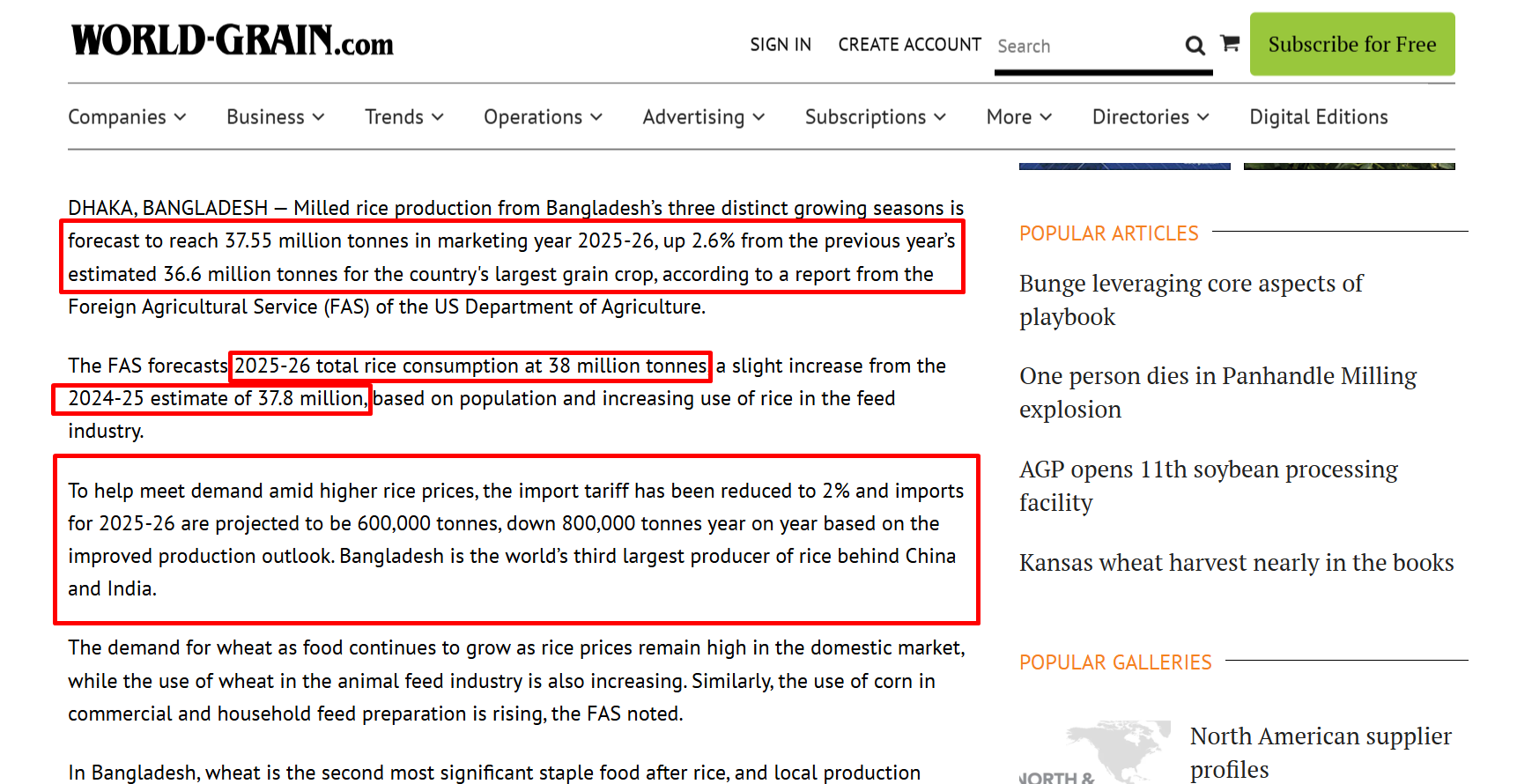
However, significant imports undermine the claim of complete self-sufficiency. A 2022 New Age article reports Bangladesh imported 23.48 lakh tonnes (2.348 MT) of rice in FY21 and FY22 combined, with 9.89 lakh tonnes in FY22 and 13.59 lakh tonnes in FY21. The Bangladesh Food Situation Report (October–December 2022) notes 0.988 MT of rice imports in FY21–22, with projections of 1.71 MT for FY22–23. A 2025 World Grain report forecasts 0.6 MT of rice imports for 2025–26 to meet a consumption demand of 38 MT, driven by population growth and increasing use of rice in animal feed. The government reduced import tariffs from 62.5% to 25% in June 2022 and to 2% in 2025 to stabilize prices, indicating reliance on imports during shortages or price spikes. A 2024 X post highlights that floods destroyed 1.1 MT of rice in 2024, prompting increased imports.
Verdict: The claim is partially true. Bangladesh produces nearly enough rice to meet domestic demand, with production close to or exceeding consumption in most years (e.g., SSR of 1.09 in 2015). However, it relies on imports (0.6–2.4 MT annually) to address production shortfalls from natural disasters, price hikes, or supply chain issues, indicating it is not fully self-sufficient.
Claim 2: High-Yielding Varieties and Modern Farming Practices Have Ensured Sustainable Self-Sufficiency
Fact-Check: Partially True
The Green Revolution in the 1970s, followed by the introduction of HYVs like IR8 and BR3 by the Bangladesh Rice Research Institute (BRRI), significantly boosted rice production. A 2023 PMC article notes that rice output quadrupled from 9.67 MT in 1971 to 38.7 MT in 2019, with yields rising from 1.5 to 3.29 tonnes per hectare (t/ha). A 2025 Business Standard article reports yields exceeding 4.5 t/ha, driven by mechanization (95% land preparation by tractors, 15% harvesting by combine harvesters), irrigation (most cultivable land irrigated), and subsidies (50–70% for machinery). HYV adoption rates are high: 72% for Aus, 73.5% for Aman, and 98.4% for Boro seasons. Government policies, including credit distribution, fertilizer supply, and seed quality, have supported this growth.
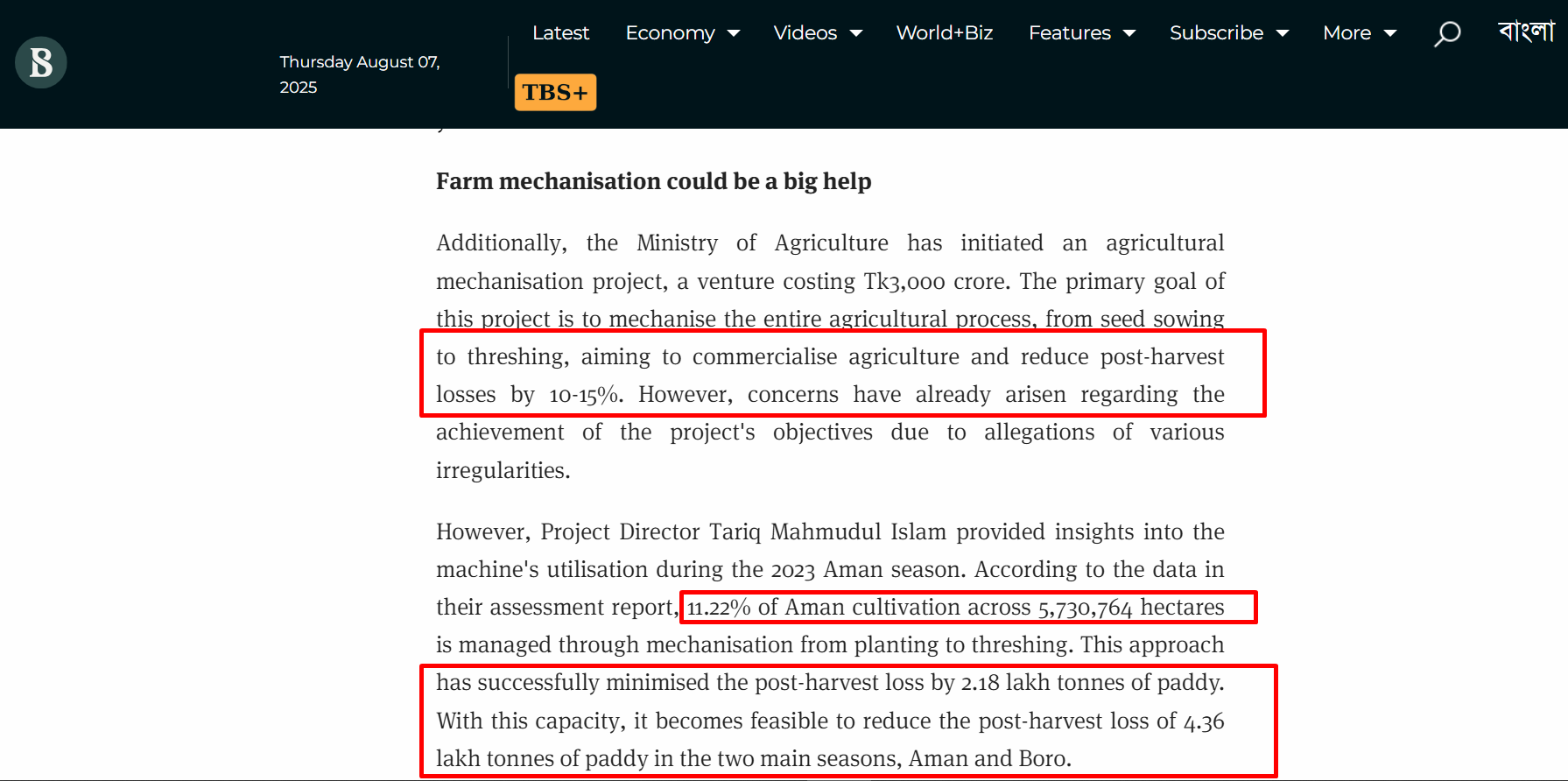
However, sustainability is questionable. A 2023 PMC article highlights a low genetic gain rate (0.01 t/ha per year) in BRRI varieties, insufficient to meet the 0.044 t/ha needed for 2050’s projected 215 million population. Climate change poses risks, with rising temperatures, anomalous rainfall, and salinization reducing yields. A 2025 ResearchGate article notes that nutrient deficiencies (e.g., phosphorus, magnesium, zinc) and reliance on imported fertilizers (80% of chemical fertilizers) threaten long-term productivity. Post-harvest losses (10–15% for rice) and supply chain inefficiencies further erode gains. A 2018 PMC article projects that even with full yield gap closure, rice SSR may only reach ~1 by 2050, barely meeting demand.
Verdict: The claim is partially true. HYVs and modern practices have driven significant production gains, achieving near self-sufficiency. However, low genetic gains, climate vulnerabilities, nutrient deficiencies, and import dependency for fertilizers raise concerns about long-term sustainability.
Claim 3: Bangladesh’s Rice Self-Sufficiency Eliminates Food Insecurity
Fact-Check: False
Rice is central to food security, providing 75% of caloric intake in Bangladesh. A 2023 Dhaka Tribune article claims self-sufficiency in rice, alongside fish, meat, and vegetables, has strengthened food security. A 2020 Bangladesh Post article quotes the Food Minister claiming full food assistance without imports, suggesting rice self-sufficiency addresses hunger. A 2019 IRRI article notes self-sufficiency was first achieved in 2008, aligning with Sustainable Development Goals (SDGs) 1 and 2.
However, food insecurity persists. A 2021 PMC article reports that 30.5% of the population faced moderate food insecurity and 10% faced extreme food insecurity in 2017, with 33% of children underweight in 2014. The COVID-19 pandemic increased poverty to 42% and extreme poverty to 28.5% in 2020, exacerbating hunger. A 2023 Daily Star article notes that despite claims of self-sufficiency, high rice prices and import dependency (e.g., $850.9 million in rice imports in FY20–21) strain affordability. Socioeconomic factors, such as limited access to credit, land tenure issues, and high post-harvest losses (10–15%), hinder equitable food distribution. A 2021 Business Standard article quotes the Agriculture Minister admitting that high rice consumption (380 g/day per person vs. 100 g in Japan) and market mismanagement drive price spikes, undermining food security.

Verdict: The claim is false. While rice production is near self-sufficient, persistent food insecurity (30.5% moderate, 10% extreme in 2017), high prices, import reliance, and socioeconomic barriers show that self-sufficiency has not eliminated hunger.
Claim 4: Bangladesh Can Sustain Rice Self-Sufficiency Despite Population Growth and Climate Challenges
Fact-Check: Uncertain
Bangladesh’s population is projected to reach 186 million by 2030 and 215 million by 2050, increasing rice demand. A 2025 World Grain report estimates 2025–26 consumption at 38 MT, slightly above projected production (37.55 MT). A 2018 PMC article suggests that full yield gap closure could maintain an SSR of ~1 for rice by 2050, but this assumes significant improvements in breeding and agronomic practices. The government’s 2018 Work Plan with IRRI prioritizes climate-smart varieties and sustainable intensification to maintain self-sufficiency. A 2025 ResearchGate article notes that hybrid rice technologies could meet future demand, but adoption is declining due to farmer preferences for traditional varieties.
Conversely, challenges are significant. Arable land is decreasing by 0.4% annually, and climate change (e.g., floods, sea level rise, salinization) threatens production. A 2024 X post reports 1.1 MT of rice lost to floods in 2024, necessitating imports. A 2023 PMC article highlights that current genetic gains (0.01 t/ha per year) are insufficient, and 80% of fertilizers are imported, exposing production to global price volatility. A 2025 Business Standard article notes that post-harvest losses (10–15%) and supply chain inefficiencies could undermine self-sufficiency if not addressed.
Verdict: The claim is uncertain. Bangladesh has the potential to sustain rice self-sufficiency through improved varieties and practices, but population growth, shrinking arable land, climate vulnerabilities, and import dependency for inputs create significant risks.
Self-Sufficiency or Strategic Imports?
Bangladesh has made remarkable strides in rice production, increasing output from 9.67 MT in 1971 to 37.55 MT projected for 2025–26, driven by HYVs, irrigation, and government support. The country is nearly self-sufficient, with production meeting 97–100% of demand in most years and an SSR of 1.09 in 2015. However, imports of 0.6–2.4 MT annually, especially during natural disasters or price spikes, reveal a dependency on international markets. Claims of self-sufficiency by officials, such as the Food Minister in 2020 and the Prime Minister in 2021, are partially contradicted by data showing significant imports ($850.9 million in FY20–21) and market mismanagement. Future self-sufficiency is threatened by low genetic gains, climate change, shrinking arable land, and reliance on imported fertilizers. While Bangladesh has transformed from a “bottomless basket” to a major rice producer, true self-sufficiency—complete independence from imports—remains elusive.
what’s waiting?
They’re shouting “self-sufficient in rice” from the rooftops, and sure, Bangladesh churns out 37.55 million tonnes a year, enough to feed its 170 million mouths most days. But don’t pop the champagne yet. Floods wipe out 1.1 million tonnes in a bad year, and suddenly they’re importing 600,000 tonnes to keep prices from skyrocketing. Yields are up to 4.5 tonnes per hectare, thanks to fancy varieties and irrigation, but the land’s shrinking, climate’s a wildcard, and 80% of fertilizers come from abroad. Self-sufficient? More like “self-sufficient until the next storm or price spike.” The numbers look good on paper, but the rice bowl’s got some cracks.
Conclusion
Bangladesh is nearly self-sufficient in rice production, with 37.55 MT projected for 2025–26 against a demand of 38 MT, achieving 97–100% of domestic needs in most years. Advances in HYVs, mechanization, and irrigation have driven this progress, but imports (0.6–2.4 MT annually) are needed to address shortfalls from floods, price hikes, or supply chain issues. Food insecurity persists, with 30.5% of the population facing moderate food insecurity in 2017, exacerbated by high prices and socioeconomic barriers. Sustainability is at risk due to low genetic gains, climate change, shrinking arable land, and fertilizer import dependency. While Bangladesh has achieved significant rice production milestones, it is not truly self-sufficient, as it relies on imports and faces challenges to long-term food security. Strengthening breeding programs, reducing post-harvest losses, and addressing climate vulnerabilities are critical to achieving and sustaining true self-sufficiency.