

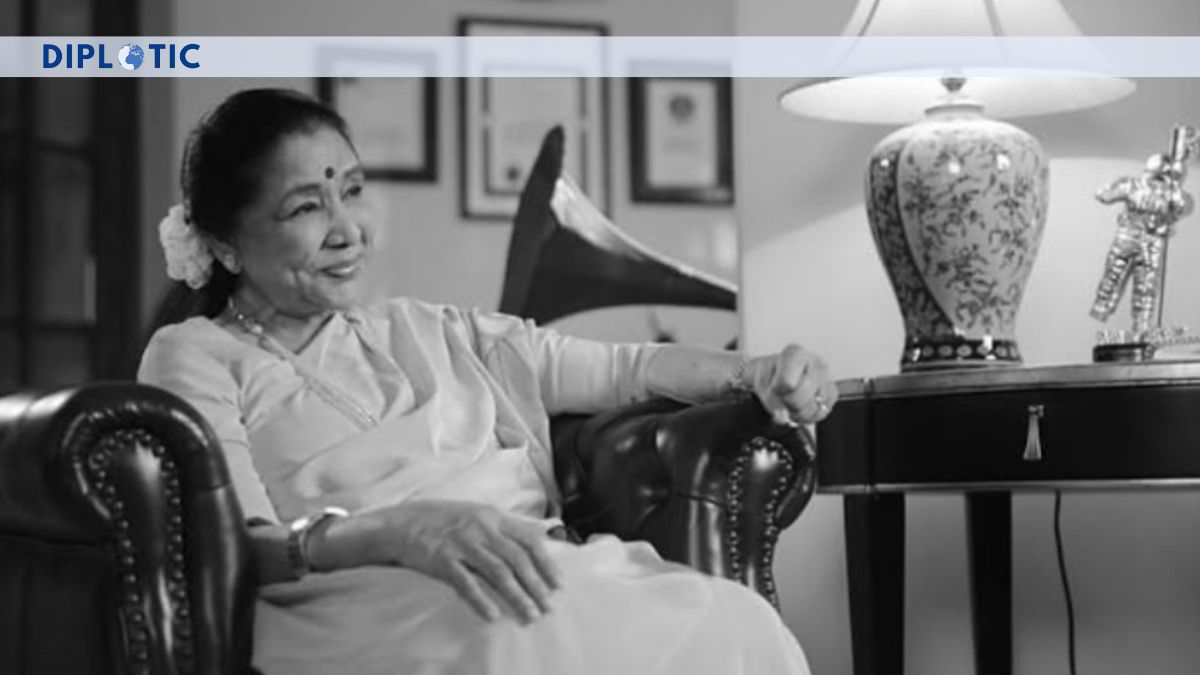
The passing of Asha Bhosle at the age of 92 on April 12, 2026, marks not just the end of an era in Indian music, but the quiet silencing of a shared cultural heartbeat that resonated deeply across South Asia. For millions in Pakistan, her voice was never “foreign.” It was familiar, intimate, and profoundly personal woven into the fabric of everyday life, memory, and emotion.
In homes from Karachi to Lahore, from Islamabad to small towns tucked away in Punjab and Sindh, Asha’s songs played on radios, cassette decks, and later, digital playlists. She belonged not to one nation, but to a shared cultural legacy that transcended borders, politics, and history.
A Voice That Needed No Visa
Asha Bhosle’s music flowed freely across the India-Pakistan border even when people could not. After 1965, physical movement between the two countries became limited, but her voice remained unrestricted. It entered Pakistani homes through radio waves, film soundtracks, and pirated cassettes, becoming a constant presence in weddings, gatherings, and solitary moments alike.
For Pakistani listeners, she was more than a playback singer she was a storyteller, a companion, and a symbol of emotional expression. Her voice carried joy, rebellion, heartbreak, and longing with equal intensity. It required no translation, no passport, and no permission.
The Soundtrack of Rebellion and Freedom
During the politically restrictive years of the late 1970s and 1980s in Pakistan, Asha’s music took on an unexpected role it became a subtle form of resistance. Songs like Dum Maro Dum echoed through college campuses, tea stalls, and even conservative households.
While officially frowned upon due to its association with counterculture themes, the song resonated deeply with youth seeking an escape from societal constraints. Its hypnotic rhythm and bold lyrics symbolized freedom an unspoken rebellion against rigid norms.
Similarly, tracks like Piya Tu Ab To Aaja and Kajra Mohabbat Wala pushed boundaries of expression. They scandalized traditional sensibilities while empowering a new generation of women to embrace confidence and individuality. Asha’s voice carried a daring energy that quietly challenged societal expectations.
Reinventing Herself Through Classical Mastery
What made Asha Bhosle truly extraordinary was her unmatched versatility. She was not confined to one genre or style. From cabaret and pop to classical and ghazal, she mastered each with astonishing precision.
Her transformation reached its peak with the film Umrao Jaan (1981). Under the guidance of composer Khayyam, Asha redefined her singing style slowing her pace, softening her tone, and immersing herself in the delicate nuances of Urdu poetry.
Songs like Dil Cheez Kya Hai and In Aankhon Ki Masti Ke were not merely performances they were experiences. For Pakistani audiences, these tracks felt authentic, as if rooted in their own literary and musical traditions. Even purists who often dismissed film music found themselves captivated by her depth and discipline.
A Legendary Musical Connection with Mehdi Hassan
One of the most powerful chapters in Asha Bhosle’s cross-border legacy is her association with Pakistan’s legendary ghazal maestro Mehdi Hassan. Their meeting in Lahore during a brief thaw in India-Pakistan relations in 1978 has since become the stuff of musical folklore.
After attending his performance, Asha reportedly visited him at his residence, where he sang Ranjish Hi Sahi. Deeply moved, she expressed her admiration, and the two went on to collaborate.
Their duets remain rare treasures cherished by connoisseurs. Tracks like Mujhe Tum Nazar Se and Tera Milna Bahut Achha Lage Hai captured a magical synergy two masters united by their devotion to melody and emotion.
These collaborations were more than musical achievements; they were symbolic acts of unity. At a time when political tensions dominated headlines, their voices created a space where harmony prevailed over division.
Inspiring Generations of Pakistani Artists
Asha Bhosle’s influence extended far beyond her own recordings. She shaped the sound and confidence of countless Pakistani artists across generations.
Her collaborations with R.D. Burman laid the foundation for experimental fusion music that would later inspire projects like Coke Studio Pakistan. Artists such as Ali Zafar and Meesha Shafi have drawn from her fearless style blending genres, embracing bold expression, and redefining performance norms.
Even spiritual icons like Abida Parveen have acknowledged Asha’s impact, emphasizing how she redefined the perception of a woman’s voice not as something to be restrained, but as something to be celebrated.
Asha’s legacy empowered women in South Asia to sing without hesitation, to express without fear, and to own their artistic identity with pride.
A Sacred Presence During Ramzan
Perhaps one of the most profound examples of Asha Bhosle’s cross-cultural significance lies in her presence during Ramzan in Pakistan. In the 1980s, Pakistan Television (PTV) aired a pre-iftar segment called Rooh Ki Ghiza, where her hamd Fariyaad Ummati Ki became a regular feature.
The image of a Hindu artist singing a Muslim devotional broadcast across a country that had experienced multiple conflicts with her homeland speaks volumes about the unifying power of art.
For millions of Pakistanis, her voice became part of their spiritual routine, accompanying moments of reflection, gratitude, and faith. In those moments, identity dissolved. What remained was pure connection.
A Cultural Bridge That Still Stands
Asha Bhosle’s legacy is not confined to nostalgia it continues to shape contemporary culture. Her songs are sampled, remixed, and rediscovered by younger audiences who may not fully grasp the historical context but instinctively feel the emotional depth.
In cities like Karachi, her influence is visible even in street art. Murals celebrating her image and lyrics serve as powerful reminders that music can transcend even the most entrenched divides.
Her voice did what diplomacy often could not it built bridges. It softened perceptions, created shared memories, and reminded people on both sides of the border of their cultural interconnectedness.
The End of an Era, But Not the End of Her Voice
With her passing, South Asia has lost more than a legendary singer it has lost a symbol of unity, resilience, and artistic brilliance. Yet, her voice endures.
It lives on in the crackle of old records, the hiss of cassette tapes, and the clarity of digital streams. It echoes in wedding halls, late-night radio shows, and quiet moments of solitude.
The borders remain. The flags still wave. Political narratives continue to shift. But Asha Bhosle’s voice exists beyond all of that—untouched, timeless, and universal.
A Shared Loss, A Shared Legacy
For Pakistan, her loss feels deeply personal. She was not just admired she was embraced. She was “hamari nightingale,” a voice that belonged as much to Pakistan as it did to India.
Her music taught generations to feel deeply, to express freely, and to find beauty in shared humanity. In a region often defined by division, she offered something rare connection.
And that connection does not fade with her passing.
Asha Bhosle may no longer be physically present, but her voice continues to sing across borders, across generations, and across hearts.
Her legacy is not bound by geography. It is carried forward in every note, every memory, and every listener who still finds solace, joy, and meaning in her timeless music.




