

A Speech Borrowed Across Two Centuries
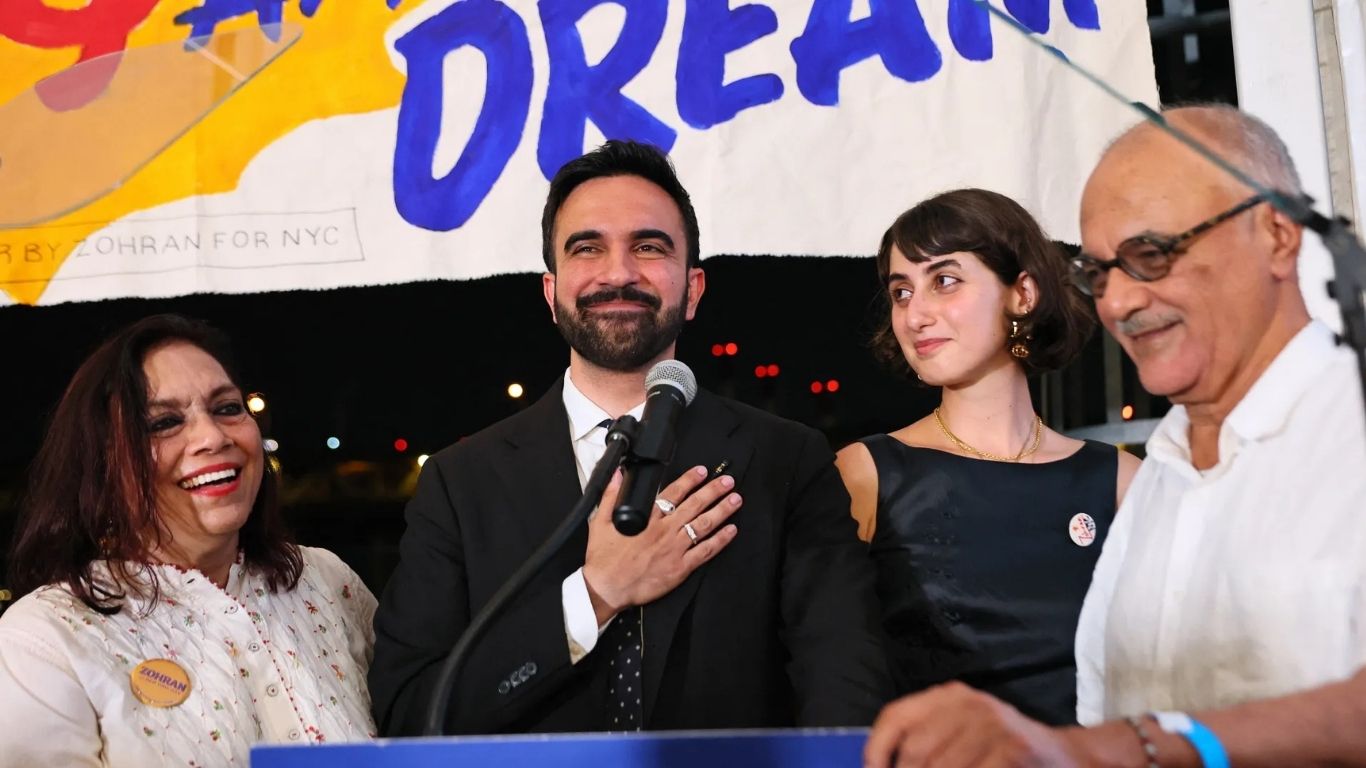
At 11:47 p.m. on election night, the ballroom lights dimmed and a single spotlight found Zohran Mamdani on the podium. The new mayor-elect of New York City—thirty-four, born in Kampala, raised in Manhattan—did not open with the usual thank-yous. Instead he spoke the exact words Jawaharlal Nehru had used at the stroke of India’s independence in 1947: “A moment comes, which comes but rarely in history, when we step out from the old to the new.” The room froze. Phones rose. Within minutes the clip was racing across WhatsApp groups from Jackson Heights to Jammu.
Nehru had delivered those lines in a Delhi hall draped in saffron, white and green, with conch shells sounding and a nation of 340 million listening on crackling radios. Mamdani spoke beneath American flags and disco balls, to a crowd of 2,000 that included Sikh cabdrivers, Bangladeshi nurses, and Dominican grandmothers. Same cadence, different empire.
The quotation was not random. For six months Mamdani had seeded his campaign with Hindi film dialogue, posting reels in which he promised “ab ki baar, rent control sarkar” while the background score from Lagaan played. Opponents called it gimmick. Supporters called it translation: a way to tell 420,000 South Asian New Yorkers that City Hall finally spoke their language. When the Nehru lines landed, the message was complete—history’s most celebrated anti-colonial speech had been repurposed for a municipal ballot.
Yet the echo carried risk. Nehru’s midnight address ended with a vow to wipe tears from every eye. Within forty-eight hours the subcontinent was burning. Partition killed a million and displaced fifteen million. Could a mayor who quoted destiny also deliver it? The question hung in the air long after the Bollywood track faded.
From Tryst to Tenement
Nehru governed a country that had 12 percent literacy, 3,000 miles of paved roads, and a treasury emptied by war. Mamdani inherits a city with 88 percent high-school graduation, 6,000 miles of subway track, and a $115 billion budget—yet one in four New Yorkers still skips meals to pay rent. The parallel is not poetic; it is arithmetic.
In 1947 Nehru nationalized coal mines, built steel plants, and reserved half of university seats for the backward castes. In 2026 Mamdani has promised to seize 40,000 vacant luxury units, convert them to public housing, and cap rents at 25 percent of income. Both men framed their plans as moral missions, not mere policy. Both discovered that moral missions collide with vested wealth.
When Nehru took office, British banks still controlled India’s foreign exchange. When Mamdani takes office, private equity firms own one in eight apartments in the Bronx. Nehru solved his problem by licensing every import and locking capital inside the country. Mamdani cannot print money or close borders, but he can tax vacant pied-à-terres at 10 percent of value per year—a move that would raise $3 billion annually, enough to build 25,000 homes. The Real Estate Board has already filed suit. The courts that once upheld Nehru’s land reforms now host Zoom hearings paid for by the same landlords.
History rhymes in the footnotes. Nehru’s first budget speech lasted four hours and quoted Shelley. Mamdani’s transition memos are twelve-page Google docs with color-coded rent-stabilization maps. Both leaders learned that destiny is negotiated line by line.
The Empire That Stayed Home
New York is not Delhi, yet both cities are palimpsests of empire. The British left Delhi in 1947 but kept the railway gauges, the penal code, and the idea that some streets are meant for cars while others are meant for carts. America never left New York; it simply rebranded the occupation. Robert Moses bulldozed Black and Puerto Rican neighborhoods the way Lord Wavell redrew provincial maps. Redlining replaced the Bengal Land Revenue Act, but the effect was identical: entire communities priced out of their own future.
Mamdani’s victory speech nodded to that continuity. By quoting Nehru he reminded 1.8 million foreign-born New Yorkers that the city’s housing crisis is not a market glitch; it is a partition by another name. The lucky keep their ZIP codes, the rest are pushed across invisible borders into motels and shelters.
The strategic miscalculation belongs to the old guard. They mocked Mamdani’s Bollywood reels, never noticing that 62 percent of Queens renters are now Asian or Latino. They dismissed his Nehru quotation as theater, missing the subtext: every diaspora carries its own midnight. When Nehru spoke of “tears and suffering,” he meant peasants without land. When Mamdani repeats the phrase, he means nurses paying $2,800 for a one-bedroom in Elmhurst. The audience heard both versions at once.
Midnight’s Grandchildren
On January 1, 2026, Zohran Mamdani will stand on the City Hall steps and take the oath beneath a sky that once belonged to the Lenape. Cameras will search for the Bollywood flourish, the Hindi slogan, the Jay-Z needle-drop. They will miss the quieter revolution.
For the first time since Fiorello La Guardia spoke Yiddish to Italian garment workers, a New York mayor will govern in the mother tongues of the governed. City contracts will carry Bengali side-by-side translations. Subway announcements will test Tamil and Punjabi. The Department of Education will pilot dual-language schools in Urdu and Korean. None of this requires a new law—only the political will to treat arrival as citizenship.
The danger is hubris. Nehru believed steel plants would end poverty; they mostly enriched contractors. Mamdani believes public land trusts will end homelessness; they could simply create a new bureaucracy. Both men quoted destiny because destiny is easier than spreadsheets.
Yet the echo works both ways. Nehru’s failures—crony licensing, neglected villages—taught India to distrust grand plans. Mamdani’s constituents, many of them children of that lesson, will demand quarterly dashboards, not midnight poetry. If he forgets that, the conch shell will sound again, this time as a warning.
Seventy-seven years after Nehru stepped into the old princely palace and called it a people’s house, another son of the colonized world prepares to rename City Hall. The building is marble, the budget is digital, the stakes are local. But the pledge remains the same: to redeem, not wholly or in full measure, but very substantially.
Outside, the city that never sleeps is already awake. Inside, a new tryst begins.




