When the Market Collapsed, Hope Had to Be Rebuilt
The 2008 crash didn’t just bring down banks – it shattered belief itself. The faith people had in capitalism as a path to freedom and prosperity cracked wide open.
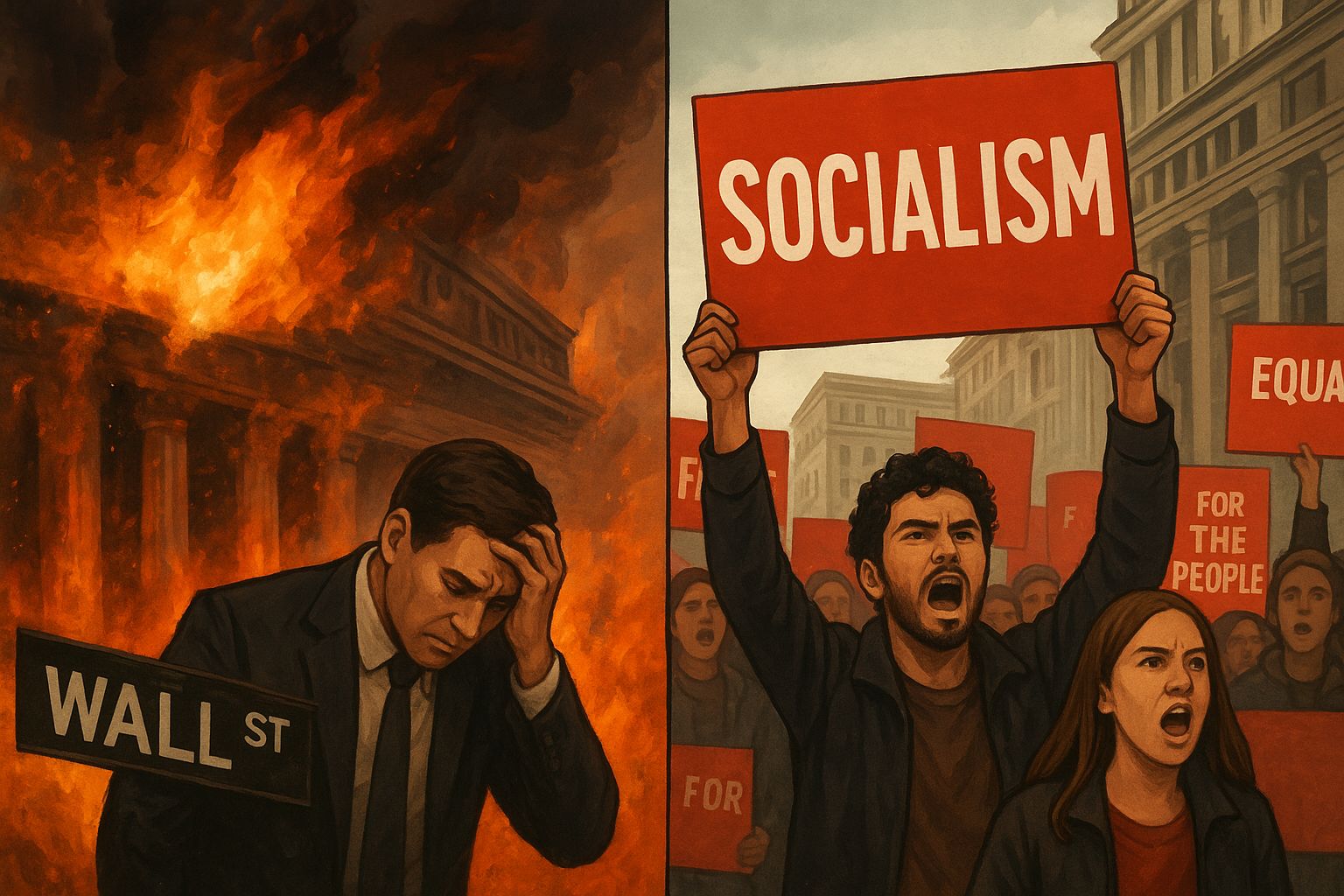
Families lost homes, jobs vanished overnight, and entire communities were left to pick up the pieces while the same banks that caused the disaster were rescued with billions. To many, it felt like the system was protecting the powerful and punishing the powerless.
And in that frustration, a new question began to rise — what if capitalism isn’t the only way?
The Day Capitalism Lost Its Shine
For decades, “free markets” had been celebrated as the foundation of progress. But the 2008 financial meltdown exposed a darker truth — the system wasn’t built to protect everyone equally.
And while the risky Wall Street games brought the world economy crashing to the ground, governments rushed to bail out companies but allowed ordinary people to fall. The warning was clear: if you’re rich enough, your mistakes would be forgotten; otherwise, you pay.
Realizing that was a turning point. In one night, socialism — once muttered in pamphlet language as a forbidden word — seemed a reasonable proposition.
The Generation That Inherited the Wreckage
Millennials and Gen Z didn’t grow up during the boom times of the 1980s or 1990s. They grew up watching their parents lose jobs and homes, or graduating into an economy that offered only gig work and impossible rent prices.
For them, the dream of “work hard, buy a house, retire in peace” felt like a cruel joke. Instead, they got student debt, unpaid internships, and a climate crisis.
No wonder polls today show that more young Americans view socialism positively than capitalism. They aren’t romanticizing old Soviet ideals — they’re demanding a fair chance at stability.
Movements like Occupy Wall Street gave this feeling a voice: “We are the 99%.” That phrase wasn’t just a protest chant — it was a declaration of how people felt about the system that abandoned them.
From Protest Signs to City Halls
What began as indignation on the streets quickly turned into political momentum. Socialist and liberal politicians, such as Zohran Mamdani, are now gaining real power in cities like New York.
Their message? Those essentials — housing, health care, education — shouldn’t be luxuries.
These ideas were made popular by politicians like Bernie Sanders and Alexandria Ocasio-Cortez. They connected economic pain with political action, giving millions a sense that collective change was possible.
The 2008 crash didn’t create socialism out of thin air — it made people listen to it again.
The Moral Wound of Capitalism
Before the crash, capitalism was seen as self-correcting — a natural law of human progress. But when the system collapsed, it became clear that capitalism doesn’t always reward hard work or fairness.
It rewards risk-taking and power.
Banks that gambled with people’s lives were saved. Families who lost everything weren’t. The moral wound of that double standard never really healed.
Economists such as Thomas Piketty later demonstrated what many already suspected: the system accumulates wealth among the few. That’s not a bug — it’s a feature.
To many, socialism was no longer so much about government control but about reasserting fairness.
How the Media Shifted the Conversation
Since 2008, the public mood of the debate has changed radically. All of a sudden, “inequality” and “economic justice” were not hypotheses — they were front-page news.
Films like Inside Job and The Big Short made financial corruption mainstream. Social media gave a voice to young protesters and allowed them to organize.
People learned that the economy was not this magical force — it was a series of choices made by the powers that be. And their choices were open to challenge.
Did 2008 Really Change Everything?
Not completely. Capitalism didn’t collapse — it adapted. Tech giants like Amazon, Apple, and Meta emerged stronger than ever, creating new monopolies and even wider wealth gaps.
But the conversation changed forever. The belief that “there is no alternative” no longer holds. Young people now openly debate ideas like universal basic income, debt cancellation, and green public investment.
It’s not about destroying capitalism — it’s about redesigning it to actually serve people.
A Global Awakening
Wall Street was not the only target of the economic crisis. Austerity compounds generated resentment across all of Europe and bred the emergence of left-wing forces in Spain and Greece. Anti-capitalist populism made a comeback in Latin America. Activists started challenging economic inequality and demanding greater worker rights even in nations such as Bangladesh and India. Ironically enough, 2008 brought people from all corners of the world together—not because of wealth, but because of disillusionment.
Toward a Fairer Future
Will socialism replace capitalism? Probably not entirely. But something new is forming — a hybrid economy built on moral capitalism.
One where profits don’t come at the cost of people. One where opportunity isn’t determined by the zip code you’re born in.
The new socialism is less about ideology and more about empathy — building systems that protect people, not just balance sheets.
Conclusion: The Real Revolution Was in Our Minds
The economic crisis of 2008 may have started as a banking debacle, but it ended as a wake-up call. It forced millions of people to ask themselves: Who does the economy really serve?
Fifteen years later, that question still informs the politics of the day. Whether in the chants of student protests or in the language of emerging generation leaders like Mamdani, the 2008 spirit still lingers on.
The crash didn’t make socialism “great again.” It made people believe — for the first time in a long time — that a better, fairer world might actually be possible.