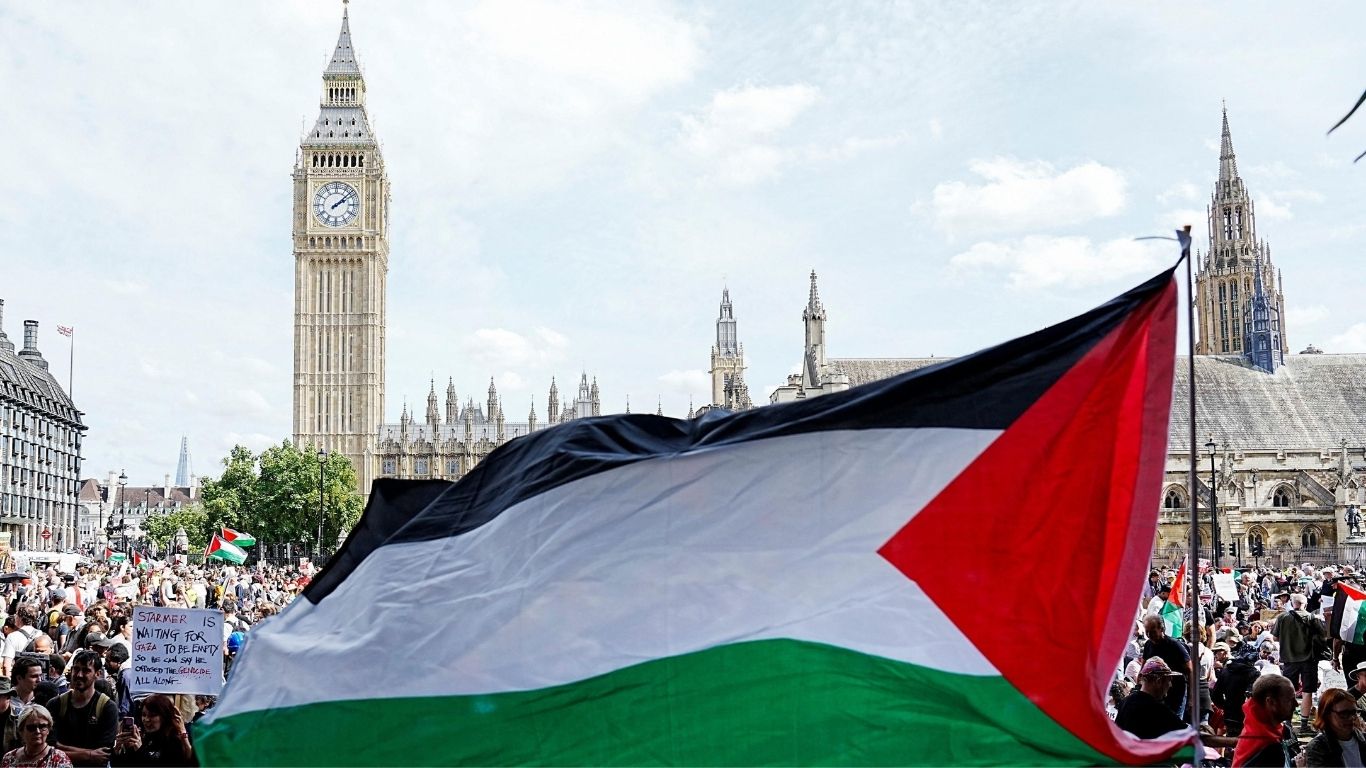
In a landmark diplomatic decision, the governments of the United Kingdom, Canada, and Australia have officially recognised the State of Palestine. This trio of democratic powerhouses, long committed to a two-state solution, have taken this bold and symbolic step as part of a coordinated international effort to revive peace in the Middle East. the governments of the United Kingdom, Canada, and Australia have formally recognised the State of Palestine. The coordinated announcement, made on 21 September 2025, is being hailed as a watershed development that could reshape the dynamics of the Middle East conflict.
For decades, these three Western democracies traditionally among Israel’s closest allies have backed the concept of a two-state solution but resisted unilateral recognition. Their dramatic shift signals mounting impatience with the status quo, escalating violence in Gaza, and the erosion of any viable path to peace.
Australia Leads with a Bold Declaration
Australia was the first to go public. Prime Minister Anthony Albanese and Foreign Minister Penny Wong confirmed recognition of Palestine as a sovereign state, calling the decision a necessary step to re-energize peace talks and secure a ceasefire in Gaza.
Canberra stressed that recognition does not extend to Hamas, which remains classified as a terrorist organisation. Instead, officials highlighted the move as a moral stand for the Palestinian people’s right to self-determination and dignity. “This is about hope, not hostility,” Wong said in a statement that underscored Australia’s new position.
Canada Follows with Strong Conditions
Within hours, Canada joined in. Prime Minister Mark Carney framed Ottawa’s decision as both principled and pragmatic, insisting it was essential to preserve the possibility of peace. Carney highlighted Canada’s long-standing support for a negotiated two-state solution but acknowledged that waiting for a perfect moment had become untenable.
At the same time, Canada made clear that recognition comes with expectations. Palestinian leaders were urged to implement democratic reforms, ensure transparent governance, and cut ties with Hamas. Ottawa argued that recognition should serve as a challenge to Palestinian leadership: to prove their readiness for sovereignty by committing to accountability and human rights.
The United Kingdom Seals the Message
The United Kingdom completed the trio, with Prime Minister Keir Starmer and Foreign Secretary Yvette Cooper declaring that recognition was necessary to “protect the viability of the two-state solution before it is lost forever.”
London’s statement directly criticised Israeli settlement expansion, describing it as a mounting threat to peace. It also stressed that Hamas would have no role in Palestine’s future governance. The UK acknowledged the complexity of the move but insisted recognition was a crucial foundation for renewed diplomacy, humanitarian relief, and international accountability.
Global Reactions and Diplomatic Shockwaves
The coordinated move immediately sparked fierce debate. Israel condemned the recognition as a dangerous reward for terrorism, while the United States voiced opposition, warning that unilateral recognition could complicate peace negotiations.
Yet momentum for Palestinian recognition appears to be building. France is reportedly preparing its own announcement, while other European nations are weighing similar steps ahead of the United Nations General Assembly. The ripple effect may soon extend well beyond Europe, potentially reshaping global alliances and strategies in the region.
What Recognition Means in Practice
Though largely symbolic, recognition carries significant political and legal implications. It raises Palestine’s diplomatic profile, opens the door to formal treaties, and strengthens its standing in international institutions such as the United Nations and the International Court of Justice.
It also comes with heightened expectations. With formal recognition, donor nations and allies are likely to demand far greater transparency from Palestinian leaders. The international community will now expect credible governance, democratic elections, and a firm rejection of extremism.
Challenges Ahead for Both Sides
Despite the historic nature of the announcements, recognition alone will not solve the conflict. Analysts warn that without follow-up action such as negotiations on final borders, guarantees of Israeli security, democratic reform in Palestine, and large-scale humanitarian assistance the move risks becoming purely symbolic.
The Palestinian Authority will need to prove its commitment to democracy, transparency, and good governance. Israel, meanwhile, faces renewed pressure to halt settlement expansion, allow humanitarian access into Gaza, and recommit to meaningful negotiations. The future of the two-state solution now rests on whether these parallel responsibilities are met.
A Transformative but Fragile Moment
For many observers, the recognition by the UK, Canada, and Australia is a transformative milestone in Western foreign policy. These are not fringe states but central players in global diplomacy, long aligned with Washington and cautious about diverging from Israel. Their coordinated decision represents both a moral awakening and a strategic pivot.
By acknowledging Palestinian statehood, these nations are challenging decades of paralysis and sending a powerful message: the world is no longer willing to wait. Whether this moment becomes a turning point in the Israeli Palestinian conflict or merely another symbolic gesture depends on what happens next.
For the first time in years, however, Palestinian statehood is no longer just an aspiration. It has become a political reality backed by some of the world’s leading democracies.