

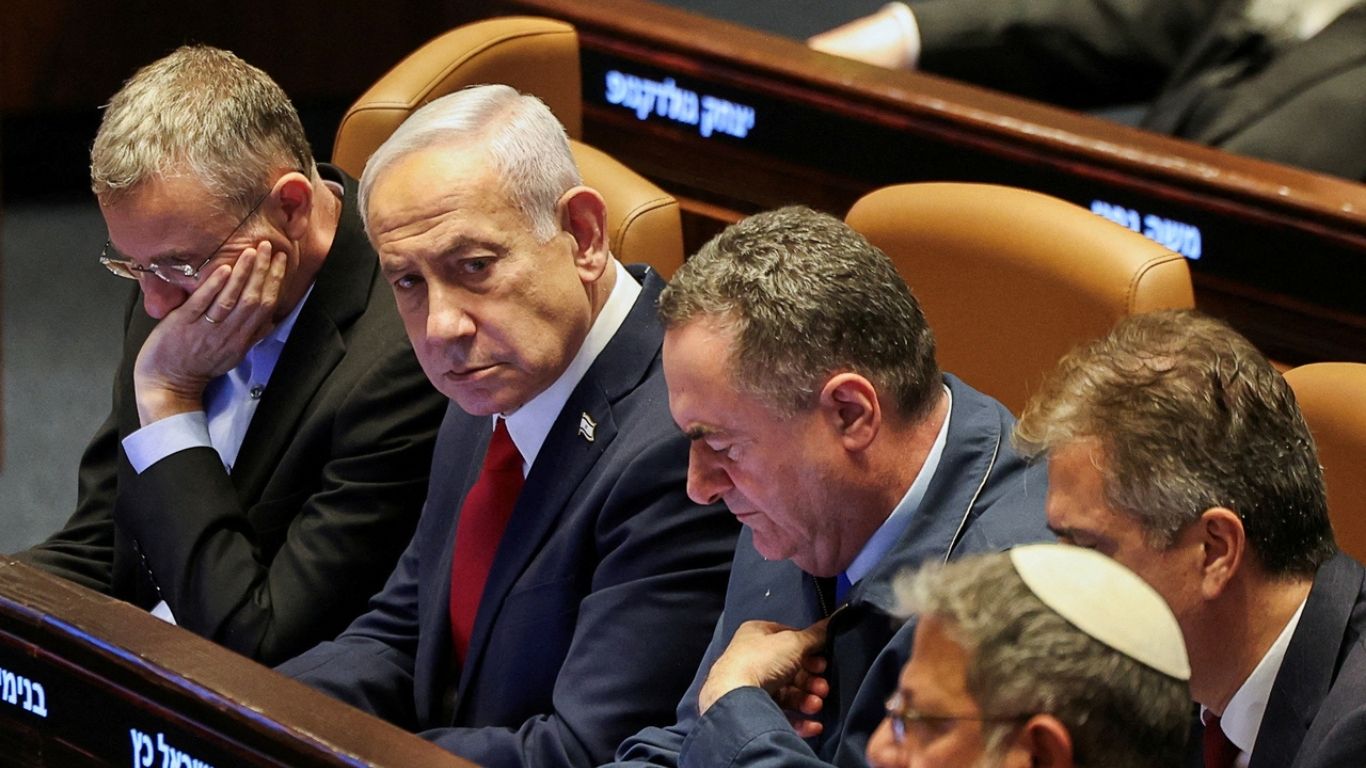
Israeli Prime Minister Benjamin Netanyahu has refused to rule out further strikes against Hamas leaders, saying they will not enjoy immunity “wherever they are.” His remarks, delivered at a tense press conference in Jerusalem alongside U.S. Secretary of State Marco Rubio, come days after Israel carried out a controversial strike in Qatar, a key U.S. ally in the Gulf.
The move has triggered global outrage, drawn sharp criticism from President Donald Trump, and raised fears of deeper instability across the Middle East.
Israel Defends Strikes Beyond Its Borders
Speaking defiantly, Netanyahu insisted that Israel reserves the right to protect itself, even outside its own territory.
“Every country has the right to defend itself beyond its borders,” he said, signaling that the strike in Qatar may not be the last.
Israel’s decision to target Hamas leaders in Doha has escalated diplomatic tensions. According to Hamas, six people were killed in the attack, though its senior leaders survived.
Pressed by journalists on whether Washington had played any role in the operation, Netanyahu was blunt:
“We did it on our own. Period.”
The assertion underscores Israel’s willingness to act unilaterally, even if it risks complicating relations with its closest allies.
U.S. Balances Support for Israel and Gulf Allies
Secretary of State Marco Rubio attempted to strike a careful balance when asked whether the attack in Qatar had damaged U.S. relations in the Gulf.
“Washington maintains strong relationships with our Gulf allies,” he said, without directly criticizing Israel.
The comments highlight the Biden administration’s delicate diplomatic juggling act. Qatar hosts one of the largest U.S. airbases in the region and has long served as a mediator in indirect talks between Hamas and Israel. Its role has been vital in brokering fragile ceasefires during the war in Gaza.
However, Israel’s strike on Qatari soil could strain these relationships at a time when the Middle East is already on edge.
Arab Leaders Rally Behind Qatar
As Netanyahu and Rubio met in Jerusalem, Arab leaders convened a special summit to show solidarity with Qatar. Doha’s prime minister accused the international community of applying “double standards” and called for accountability over Israel’s actions.
The meeting underscored growing anger across the Arab world. For many, the attack on Qatari territory represents not only a violation of sovereignty but also a dangerous escalation in the Gaza conflict.
Growing Crisis in Gaza
Meanwhile, the humanitarian crisis inside Gaza continues to worsen. Over the weekend, the Israel Defense Forces (IDF) intensified its assault on Gaza City, demolishing residential buildings and signaling preparations for a full-scale ground operation in the city’s western neighborhoods.
The IDF has ordered Gaza City’s residents to evacuate southward, estimating that around 250,000 Palestinians have already fled. But hundreds of thousands more remain trapped either unable to afford relocation, unwilling to leave, or convinced that southern Gaza is no safer given the continued Israeli airstrikes there.
Some displaced families reported that after heading south, they found no place to pitch tents and were forced to return to Gaza City.
The United Nations has issued a stark warning: escalating operations in a region where famine has already been declared risks plunging civilians into an “even deeper catastrophe.”
Settlement Expansion Sparks Global Backlash
Beyond the immediate conflict in Gaza, Netanyahu’s government is pushing ahead with controversial plans to expand settlements in the occupied West Bank.
Just last month, Israel approved the E1 settlement project east of Jerusalem, a move that would effectively split the West Bank into two disconnected areas making the establishment of a contiguous Palestinian state nearly impossible.
At the signing ceremony, Netanyahu declared:
“We are going to fulfill our promise that there will be no Palestinian state. This place belongs to us.”
Israel’s far-right Finance Minister Bezalel Smotrich has gone further, proposing the annexation of roughly four-fifths of the West Bank. Currently, about 700,000 Israelis live in 160 settlements across the West Bank and East Jerusalem territories captured during the 1967 Middle East war and considered illegal under international law. Some 3.3 million Palestinians also live in the same area, fueling rising tensions.
UN General Assembly to Weigh Recognition of Palestine
The timing of Israel’s actions is particularly sensitive, as the UN General Assembly prepares to meet next week. Several key U.S. allies including the UK, France, Canada, Australia, and Belgium are expected to formally recognize the State of Palestine.
This anticipated move is intensifying debates inside Israel. Hardline members of Netanyahu’s coalition argue that only annexation can prevent the international community from legitimizing Palestinian statehood.
Rubio’s Symbolic Visit Amid Controversy
Despite the growing international backlash, Secretary Rubio used his trip to reinforce U.S.-Israel ties. Accompanied by U.S. Ambassador Mike Huckabee, he joined Netanyahu at the Western Wall in Jerusalem’s Old City, describing the bilateral relationship as “durable as the stones” in the sacred site.
Later, Rubio is expected to attend the inauguration of the “Pilgrimage Road” tunnel at the City of David archaeological park in occupied East Jerusalem. The project, run by a settler organization, has been criticized as an attempt to politicize archaeology while undermining Palestinian residents of the Silwan neighborhood.
Conclusion: A Region on the Edge
Netanyahu’s refusal to rule out more strikes on Hamas leaders, combined with Israel’s aggressive settlement expansion and intensifying military campaign in Gaza, underscores the precarious state of Middle East stability.
For Washington, the challenge is clear: how to support its closest ally without alienating Gulf partners like Qatar, whose cooperation remains vital for diplomacy and regional security.
With the UN General Assembly looming and Arab leaders uniting behind Qatar, the coming weeks could reshape not only the trajectory of the Gaza conflict but also the future of the Palestinian cause on the global stage.
As the crisis deepens, one thing is certain: the decisions made in Jerusalem, Doha, and Washington will reverberate far beyond the region, determining whether this moment leads to escalation, diplomacy, or lasting change.




