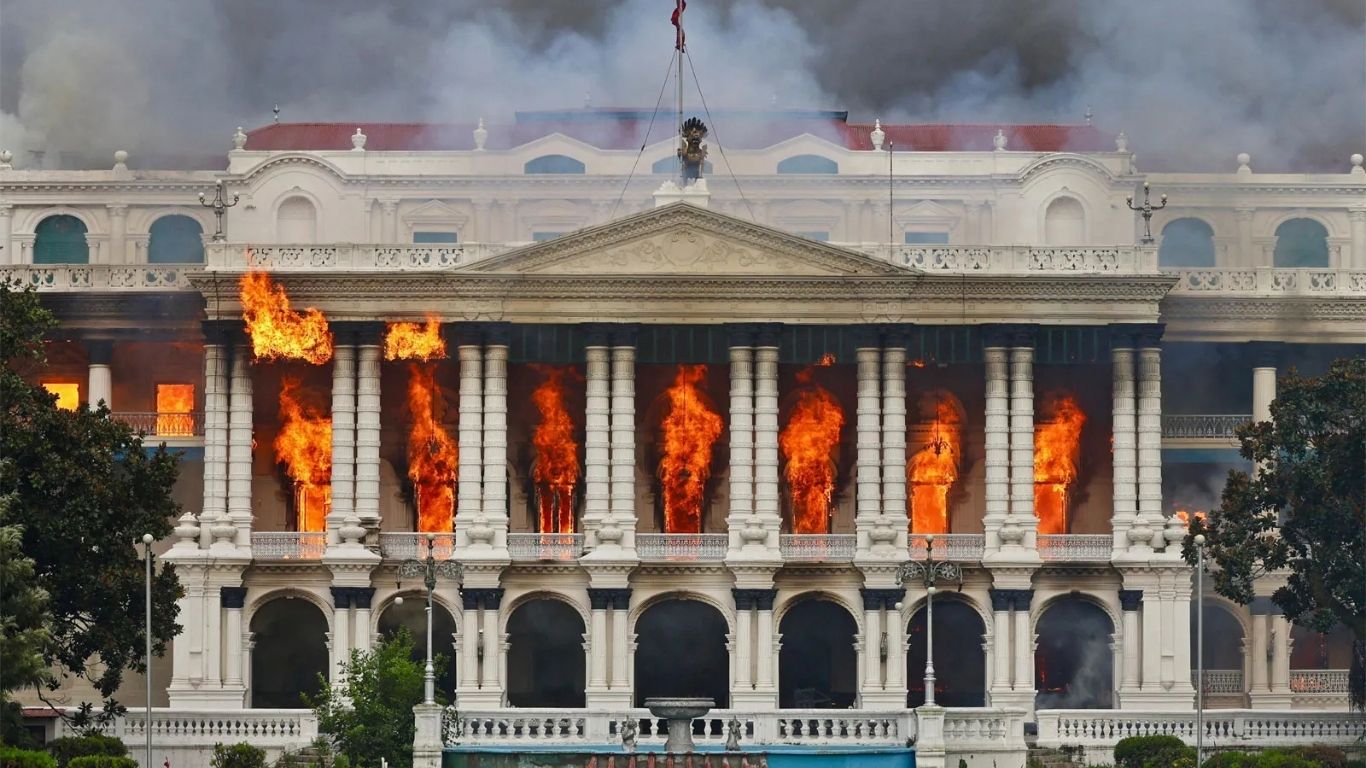
Two days of unprecedented violence left the streets of Kathmandu, Nepal’s bustling capital, resembling a war zone. The nation’s most iconic symbols of power, Parliament, the Supreme Court, and the president’s residence were engulfed in flames as enraged protesters vented their fury. The prime minister resigned in panic, state institutions crumbled, and for a moment, Nepal seemed leaderless.
Then came a pivotal turning point.
On Tuesday evening, General Ashok Raj Sigdel, the chief of the Nepal Army, appeared in a prerecorded video urging calm. Within hours, army units were deployed across the capital. The chaos began to subside, and dialogue was initiated with young protesters who had toppled the government. By the fifth day, the once-escalating spiral of destruction had been contained. Yet, the question lingers: Who really holds power in Nepal today?
The Spark: Social Media Ban and Public Outrage
The violent uprising, which left at least 34 people dead, was triggered by a sudden and short-lived social media ban. What began as online outrage quickly snowballed into street protests, fueled by years of growing frustration over corruption, unemployment, and government inaction.
Protesters accused the government of attempting to stifle free expression, and when police resorted to force, the backlash turned deadly. Entire districts of Kathmandu were engulfed in riots, with clashes that overwhelmed the police.
Nepal’s Army: A Force Trusted at Home and Respected Abroad
Unlike in many countries where the military’s presence sparks fear, Nepal’s army enjoys extraordinary popularity and trust. Traditionally confined to barracks, the army is rarely mobilized unless natural disasters strike earthquakes, floods, or landslides. Its reputation as a neutral and stabilizing force has been carefully cultivated over decades.
Historically, Nepal’s army has played critical roles during transformative moments:
- In the 1990 pro-democracy movement, when citizens rose against the monarchy.
- In 2006, when protests ultimately abolished the monarchy altogether.
Beyond its domestic role, the Nepal Army is internationally admired as one of the largest contributors to United Nations peacekeeping missions, serving in conflict zones from Africa to the Middle East. This legacy of peacekeeping has bolstered its image as a guardian of order rather than a political actor.
A Crisis Like No Other
Yet, the recent turmoil may be its biggest test in modern history. With the prime minister, Khadga Prasad Oli, fleeing his official residence and his whereabouts unknown, the state was effectively without leadership. President Ram Chandra Poudel, whose powers are mostly ceremonial, had initially asked Oli to serve as caretaker. But as the situation spiraled, it became clear that the army was the only institution capable of restoring stability.
In just days, the military quelled riots, prevented a major jailbreak in central Kathmandu, and began facilitating dialogue between the president, political factions, and protest leaders. Talks are ongoing to appoint a transitional leader, though Nepal’s 2015 constitution lacks a clear provision for such a scenario.
A Mirror of Bangladesh?
The current situation in Nepal draws striking parallels with events in neighboring Bangladesh just last year. There, a student-led uprising forced Prime Minister Sheikh Hasina to resign. The Bangladeshi army, working with protest leaders, eventually backed an interim government led by Nobel Peace Prize laureate Muhammad Yunus.
In Nepal, however, the road ahead looks murkier. While some protesters welcome the army’s intervention, analysts warn that prolonged military involvement risks dragging the institution into politics, undermining its credibility.
Security analyst Geja Sharma Wagle cautioned:
“The army should not be involved in politics themselves but rather assist the president in resolving issues with the protesting groups. Their role is to facilitate, support and assist not to govern.”
Public Reaction: Relief and Praise
Despite these warnings, many ordinary Nepalis view the army as a savior. With police accused of brutality, the army’s arrival was seen as a calmer, more disciplined response.
- “When the police failed to control chaos, the army stepped in right on time and saved the country from lawlessness,” said Ramesh Shrestha, a car mechanic in Kathmandu.
- “Nepal’s army is known for peacekeeping roles internationally, and now it has brought peace at home too,” added Kabita Yadav, a university student.
This perception has reinforced the military’s heroic image, setting it apart from the police and political elites.
The Road Ahead: Uncertainty and Hope
Nepal today stands at a crossroads. The people’s revolt has shown the fragility of its democratic institutions, while the army’s intervention has highlighted the void of credible civilian leadership. The immediate future hinges on whether a consensus can be reached for a transitional authority that satisfies both protesters and the establishment.
For now, the Nepal Army has succeeded in restoring a fragile calm. But the larger question remains: Will Nepal’s military simply be a stabilizer, or will it become a central player in shaping the country’s political destiny?
Conclusion
The events of September 2025 mark a historic moment for Nepal. What began as outrage over a social media ban has evolved into a transformative political crisis, testing the resilience of Nepal’s young republic. The army’s rapid and decisive role has prevented further bloodshed, earning praise at home and abroad.
Yet history reminds us that military involvement in governance is a double-edged sword. If Nepal’s leaders fail to chart a peaceful, democratic path forward, the very institution hailed as a guardian today may face the burden of political entanglement tomorrow.
For now, Nepalis breathe a cautious sigh of relief, hoping that peace, stability, and democratic renewal will triumph over violence and chaos.