Introduction
Eid-e-Milad-un-Nabi (ﷺ) marks the blessed birth of the greatest benefactor of humanity, the seal of all prophets, Prophet Muhammad (ﷺ). The 12th of Rabi’ al-Awwal is the most significant day in human history when the “Mercy for the Worlds” arrived on earth. Commemorating this day with joy and reverence is not merely an emotional act, but an established worship substantiated by the Qur’an and Hadith.
Legitimacy of Celebrating the Mawlid in the Light of the Qur’an
Surah Yunus (10:58):
“Say, in the bounty of Allah and in His mercy—in that let them rejoice; it is better than what they accumulate.”
According to Ibn Abbas (RA), “mercy” here refers to the Prophet (ﷺ).
Surah Aal-e-Imran (3:164):
“Indeed Allah conferred a great favor upon the believers when He sent among them a Messenger (ﷺ) from themselves.”
Surah Anbiya (21:107):
“And We have not sent you, [O Muhammad] (ﷺ), except as a mercy to the worlds.”
These verses affirm that the birth of the Prophet (ﷺ) is the greatest divine mercy. Rejoicing in that mercy is therefore a Qur’anic command.
Evidence from Hadith Supporting the Mawlid
Sahih Muslim:
The Prophet (ﷺ) used to fast on Mondays. When asked why, he replied:
“It is the day I was born.”
(Mishkat Sharif, p. 179)
This indicates that the Prophet (ﷺ) himself commemorated his birth.
Narrations from the Rightly Guided Caliphs (RA) as cited by Ibn Hajar al-Haytami (RA):
- Abu Bakr (RA): “Whoever spends even one dirham on the Mawlid will be my companion in Paradise.”
- Umar (RA): “Whoever honors the Mawlid has indeed revived Islam.”
- Ali (RA): “Whoever respects the Mawlid will die with faith and enter Paradise without reckoning.”
Precedent of Celebrating Divine Bounties in Earlier Nations
Surah Al-Ma’idah (5:114):
Prophet Isa (AS) prayed:
“O Allah, our Lord, send down to us a table spread with food from the heaven to be for us a festival (Eid).”
If divine provision was celebrated as “Eid,” then the greatest divine favor—the birth of the Prophet Muhammad (ﷺ)—deserves even greater celebration.
Historical Practice
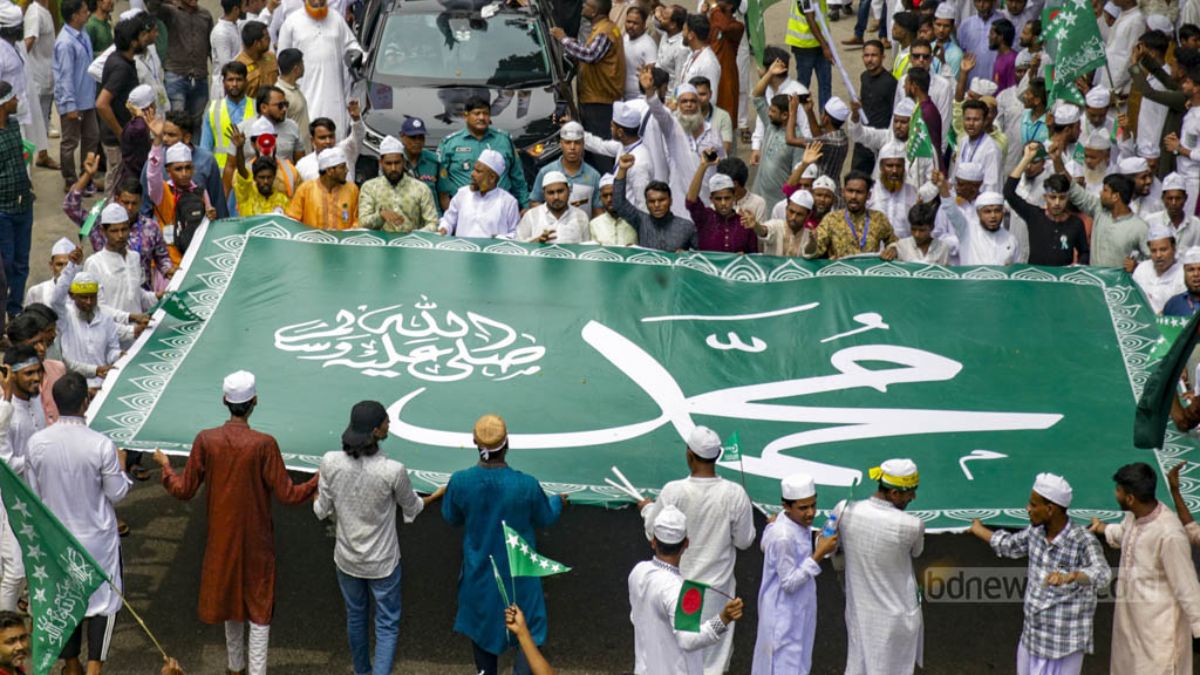
Mawlid celebrations are not a later innovation. From the earliest centuries, companions, successors, and scholars commemorated the Prophet ﷺ’s birth with gratitude and joy. Throughout Islamic history, Muslims have observed this day with Qur’an recitation, gatherings of praise, processions, and sending blessings upon the Prophet (ﷺ).
Addressing the Objections
Some argue that only two Eids (al-Fitr and al-Adha) are sanctioned. However, the Qur’an and Hadith mention other festivals too. The Prophet (ﷺ) called Friday (Jumu’ah) the “Eid of the week.”
Thus, recognizing Milad-un-Nabi as an Eid has a solid Shar’i basis.
Universal Relevance of the Prophet’s Birth
The Prophet (ﷺ) was sent not only for Muslims but for all humanity and creation. His arrival transformed the barbaric Arabs into a civilized, morally upright nation. Western intellectuals acknowledged his greatness:
- Michael H. Hart ranked him first in The 100: A Ranking of the Most Influential Persons in History.
- George Bernard Shaw said: “If a man like Muhammad (ﷺ) were to assume dictatorship of the modern world, he would succeed in solving its problems in a way that would bring peace and happiness.”
- Thomas Carlyle described him as one of history’s greatest heroes.
Religious and Social Significance of Eid-e-Milad-un-Nabi
- Gratitude for Allah’s greatest blessing – the Prophet (ﷺ)’s birth.
- Promotes unity – strengthens brotherhood among Muslims.
- Educational value – instills love for the Prophet (ﷺ) in younger generations.
- Spiritual upliftment – gatherings of Qur’an, Dhikr, and Salawat.
- Message of peace – the Prophet (ﷺ)’s teachings embody universal justice and harmony.
Mawlid vs. Seerah Observance
Some suggest celebrating only Seerah-un-Nabi (ﷺ). Yet, Imam Burhanuddin al-Marghinani (RA), author of al-Hidayah, states:
“Seerah primarily refers to the battles and campaigns of the Prophet (ﷺ).”
Without his blessed birth, even Seerah would not exist. Hence, Mawlid is the foundation.
The Joy of Creation and the Grief of Satan
When the Prophet (ﷺ) was born, all of creation rejoiced except Iblis. Even today, his followers are pained when Muslims celebrate the Mawlid.
Conclusion
Eid-e-Milad-un-Nabi (ﷺ) is firmly rooted in the Qur’an and Hadith as a day of gratitude and joy for Allah’s supreme mercy. It is not only an Eid for Muslims but a universal festival for humanity at large. The Prophet (ﷺ)’s life and teachings remain a guiding light for today’s conflict-ridden world. Therefore, celebrating this day is both legitimate and necessary.