I didn’t expect “K-Pop Demon Hunters” to hit me this hard—in the heart, in the ears, in the head. Now here I am, tea in hand, writing with pure excitement and awe.
The Magic of the Trio: Rumi, Zoey, Mira
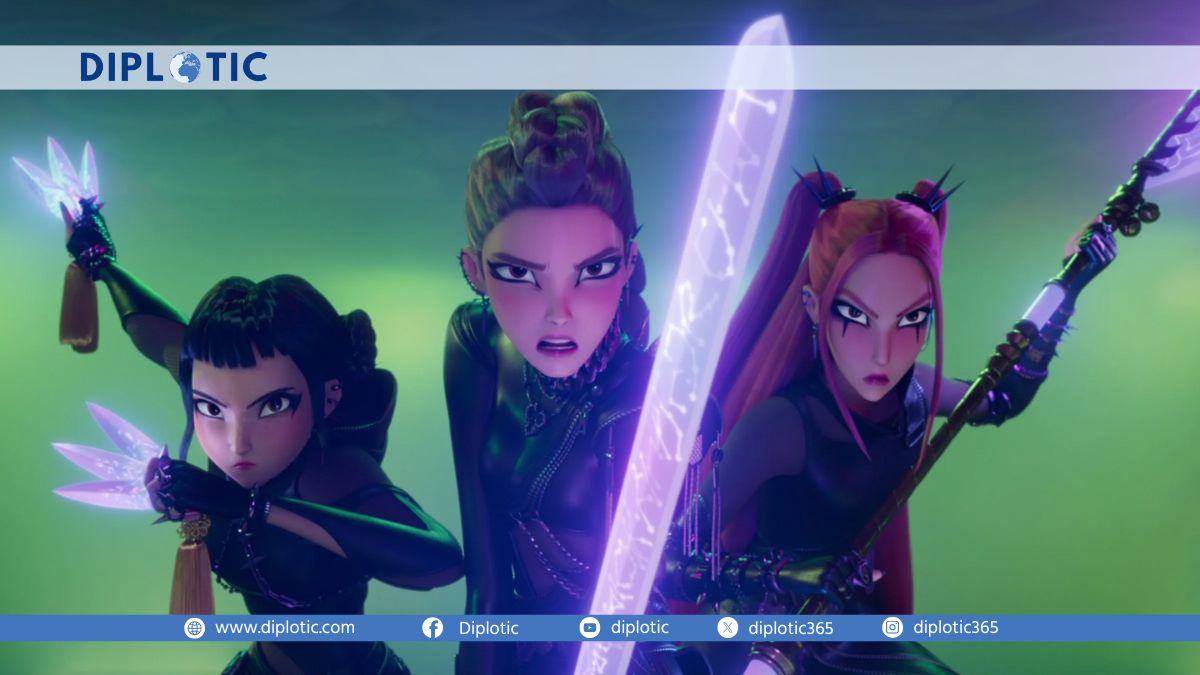
First, the magic: Rumi, Zoey, and Mira form the super trio Huntr/x—K-pop idols onstage, demon-fighters offstage. They follow in the footsteps of legendary guardians from a forgotten era, carrying forward their legacy in the modern world. We get flashes of that history, almost like echoes of older-generation champions before the rise of K-pop. Today, they shine on stage as idols, yet the responsibility of protecting others and facing unseen threats still lingers.
Rumi especially carries the heaviest burden. She hides a demon mark on her skin—secret and painful. Every time she sings, every time Huntr/x performs, she risks exposing it. That weight—the fear of not only entertaining her fans but also battling her own scars—makes her such a powerful character. Watching her balance between music, identity, and survival broke my heart.
Jinu’s Suffering and Conflict
Jinu, the leader of rival boyband Saja Boys, also carries his own suffering. He is torn between ambition and the darker shadow living inside him. The film doesn’t shy away from showing how even voices can become weapons of sorrow. The Saja Boys—and Jinu himself—are not entirely what they seem; some demons have come to the human world in disguise, hiding their true forms while blending into pop culture.
When the Saja Boys perform, Jinu’s speaking voice is provided by Ahn Hyo-seop, while his singing voice is delivered by Andrew Choi, adding layers of charisma, cunning, and hidden conflict. Then there’s Gwi-Ma—the dark, reaper-like villain—voiced by Byung-Hun Lee. His voice is chilling, a reminder that evil doesn’t just appear on screen, it breathes through sound. When he whispers, you can almost feel the dread in your bones.
The Battle for the Honmoon
Meanwhile, Huntr/x, the K-pop girl group mentioned earlier, leads a double life as demon hunters, singing to protect the Honmoon—a mystical barrier separating the human world from demons. Their mission is to strengthen this barrier by turning it golden, which would permanently seal the demons away. However, the Saja Boys, a rival boy band, are actually demons in disguise, sent by their ruler, Gwi-Ma, to weaken the Honmoon. They aim to drain the souls of Huntr/x’s fans through their music, thereby breaking the barrier and unleashing chaos. As the Saja Boys’ popularity grows, Huntr/x must confront them, leading to a high-stakes battle to protect the Honmoon and maintain the balance between worlds. What happens next, and whether Huntr/x can succeed, is a thrilling ride you’ll have to watch the movie to find out.
Music That Sticks in Your Head
And then, the music. Oh, the songs! They’re so catchy I find myself humming them all day without even realizing it. The reason is simple: the singing voices are performed by talented singers, making the soundtrack feel authentic and alive.
Ejae provides Rumi’s singing voice, making the soundtrack sound authentic instead of just “animated movie music.” Audrey Nuna as Mira adds a soulful depth, while Rei Ami as Zoey brings a playful charm. Together, they make songs that could easily fit into real K-pop playlists.
The standout track, Golden, is unforgettable. Its powerful vocals and emotive delivery have captivated audiences worldwide, helping it climb to Number 1 on the Billboard Hot 100 and Global 200.
Other tracks carry their own weight. “Takedown” shows Rumi stumbling under her power, trying to soften her lyrics, while Mira and Zoey refuse—forcing her to confront her demon mark. The song is more than catchy; it’s about identity and fear. On the other hand, “Soda Pop” by the Saja Boys is bubbly and playful on the surface, but underneath, it’s a trap. The sweet lyrics mask the darkness—they feed on souls while charming listeners. This is storytelling through music at its finest.
How It Became Netflix’s Biggest Hit
With music this powerful, it’s no surprise the soundtrack exploded—four singles in the Top 10 of Billboard Hot 100, the album reaching #2 on Billboard 200, and over 3 billion global streams.
Since its June 20 release, K-Pop Demon Hunters has become Netflix’s most-watched film ever—236 million views in ten weeks, beating Red Notice. Even its limited sing-along theatrical release made history, becoming the first Netflix film to top the U.S. box office with $18–19 million in just two days.
A Global Movement
Watching all this unfold feels like being part of a global wave. Korean culture is not just being consumed, it’s being celebrated worldwide. The sing-along screenings—fans singing together, cosplaying, dancing in theatres from the Bay Area to Times Square—turned the film into something larger than just a movie. It became an event, a shared experience.
What made it connect? Soul. Rumi’s suffering—the demon mark, her hope to cure herself by turning the Honmoon golden—makes her not a flawless idol, but a vulnerable heroine. Jinu’s inner conflict adds complexity, proving this isn’t a story of simple good versus evil. And the voice actors, doubling as singers, infused real emotion into every performance, giving the movie its living, breathing heart.
Final Thoughts
If I had to point out flaws, I’d say the runtime feels a bit short. Mira and Zoey deserved more backstory, Rumi’s resentment toward Celine could have been explored further, and the climax felt slightly rushed. But even with these issues, the world they created—mixing Korean mythology with K-pop fashion, glowing armor, tiger mascots, swords, norigae charms—pulled me in so strongly that I just wanted more.