
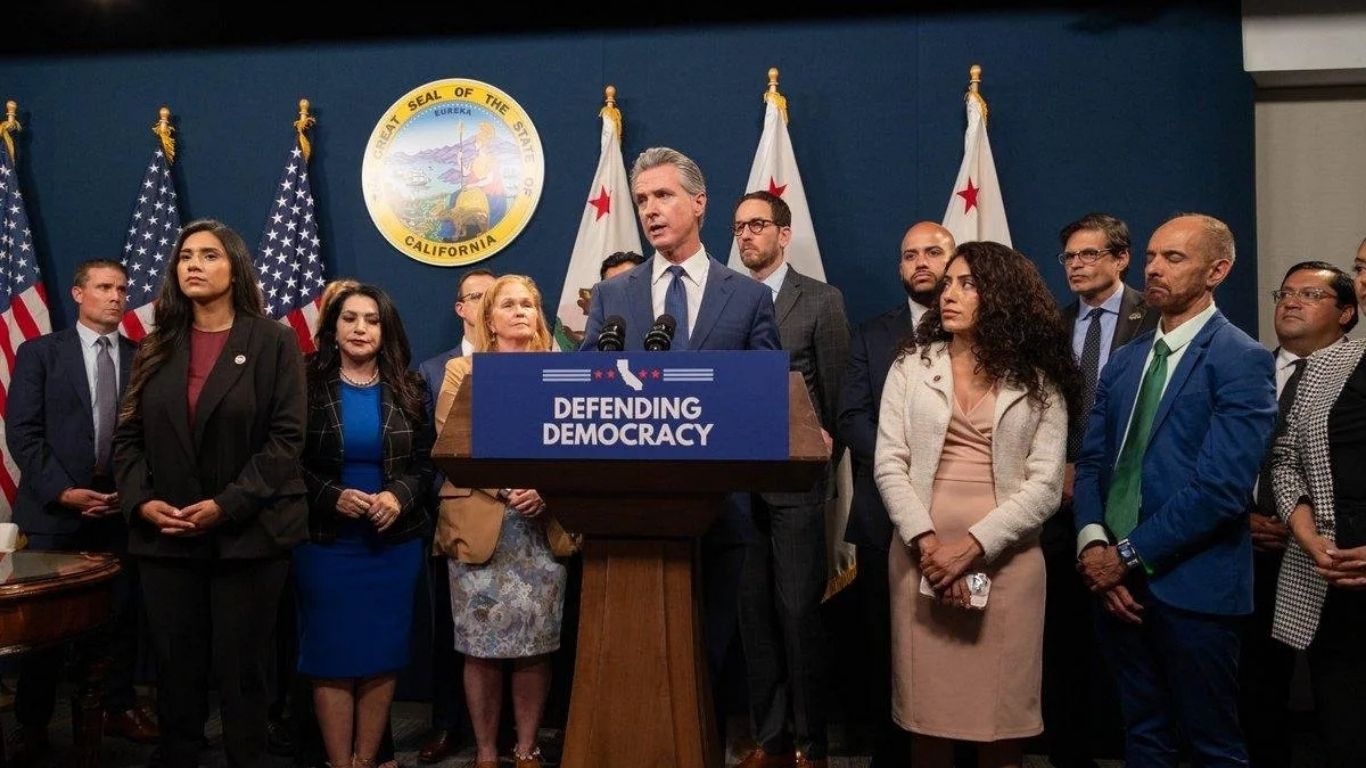
In a stunning twist of political brinkmanship, California Democrats and Texas Republicans are locked in a redistricting arms race that could redefine the 2026 midterms and tilt control of the House of Representatives. What started as a bluff by California leaders to deter Donald Trump’s push for a Texas mid-decade redistricting has escalated into a high-stakes national contest pitting Gov. Gavin Newsom against Trump in one of the most consequential political fights of his presidency.
The stakes could not be higher: control of the House, the trajectory of Trump’s second term, and the future of America’s approach to redistricting and gerrymandering.
How the Redistricting Clash Began
Rumors began circulating in April that Texas Republicans, under pressure from Trump, were preparing to redraw congressional maps six years ahead of schedule. By June, the plan was public, and Democrats feared the GOP could squeeze out at least five more Republican seats, putting the House even further out of reach for Democrats.
Texas Democrats scrambled for allies. They lobbied governors and lawmakers in blue states, including New Mexico, Illinois, and Connecticut, to consider retaliatory measures. Their pitch: the mere threat of Democratic-led redistricting in solidly blue states might dissuade Republicans from moving forward.
At first, California Democrats played along with the bluff. Rep. Zoe Lofgren, chair of California’s 43-member Democratic delegation, consulted data experts who warned the plan was risky and potentially ineffective. “It seemed to me worth a bluff,” Lofgren said, hoping the specter of retaliation would stall Republicans.
But when Trump doubled down, so did California.
Gavin Newsom Seizes the Spotlight
By mid-summer, Gov. Gavin Newsom had transformed from skeptic to champion of redistricting retaliation. His fiery rhetoric on social media and provocative podcast appearances made clear he was ready to play political hardball. On X, after Trump demanded five new GOP seats in Texas, Newsom responded bluntly: “Two can play at that game.”
Newsom’s declaration blindsided many in California’s congressional delegation, but it electrified Democrats nationally. Former House Speaker Nancy Pelosi and Minority Leader Hakeem Jeffries quickly lent their tacit support. Pelosi, in particular, signaled that California could not “unilaterally disarm” while Republicans re-engineered Texas to Trump’s advantage.
What began as a strategic bluff was suddenly real: California was preparing to redraw its maps.
Building the California Counteroffensive
Unlike Texas, where Republicans simply needed legislative approval, California faced a steeper challenge. The state’s independent redistricting commission, created by voters in 2008, holds constitutional authority over map-drawing. To override it, Newsom and Democratic leaders would need voter approval through a special election ballot measure.
By late June, Newsom reassembled his trusted recall campaign team to plot the path forward. The group debated whether to dismantle the commission entirely or simply carve out a temporary exception. Polling showed the commission remained popular with voters, so Newsom’s team opted for a narrowly tailored measure:
- Allow mid-decade redistricting only if another state, like Texas, took similar action.
- Make the new maps temporary, restoring full commission authority after the 2030 census.
- Frame the fight as a direct response to Trump and Republican gerrymandering.
Early polling showed a slim majority of Californians supported the idea, though skeptics warned of a tough, costly campaign that could exceed $100 million.
Drawing the New Maps
Meanwhile, the technical work of redistricting began. Veteran consultant Paul Mitchell, who initially dismissed the idea, was recruited by Lofgren to explore whether Democrats could realistically offset Texas’s gains. His goal: craft five additional Democratic-leaning seats while protecting vulnerable incumbents and adhering to the Voting Rights Act.
Mitchell and a team of redistricting experts churned through dozens of map revisions in marathon Zoom sessions. Outlandish “bacon strip” proposals that sliced districts into thin, spindly shapes were rejected. Instead, the group pursued a pragmatic approach designed to secure buy-in from civil rights groups, progressive lawmakers, and voters.
Rep. Pete Aguilar, the third-ranking House Democrat, acknowledged the challenge: “The action we knew would be very, very hard … so we were pretty cautious.” Yet as Newsom signaled seriousness, California’s congressional Democrats closed ranks, projecting unity despite private grumbles about losing familiar turf.
National Democrats Rally Behind the Plan
As California’s strategy took shape, national Democratic leaders began preparing for a nine-figure campaign. Pelosi tapped her formidable donor network, while Jeffries’ House Majority PAC made the California measure central to its fundraising pitch.
“This is happening in California, but it’s bigger than California,” said Mike Smith, president of House Majority PAC. “It’s about Democrats’ effort to actually take a stand and win back the House.”
Even former President Barack Obama joined the fray, encouraging Texas Democrats in exile who had fled Austin to block a quorum. His message was one of perseverance: the fight was part of the long, uneven struggle to preserve democracy.
Republicans Cry Foul
California Republicans and national GOP leaders blasted Newsom’s maneuver as raw hypocrisy. Fifteen years earlier, voters had stripped legislators of redistricting power to eliminate backroom deals. Now, critics argued, Democrats were undermining democracy by pursuing the same partisan gerrymandering they had once decried.
“No matter what the justification is, why would we engage in behavior that is considered unacceptable by those who elected us?” asked Assemblymember Tom Lackey during floor debate.
The opposition campaign an unusual alliance of Republicans and independent redistricting advocates—warned Californians not to follow Texas into the gerrymandering spiral.
A Turning Point for Newsom and the Democrats
For Newsom, the fight represents more than a redistricting skirmish. It has positioned him as the de facto leader of the national Democratic resistance, sharpening his profile ahead of a likely 2028 presidential run. By taking on Trump directly, Newsom is betting that voters see him not just as California’s governor but as a national figure unafraid to throw punches.
For Democrats more broadly, California’s move is both a risk and an opportunity. If successful, it could yield enough seats to counter Texas and potentially swing control of the House. If it fails, it risks alienating voters who value California’s independent commission and view partisan map-drawing as an assault on democratic norms.
The Redistricting Arms Race Spreads
The clash is already rippling beyond Texas and California. Ohio is legally required to redraw its maps ahead of 2026, a process Republicans hope to exploit. Indiana, Missouri, and Florida are considering mid-cycle redistricting, emboldened by Trump allies like Vice President JD Vance.
Blue-state governors, including New York’s Kathy Hochul, have hinted at potential retaliation, though none have matched Newsom’s bold steps. Some Democrats, like Texas Rep. Marc Veasey, argue that California’s example is necessary to deter further GOP aggression:
“Mutually assured destruction is the only way how you stop mid-decade redistricting moving forward.”
Conclusion: A Test of Power and Principles
What began as a bluff has become a defining battle of Trump’s second term. With Texas Republicans approving new gerrymandered maps and California Democrats racing to place their countermeasure on the ballot, the stage is set for a historic clash over democracy, fairness, and power.
At its core, the fight raises profound questions: Should Democrats embrace the same tactics they have long denounced? Is partisan redistricting the only way to survive in today’s zero-sum politics? And will voters accept the argument that fighting fire with fire is the only path forward?
One thing is clear: the redistricting showdown between California and Texas is no longer just about maps. It is about the balance of power in Washington, the credibility of democratic institutions, and the political future of America itself.