
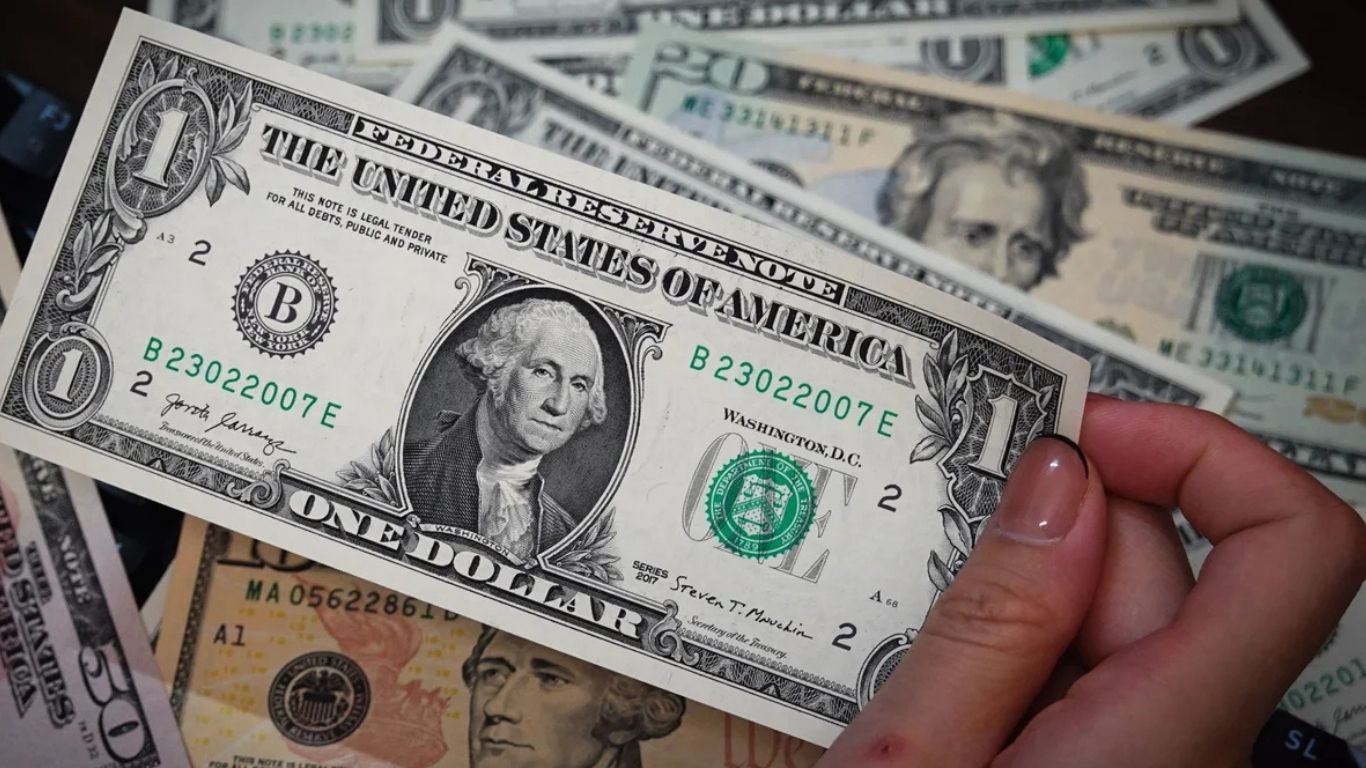
Could history be on the verge of repeating itself? The current dollar surge, political pressure on the Federal Reserve, and stock market overvaluation mirror the conditions before the 1987 Black Monday crash. Discover why investors should be on high alert.
A Rising Dollar and Political Pressure
The U.S. Dollar Index (DXY) has roared back to life, posting its strongest weekly performance since October 2022. After a devastating 11% drop earlier this year its worst first-half decline since the index’s inception in the early 1970s the greenback’s recent rebound has raised both eyebrows and alarms.
At first glance, the dollar’s resurgence seems like just another blip on the financial radar. However, seasoned market analysts are increasingly drawing ominous parallels between today’s environment and the precarious conditions leading up to the 1987 stock market crash, also known as Black Monday.
In that single session, the Dow Jones Industrial Average (DJIA) plunged 22.6%, a record one-day loss that still haunts Wall Street. And now, eerily similar patterns are emerging.
Do Dollar Movements Really Matter for U.S. Stocks?
Historically, the relationship between the U.S. Dollar Index (DXY) and the S&P 500’s earnings per share (EPS) has been inconsistent at best. Analysis shows that trailing-year changes in the dollar index explain merely 1% of contemporaneous EPS changes. Correlation swings wildly depending on the period from a robust 0.44 positive correlation in the mid-1990s to a disturbing -0.83 in the early 2000s.
Furthermore, when examining the dollar as a leading indicator of EPS growth, results are similarly inconclusive. Since the 1970s, the dollar’s year-over-year changes have explained just 0.4% of EPS growth rates in the following 12 months. This lack of statistical significance suggests that, in normal times, the dollar’s trajectory has minimal predictive power for corporate earnings.
The Dollar’s Role in the 1987 Crash
While quantitative data shows no strong dollar-EPS correlation, extreme macroeconomic situations tell a different story. Prior to the October 1987 crash, the dollar had fallen 7% from its January level. The Reagan administration, with Treasury Secretary James Baker at the helm, was openly pressuring the Federal Reserve to lower interest rates aggressively. Their goal? Spur economic growth and devalue the dollar further to gain competitive export advantages.
This policy stance triggered panic among investors. Baker’s jawboning against the Fed was seen as reckless currency manipulation, igniting fears of a currency war. Markets interpreted this as a dangerous mix of political overreach and fiscal imprudence, which led to a mass exodus from equities.
Barron’s editor Randall Forsyth noted that Baker’s comments effectively “pushed the dollar lower against the German mark and other currencies.” The markets reacted violently, selling off risk assets as fears of a global currency conflict overshadowed any short-term economic benefits.
Are Markets Ignoring the Warning Signs?
Fast forward to today, and the financial and political parallels are strikingly similar. The current administration is echoing a familiar script, pressuring the Federal Reserve to cut interest rates amidst a rising dollar. Much like in 1987, the rationale is to sustain economic momentum, but the unintended consequence could be a destabilizing dollar devaluation.
Moreover, today’s stock valuations are even more inflated compared to the 1987 pre-crash environment. With global markets already jittery over geopolitical tensions and inflationary concerns, any abrupt policy misstep especially an aggressive rate cut could trigger a cascading sell-off reminiscent of Black Monday.
The prospect of a currency war, fueled by deliberate political pressure, is no longer a hypothetical risk. It’s a looming threat that investors should not ignore.
Why Investors Must Stay Vigilant
It’s essential to recognize that the 1987 crash was a singular event, shaped by a confluence of policy errors, market complacency, and speculative excess. However, the broader lesson is timeless: markets are sensitive to policy-induced shocks, especially when politics interferes with monetary policy.
While statistical models might dismiss the dollar’s impact on equities, extreme scenarios defy averages. A persistently strong dollar, followed by aggressive Fed rate cuts under political duress, is a formula that has destabilized markets before and could very well do so again.
For investors, now is the time to recalibrate risk exposure, stay informed, and brace for potential volatility. The Trump-Dollar-Fed dynamic is a powder keg that, if mishandled, could spark a market correction of historic proportions.
Conclusion
The unsettling similarities between the current financial climate and the months leading up to the 1987 Black Monday crash should serve as a wake-up call for investors and policymakers alike. While history may not repeat itself in identical fashion, its tendency to rhyme particularly when hubris meets fragile economic underpinnings is a risk too significant to ignore.