
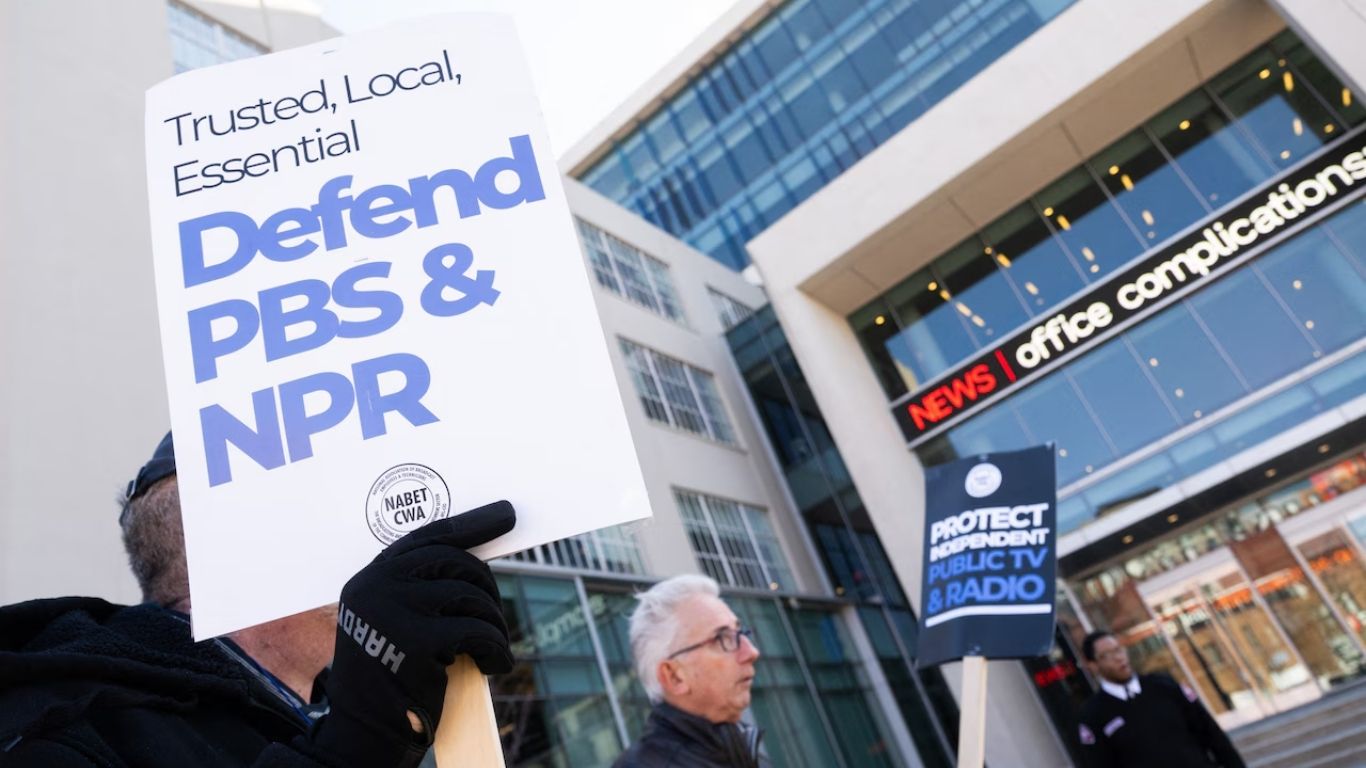
The Corporation for Public Broadcasting will shut down after President Trump’s historic funding cuts. How this move will reshape PBS, NPR, and local public media stations across America, and what it means for the future of independent journalism.
In a landmark decision that signals the end of an era, the Corporation for Public Broadcasting (CPB) announced on Friday that it will cease operations following sweeping funding cuts pushed through by President Donald Trump and Republican lawmakers. After over 60 years of supporting public television and radio stations like PBS and NPR, the CPB will shut its doors, leaving the future of non-commercial media hanging in the balance.
The decision follows the passage of a rescissions bill that clawed back $9 billion in previously approved federal spending, including $1.1 billion earmarked for public broadcasting over the next two years. Despite a nationwide campaign by millions of Americans to protect CPB funding, the closure marks a significant political win for Trump, who has long targeted public media, claiming systemic liberal bias within its programming.
“This is a heartbreaking moment for American public media,” said Patricia Harrison, CPB President and CEO. “Despite the extraordinary efforts to preserve our funding, we now face the difficult reality of closing operations. We remain committed to supporting our partners through this transition with transparency and care.”
Public Media Faces Uncertain Future as CPB Funding Disappears
The Corporation for Public Broadcasting has served as the backbone of the public media ecosystem, distributing federal funds to local PBS and NPR affiliates, particularly in rural and underserved areas. While larger urban stations have diversified funding streams, including member donations and corporate sponsorships, smaller outlets heavily depend on CPB grants to survive.
Without CPB’s foundational support, many of these local stations now face imminent closure. Harrison warned that rural stations, often lifelines for educational and cultural programming in isolated communities, will be among the hardest hit. The ripple effects are expected to destabilize the entire public media network, undermining its interconnected structure that relies on collaboration and shared content resources.
“The closure of CPB will resonate far beyond Washington,” said NPR CEO Katherine Maher. “Communities across America that rely on public broadcasting for trusted news, emergency alerts, educational content, and cultural programming will feel the void.”
Mass Layoffs and Station Closures Loom as CPB Winds Down
The immediate human impact of the shutdown is already evident. Roughly 100 staff positions at CPB will be eliminated when federal funds are exhausted on September 30. A small transition team will remain in place through January to oversee the orderly closure of the organization’s operations.
Many local station leaders are scrambling to assess how they can weather the loss of federal funding. While powerhouse stations like GBH in Boston and WNYC in New York have launched aggressive fundraising campaigns to offset the financial blow, smaller stations lack such donor bases, making survival uncertain.
GBH, for example, has embraced the moment as a rallying cry, recently displaying a bold banner outside its headquarters that reads, “Local. Trusted. Defunded.” In a recent fundraising appeal, the station vowed resilience but emphasized its dependence on community support: “We’re not backing down, but we can’t do it without you. Donate now to keep public media strong and independent.”
Trump’s Long-Standing Crusade Against Public Broadcasting Succeeds
For Trump and his Republican allies, the dissolution of CPB is a long-sought triumph. Efforts to defund public broadcasting date back over 40 years, with conservatives often accusing NPR and PBS of liberal bias and using federal dollars to push partisan narratives. Trump’s relentless drive to dismantle CPB culminated in multiple attempts this year to undercut the organization, including an unsuccessful bid to fire three CPB board members.
After the rescissions bill passed both GOP-controlled chambers of Congress, Trump took to his social media platform, Truth Social, to celebrate: “REPUBLICANS HAVE TRIED DOING THIS FOR 40 YEARS AND FAILED…. BUT NO MORE.”
Even after Trump signed the bill, public media advocates had hoped funding could be restored via Congress’s annual appropriations process. However, those hopes were dashed when a Senate draft budget advanced without reinstating CPB funding, signaling the final blow.
Public Media Advocates Decry the End of Federally Funded Journalism
Progressive media watchdogs and public broadcasting advocates have sharply criticized the move, calling it a blow to democracy and independent journalism. Craig Aaron, co-CEO of Free Press, condemned the defunding as a “corrupt failure of Congress and the Trump administration to invest in informing the American public.”
“They have trashed decades of democracy-building work and will deny many journalists, educators, and creators the opportunity to be heard,” Aaron said. Still, he expressed optimism that this could be a moment to reinvent public media as grassroots, community-supported enterprise, free from political interference.
Station leaders across the country are echoing similar sentiments, framing this crisis as an opportunity to build a new model of public broadcasting that is more locally rooted and resilient. However, the challenges ahead are daunting, as public media must now navigate a future without the federal safety net that has sustained it for generations.
A New Chapter or The Decline of Public Media?
The CPB’s closure marks a seismic shift in America’s media landscape, ending federal involvement in public broadcasting funding. While Trump’s supporters hail it as a victory against what they perceive as taxpayer-funded bias, critics warn that the loss of CPB could deepen news deserts, weaken educational content access, and erode a critical pillar of civic engagement.
As public media stations pivot to survive in a post-CPB era, their fate now rests with the audiences they serve. The next few years will determine whether public broadcasting can reinvent itself as a fully community-funded institution or whether Trump’s defunding efforts will trigger its irreversible decline.