
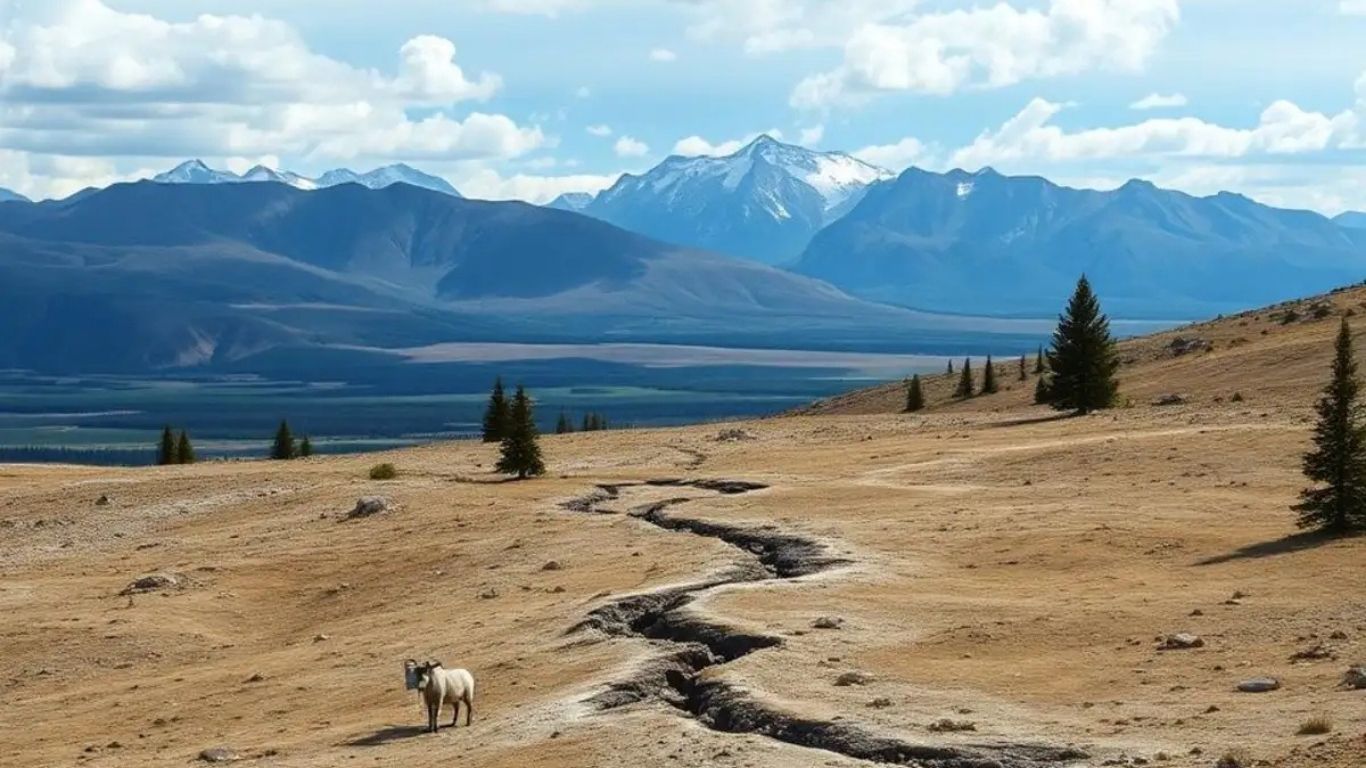
Scientists warn the long-dormant Tintina Fault in Canada’s Yukon Territory may be preparing to unleash a massive earthquake. Discover what new research reveals about this seismic threat and what it means for communities like Dawson City.
In Canada’s remote Yukon Territory, a seismic threat long thought to be dormant may be preparing to unleash devastating power. According to a new study published in Geophysical Research Letters, a 1,000-kilometer fault line known as the Tintina Fault could be in the late stages of a seismic cycle. Researchers believe that a major earthquake, potentially exceeding magnitude 7.5, could strike the region with little warning.
The discovery is raising alarm bells in towns like Dawson City, a community of 1,600 people situated perilously close to the fault. Until recently, the Tintina Fault had shown little surface activity for over 12,000 years, but new evidence indicates that beneath its stillness lies a dangerous buildup of tectonic strain.
What Is the Tintina Fault and Why Should You Care?
Stretching over 1,000 kilometers (620 miles) from the Yukon into Alaska, the Tintina Fault has long been overshadowed by more notorious seismic zones like California’s San Andreas Fault. But it may be equally capable of producing catastrophic earthquakes.
Lead researcher Theron Finley, a recent PhD graduate from the University of Victoria, explained:
“Based on the data, we think that the fault may be at a relatively late stage of a seismic cycle… If this strain is released, it could cause a significant earthquake.”
Finley and his team analyzed a 130-kilometer segment of the fault near Dawson City using advanced lidar imagery, satellite data, and drone mapping to uncover signs of ancient earthquakes previously hidden from view.
Unearthing the Past to Predict the Future
Using lidar (Light Detection and Ranging) technology, the researchers identified fault scarps, elevated ridges created by past earthquakes that reveal a violent seismic history. One such scar showed displacement of over 1,000 meters (3,280 feet), indicating a series of major earthquakes around 2.6 million years ago.
Another scarp, offset by 75 meters (250 feet), dates back approximately 132,000 years, suggesting a less intense but still powerful series of quakes. Notably, no significant seismic activity has been detected along this portion of the fault for the past 12,000 years, a geological blink of an eye but one that may point to imminent danger.
Why Stability Isn’t Always Reassuring
A common misconception is that a lack of earthquakes means a fault is inactive. In reality, a long period of seismic silence can be an ominous sign. The longer a fault remains locked, the more tectonic strain builds up beneath the surface.
Finley’s study estimates that the Tintina Fault has accumulated a slip deficit of six meters (20 feet) over the past 12,000 years. If that strain is released in a single seismic event, the resulting earthquake could exceed magnitude 7.5 comparable to the 1976 Tangshan earthquake in China or the 2010 Haiti earthquake, both of which caused massive loss of life.
What’s at Risk?
While the Yukon is sparsely populated, the threat to human life, infrastructure, and the environment is significant. A quake of that magnitude could:
- Damage or destroy critical highways, bridges, and mining operations
- Trigger massive landslides in mountainous regions
- Sever communication lines and power grids
- Cause fatalities in towns like Dawson and nearby communities
The proximity of Dawson City to the fault’s most active segment puts it squarely in harm’s way. And with limited access to emergency services and infrastructure, even a moderate quake could have long-term consequences.
Global Implications: A Waking Giant in the North
The Tintina Fault’s reactivation is not just a Canadian concern. It lies adjacent to seismically active regions in Alaska, and its awakening could have ripple effects in nearby geological systems.
Globally, the story mirrors similar concerns: fault lines thought to be dormant are showing new signs of life. In Europe, Asia, and the Americas, seismic risk is increasingly being reevaluated in light of new mapping technologies and a deeper understanding of tectonic stress cycles.
Preparing for the Unpredictable
Seismologists caution that predicting the exact timing of an earthquake is impossible. However, early warnings can help communities prepare. Residents of the Yukon are being urged to:
- Create go-bags with essential supplies
- Develop family emergency plans
- Identify safe zones inside homes and workplaces
- Stay informed through local authorities and seismic monitoring centers
“The Earth will quake at will,” Finley said. “We can only react.”
Conclusion: From Silent Fault to Looming Disaster
The findings on the Tintina Fault represent a critical wake-up call. Though it has been silent for over 12 millennia, new evidence suggests it is far from inactive. A massive earthquake may not be a matter of if but when.
In the face of this uncertainty, one thing is clear: preparedness is key. As science continues to uncover the hidden movements of our planet’s crust, communities must translate that knowledge into action, awareness, and resilience.