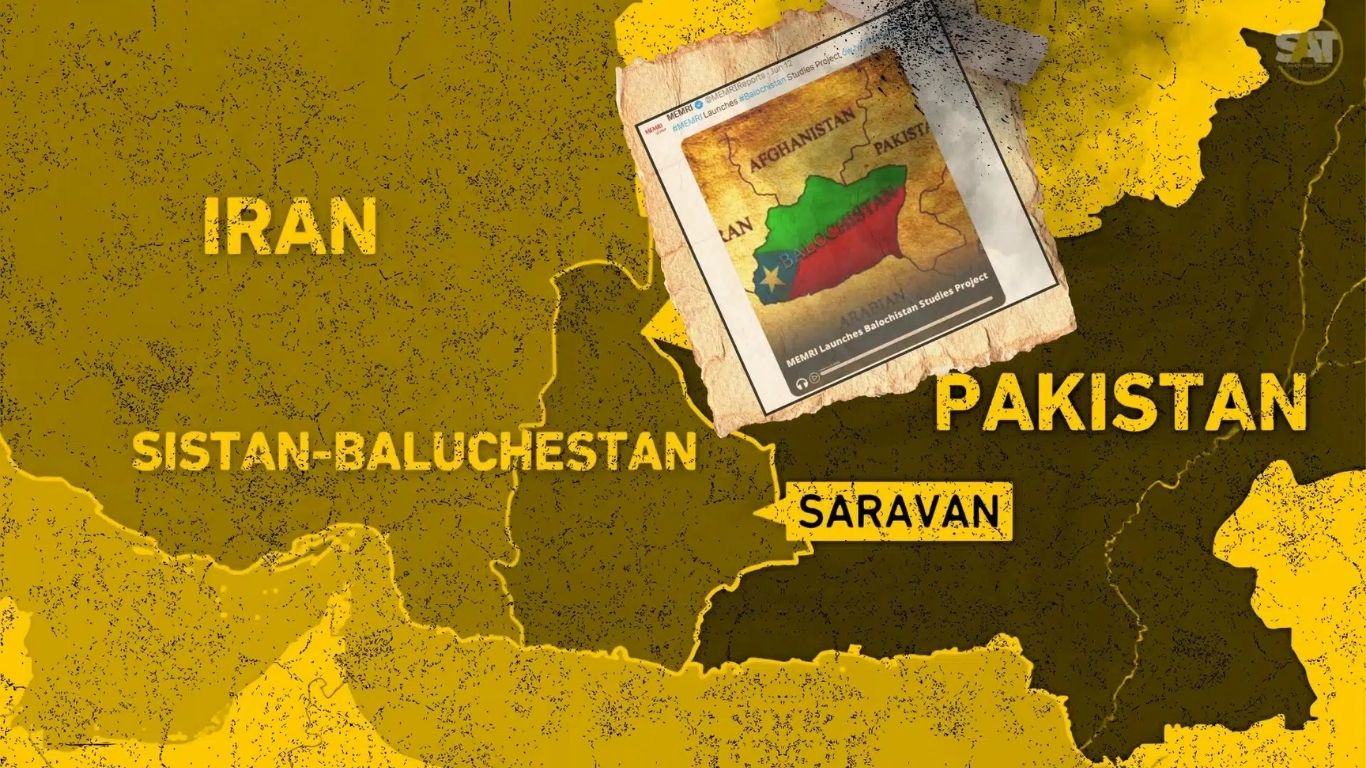
On June 12, 2025, the Middle East Media Research Institute (MEMRI)—a Washington D.C.-based think tank—announced the launch of a new initiative titled the “Balochistan Studies Project” (BSP). Framed as an effort to “highlight the political, cultural, and historical dynamics” of the Baloch region spanning parts of Pakistan, Iran, and Afghanistan, the project has drawn sharp criticism from Pakistani and Iranian authorities as well as neutral analysts. At the center of this controversy lies the alleged weaponization of academic research to serve a wider agenda of hybrid warfare.
What is MEMRI?
The Middle East Media Research Institute was founded in 1998 by Yigal Carmon, a former Israeli intelligence officer. Though MEMRI claims to bridge the language gap between the Middle East and the West by translating Arabic, Persian, Urdu, and other media, it has long been criticized for ideological bias, particularly in amplifying anti-Islamic narratives and selectively promoting content that aligns with Western strategic interests.
Key Criticisms of MEMRI:
Run by former intelligence operatives
Often accused of cherry-picking extremist content from the Muslim world
Accused of using its media footprint for soft power manipulation.
Launch of the Balochistan Studies Project (BSP)
On June 12, 2025, MEMRI officially launched the Balochistan Studies Project, introducing Mir Yar Baloch as the Special Advisor to the project. MEMRI described it as a platform to study the plight of Baloch people, their history of marginalization, and to raise awareness about state-sponsored repression in Pakistan and Iran.
“The people of Balochistan have been denied autonomy, silenced, and oppressed for decades. It is time their stories are heard on the global stage.” — Mir Yar Baloch, BSP Press Release
Who is Mir Yar Baloch?
Mir Yar Baloch is a self-declared Baloch nationalist, closely affiliated with the Free Balochistan Movement (FBM)—a UK and Geneva-based organization that advocates for Baloch independence from Pakistan and Iran. His Twitter and media appearances frequently promote slogans like “Free Balochistan,” and his rhetoric includes accusations of genocide, resource exploitation, and ethnic cleansing by Pakistani and Iranian governments.
However, several analysts suggest that “Mir Yar Baloch” may be a manufactured persona—possibly a Western intelligence proxy—created to give an intellectual and diplomatic face to the separatist movement.
Allegations of Hybrid Warfare and Foreign Meddling
Multiple Pakistani and Iranian analysts have characterized the BSP as part of a larger disinformation campaign rooted in hybrid warfare tactics. These include:
Media Manipulation
By publishing curated reports under the guise of academic research, the project aims to shape international public opinion in favor of Baloch secessionism.
Delegitimizing States
The portrayal of Pakistan and Iran as “colonial oppressors” is a recurrent theme in BSP materials, often without reference to the broader geopolitical or historical complexities of the region.
Strategic Timing
The launch comes amid:
Increasing tension in Iran-Pakistan relations
China’s strategic investment in Balochistan via the CPEC
Western anxieties over Chinese and Russian influence in South Asia
This timing suggests a geopolitical alignment with anti-CPEC narratives and broader Western concerns over regional power balances.
Geopolitical Implications
China-Pakistan Economic Corridor (CPEC)
Balochistan is the entry point of the $60+ billion CPEC project, which connects China’s Xinjiang region to Gwadar Port. Western, Indian, and Israeli think tanks have long criticized this development, arguing that it consolidates authoritarian regimes and bypasses local interests.
The BSP echoes this criticism, but in a way that many see as an indirect attempt to delegitimize Chinese investment in the region.
Alleged Indo-Israeli Nexus
Multiple Pakistani media outlets have highlighted a perceived alignment between Israeli and Indian interests in supporting separatist movements within Pakistan, including Balochistan and Khalistan.
Analysts suggest MEMRI’s new project may reflect a joint strategy of:
Media warfare
Soft diplomacy
Discrediting adversaries through narrative control
Reaction from Pakistan and Iran
Both governments have issued statements condemning the BSP as:
A “blatant interference in internal affairs”
A “coordinated disinformation campaign”
A tool of “digital colonialism” meant to destabilize regional security
Security analysts in both states warn that such projects may be used to justify sanctions, military operations, or human rights interventions in the name of “protecting oppressed minorities.”
Counterpoint: Are There Legitimate Grievances?
It is true that Balochistan faces deep structural problems:
The lowest Human Development Index (HDI) in Pakistan
Chronic underdevelopment, poor infrastructure, lack of schools and hospitals
Allegations of human rights violations by security forces
Enforced disappearances and media censorship
Yet, many argue that solutions lie in economic inclusion, local governance, and political negotiation—not in the internationalization or militarization of the issue by foreign powers.
Conclusion: Scholarship or Subversion?
The Balochistan Studies Project by MEMRI represents the complex intersection of academia, propaganda, and geopolitics. While the study of Baloch history and rights is legitimate and necessary, critics warn that such projects—when backed by military-affiliated think tanks—risk turning identity politics into weapons of disintegration.
For long-term peace in Balochistan, what is needed is:
Authentic local representation
Developmental justice
End to both domestic repression and foreign manipulation
For more than a century, quantum mechanics has challenged humanity’s understanding of reality. Unlike classical physics, which describes a predictable...