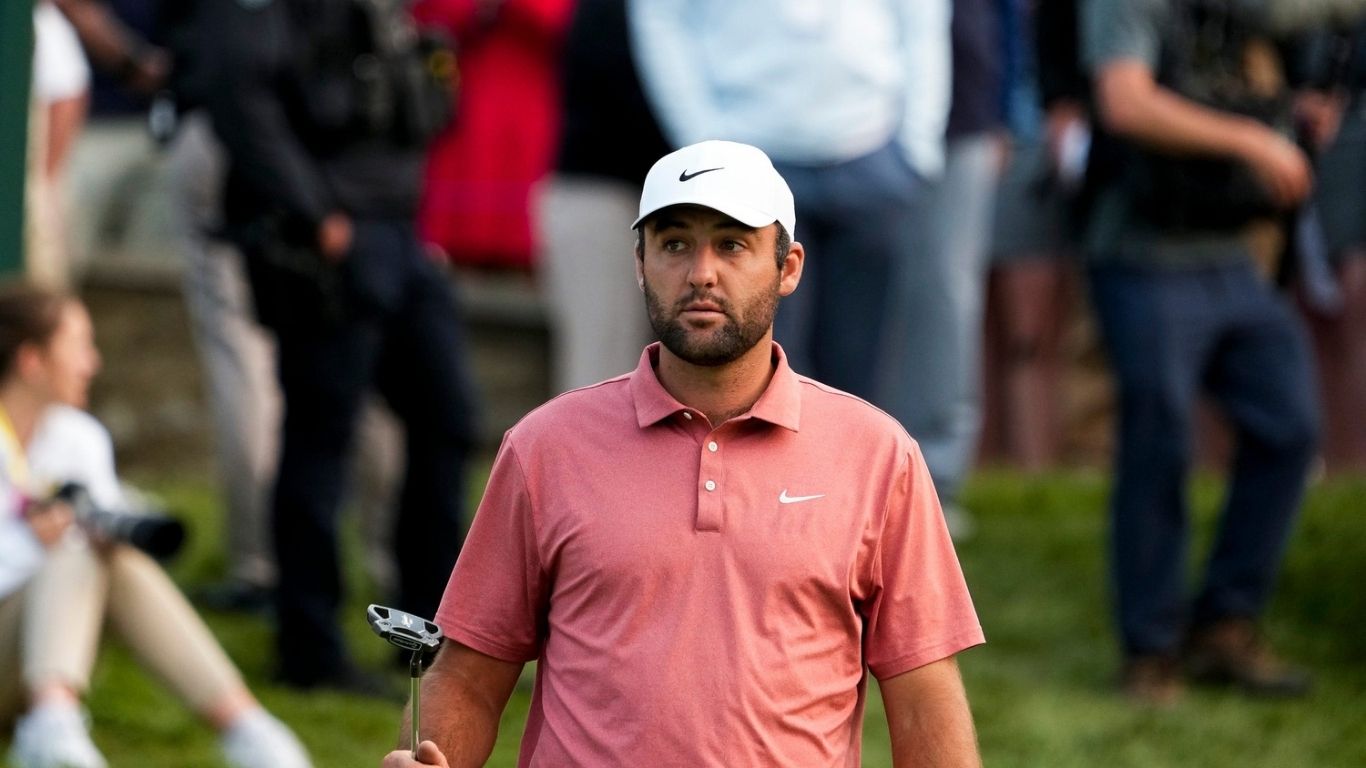
In a sport defined by laser focus, relentless precision, and the pursuit of perfection, Scottie Scheffler has emerged as one of golf’s most dominant forces. The 29-year-old American has held the world No. 1 ranking since 2023, won three majors, and enters this week’s Open Championship at Royal Portrush as the overwhelming favorite. Yet, in a surprisingly candid and introspective press conference ahead of the Open, Scheffler offered a rare glimpse behind the curtain, questioning not just his career, but the very essence of fulfillment, purpose, and what it means to “win” in life.
During what began as a routine media session, Scheffler fielded a question about how long he celebrates his victories. The answer just a few minutes set off an extraordinary moment of reflection, one that veered into the deeply philosophical and emotional terrain rarely explored in professional sport.
“There’s a lot of people that make it to what they thought was going to fulfill them in life… and they’re like, what’s the point?” Scheffler admitted. “You get to No. 1 in the world, and it’s like, why do I want to win this tournament so bad?”
Beyond the Green: A Search for Meaning
For a man at the pinnacle of professional golf, Scheffler’s remarks reflect a powerful inner conflict. Despite his immense achievements, he openly admitted to struggling with the fleeting nature of satisfaction in sport.
“If I win, it’s going to be awesome for two minutes,” he explained. “Then we’re going to get to the next week and it’s, ‘Hey, you won two majors this year; how important is it for you to win the FedExCup playoffs?’ And we’re back here again.”
Scheffler’s reflection calls into question the very structure of modern professional sports a relentless cycle of competition, media scrutiny, and expectation that leaves little time for emotional resonance. His words echo the sentiments of other elite athletes who, after reaching the peak of their profession, find themselves staring into a void of deeper questions: Is this all there is?
A Deeply Grounded Life Philosophy
Much of Scheffler’s existential questioning appears rooted in his personal faith and strong family values. While he acknowledged the thrill of competing and living out a childhood dream, he was unwavering in emphasizing that golf is not the most important part of his life.
“This is not the be-all, end-all,” he said. “This is not the most important thing in my life. That’s why I wrestle with, why is this so important to me? Because I’d much rather be a great father than I would be a great golfer.”
Scheffler credited his wife, Meredith, and their young son, Bennett, as the foundation of his life. He made it clear that he would walk away from professional golf if it ever endangered that foundation.
“If my golf ever started affecting my home life or it ever affected the relationship I have with my wife or my son, that’s going to be the last day that I play out here for a living,” he said firmly.
Mental Resilience in the Spotlight
Scheffler’s introspective tone may surprise some, given his reputation for calm under pressure and fierce competitiveness on the course. But it’s precisely this self-awareness that could be the source of his composure.
Rather than chasing wins for external validation, Scheffler finds purpose in the discipline, the preparation, and the challenge. He referred to himself as a “sicko” who loves the grind an indication that his love for golf lies in the process, not the podium.
“We really work so hard for such little moments… I love putting in the work. I love getting to practice. I love getting to live out my dreams. But at the end of the day… does it fill the deepest wants and desires of my heart? Absolutely not.”
These comments not only humanize one of golf’s greats, but also may help explain why Scheffler remains so mentally unshakeable in high-stakes moments. His ability to view the sport through a broader life lens could be his greatest psychological advantage.
Reframing Success in Modern Sport
Scheffler’s remarks invite a larger conversation about mental health, identity, and the definition of success in elite athletics. In an era where burnout, anxiety, and emotional strain are increasingly acknowledged, his transparency may serve as a vital message for fans, fellow competitors, and future stars alike.
He is not the first athlete to grapple with these themes tennis’s Naomi Osaka, gymnastics icon Simone Biles, and even NBA star Giannis Antetokounmpo have all spoken candidly about the emptiness that can accompany even the highest achievements. But coming from the world No. 1 in men’s golf, Scheffler’s confession hits differently.
It challenges the illusion that greatness automatically equals happiness and instead paints a portrait of a man who understands the value of balance, humility, and self-reflection.
What’s Next for Scheffler at the Open?
Despite his philosophical musings, Scheffler made it clear he remains determined to win the Open Championship, a title that has eluded him thus far. His best finish came at Royal Troon in 2024, where he placed seventh. Now at Portrush, he’s hungry for more, even if he questions the meaning behind it.
“It’s great to win tournaments. But sometimes the feeling of winning only lasts a few seconds. It’s exciting and fun, but it just doesn’t last that long.”
The 2025 Open could very well be another milestone in an already historic career. But for Scheffler, the true victories lie at home in the quiet, sacred moments with his family that no leaderboard or trophy can measure.