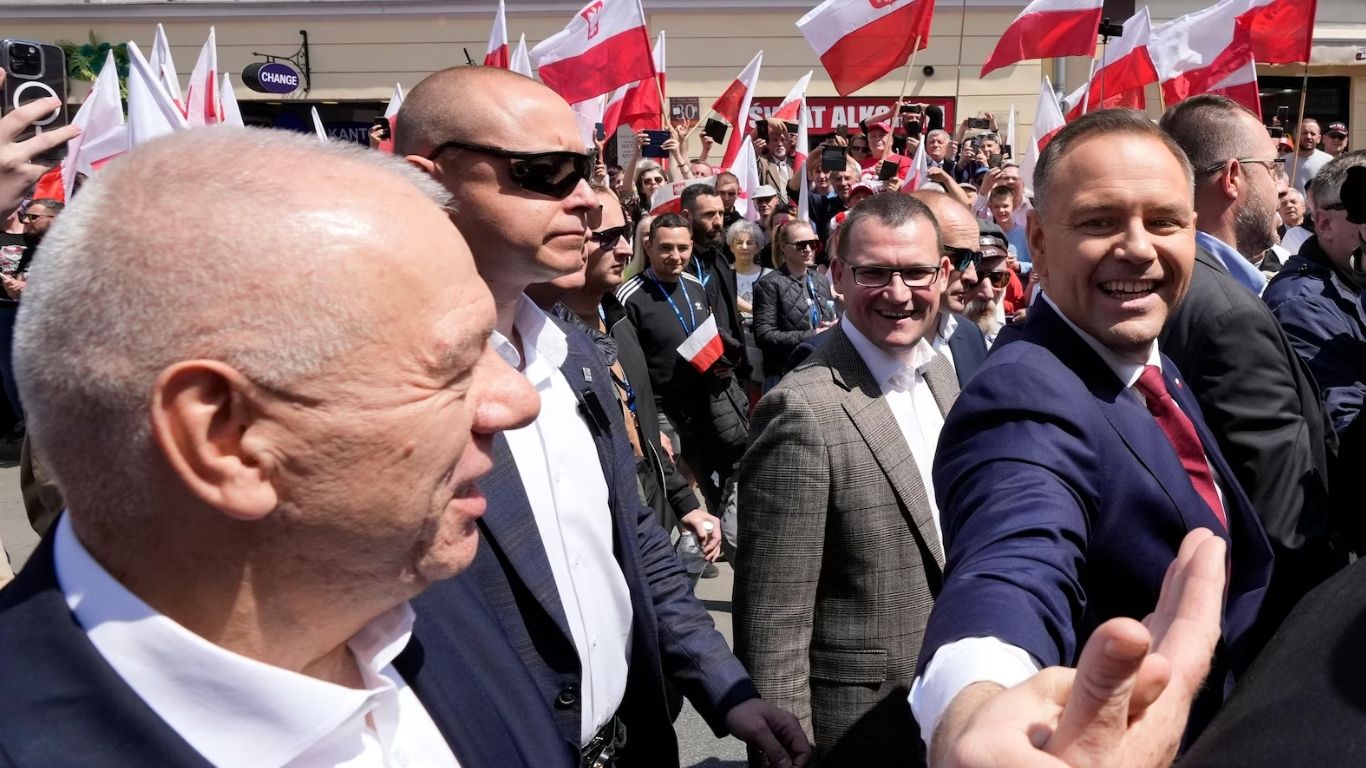
Poland votes in a critical second round of its presidential election, as pro-EU candidate Rafał Trzaskowski faces off against populist-right contender Karol Nawrocki in what may be the closest race since 1989.
Poland Presidential Election 2025: Voters Face a Defining Choice in Closely Contested Runoff
Poland is at a political crossroads as citizens head to the polls today in the decisive second round of a deeply polarized presidential election. The runoff pits two sharply contrasting candidates against each other: Rafał Trzaskowski, the pro-European mayor of Warsaw, and Karol Nawrocki, a right-wing historian and political newcomer backed by the populist Law and Justice (PiS) party.
With polls showing both candidates in a dead heat and the final margin likely to be fewer than 200,000 votes, the election is expected to be the tightest in Poland’s post-communist history.
A Referendum on Poland’s Future
Though largely ceremonial, Poland’s presidency holds critical powers—including a veto over legislation—that could define the direction of the country for years to come. This makes today’s vote far more than a symbolic contest; it is, in many ways, a referendum on the policies and promises of Prime Minister Donald Tusk’s centrist government.
A win for Trzaskowski would grant Tusk a much-needed political ally and clear the path for long-delayed reforms on judicial independence, abortion rights, and LGBTQ protections. However, a Nawrocki presidency would likely entrench legislative gridlock until the next parliamentary elections in 2027, threatening to stall key progressive initiatives.
“This isn’t just about the presidency—it’s about whether the government can function,” said Professor Aleks Szczerbiak of the University of Sussex. “A Nawrocki victory means a lame-duck administration for Tusk and possibly years of political stasis.”
The Candidates: Two Competing Visions for Poland
Rafał Trzaskowski: The Progressive Technocrat
Oxford-educated and fluent in multiple languages, 52-year-old Rafał Trzaskowski has served as the mayor of Warsaw since 2018 and previously held posts in the European Parliament and Polish government. Running under the Civic Coalition, he has promised a moderate but reform-driven presidency that works in tandem with Tusk’s administration.
His campaign focused on restoring judicial independence, expanding civil rights, and reasserting Poland’s place in the European Union. However, Trzaskowski has struggled to distance himself from the unpopular aspects of Tusk’s tenure and fend off accusations of elitism and foreign influence.
Karol Nawrocki: The Right-Wing Challenger
At 43, Karol Nawrocki is the younger and less politically seasoned candidate. A trained historian and former amateur boxer, he rose to prominence as head of the Institute of National Remembrance, a state-backed historical institute with prosecutorial powers. Although officially running as an independent, Nawrocki enjoys full backing from the conservative PiS party and its former leadership.
Nawrocki’s campaign focused on national sovereignty, traditional values, and skepticism toward European integration. His candidacy has been buoyed by endorsements from former U.S. President Donald Trump and Hungarian Prime Minister Viktor Orbán. However, he has faced mounting scrutiny over controversial aspects of his past—including participation in a football hooligan brawl and a questionable real estate acquisition.
Critics have also warned that Nawrocki’s hardline stance on Ukraine—including opposition to its NATO membership—could mark a shift in Poland’s foreign policy at a time when regional unity remains crucial.
A Nation on Edge as Campaigning Ends
After a fiercely contested campaign marked by ideological clashes, personal attacks, and disinformation, Poland entered an official 24-hour electoral silence period on Friday evening. Under law, no further campaigning or polling is allowed during this period, allowing voters to reflect ahead of the ballot.
“This race has become a barometer for the country’s mood,” said Dr. Ben Stanley, associate professor at SWPS University in Warsaw. “There are so many moving parts, and such a tight margin, that even a small change in turnout could tip the result.”
What’s at Stake: Reform, Deadlock, or Division
The outcome of today’s presidential election will determine whether Poland continues its pivot toward Europe and liberal democracy, or whether it reverts to the nationalist, conservative trajectory of the PiS era. The consequences extend beyond domestic politics, potentially reshaping Poland’s role in NATO, its support for Ukraine, and its relationship with Brussels.
Polls close at 9pm local time (8pm BST), with exit polls expected shortly thereafter. However, given the razor-thin margins, official results may not be clear until well into the night or early Monday.