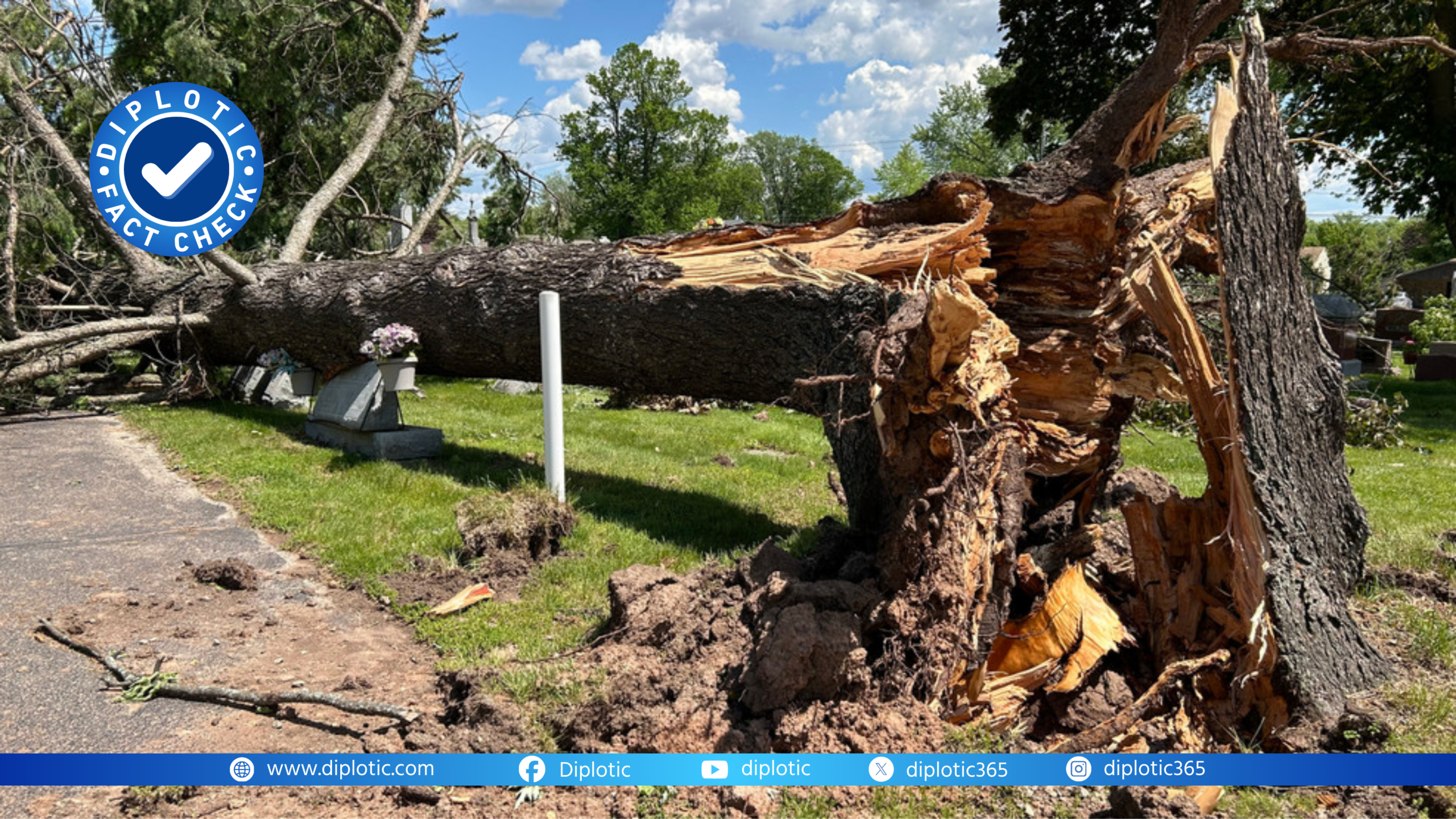
Between March 13 and 17, 2026, a massive and complex storm system swept across North America, bringing blizzard conditions to the Upper Midwest, severe thunderstorms and tornadoes to the South and East Coast, and even fueling wildfires in the Plains. In its wake, social media and news headlines have buzzed with claims of “historic” and “record-breaking” weather. This investigation examines what the actual data shows, separating which aspects of the storm were genuinely unprecedented from those that were severe but within historical norms.
Claim 1: The blizzard dumped record-breaking snowfall in parts of the Upper Midwest, with some areas seeing the most snow ever recorded in a two-day period.
Evaluation: This claim is verified by meteorological data from multiple sources. The National Weather Service office in Marquette, Michigan (located in Negaunee Township) reported that the storm dumped 36.3 inches (92.2 cm) of snow on their location over March 15 and 16 . This breaks the all-time two-day snowfall record for that site of 31.9 inches (81 cm), which was set on March 13-14, 1997. Weather records for the area go back to 1959 .
The same location also set a new one-day snowfall record on March 16 with 21.7 inches (55.1 cm), far surpassing the old record of 7.7 inches set in 2013 . Across the region, storm-total snowfall reached 52 inches (132.1 cm) near Round Lake in Alger County, Michigan, with several other locations recording more than 40 inches .
In Wisconsin, the city of Wausau picked up 23.4 inches of snow on March 15, making it the city’s snowiest day in about 130 years of records . Green Bay also set a daily record of 17.1 inches for March 15, and the three-day total of 30.2 inches from March 14-16 set a new record for the city [citation:Wikipedia].
Verdict: True. Multiple locations in the Upper Midwest, particularly in Michigan’s Upper Peninsula and Wisconsin, experienced snowfall totals that broke long-standing records for one-day and two-day accumulations.
Claim 2: The storm generated an unprecedented number of tornadoes and severe weather reports across the South and East.
Evaluation: This claim requires careful examination of the data. The storm system did generate significant severe weather. The Storm Prediction Center logged approximately 957 severe weather reports during the March 15-16 period, including over 850 reports of damaging wind gusts exceeding severe criteria . However, the number of confirmed tornadoes was 36 as of the most recent count [citation:Wikipedia], with other sources reporting 22 tornadoes from March 15-16 or 11 tornado reports in preliminary data .
These numbers, while significant, do not appear to be unprecedented for a spring storm system. The severe weather outbreak was notable for its widespread wind damage rather than a high number of strong tornadoes. The Storm Prediction Center issued an enhanced risk and later a moderate risk for severe weather, but the feared major tornado outbreak did not fully materialize, with the system favoring widespread straight-line wind damage instead .
What was unusual was the storm’s structure—a “storm complex” capable of producing both Arctic-like winter conditions and severe springtime convection simultaneously across such a wide geographic area .
Verdict: Overstated. The severe weather was widespread and impactful, with hundreds of wind damage reports and several dozen tornadoes. However, the number of tornadoes was not record-breaking for a March event, and the feared major outbreak did not occur.
Claim 3: Over 500,000 people lost power, and more than 5,000 flights were cancelled, making this one of the most disruptive storms in recent memory.
Evaluation: This claim is supported by multiple verified sources. Power outages peaked at over 500,000 customers across affected states . In Michigan alone, more than 100,000 homes and businesses lost electricity, with the hardest-hit areas experiencing ice storms and high winds . In Quebec, Canada, approximately 315,000 Hydro-Québec customers were without power just before 10 a.m. on March 17 [citation:Wikipedia].
Flight disruptions were massive. According to FlightAware data, more than 4,700 flights within, into, or out of the US were cancelled on March 16 alone, with over 11,800 flights delayed . Between March 15 and the morning of March 17, total cancellations exceeded 5,000 . Airports in Chicago, Minneapolis, New York, Atlanta, and Washington, D.C. were particularly hard hit .
The storm also forced school closures across multiple states, from Minnesota and Wisconsin to Georgia and North Carolina . In Wisconsin, Governor Tony Evers declared a state of emergency, and in Michigan, Governor Gretchen Whitmer activated the State Emergency Operations Center and later declared a state of emergency for seven counties [citation:Wikipedia].
Verdict: True. The storm caused widespread disruption with over 500,000 power outages and more than 5,000 flight cancellations, affecting millions of people across the country.
Claim 4: The storm system was unique because it simultaneously caused blizzards, tornadoes, and even fueled wildfires across the country.
Evaluation: This claim captures one of the most remarkable aspects of the storm system. The same large-scale weather pattern produced dramatically different conditions across regions . In the north, cold air from Canada clashed with moisture to produce blizzard conditions. In the south and east, warm, moist air from the Gulf of Mexico fueled severe thunderstorms and tornadoes .
Meanwhile, on the dry, windy side of the system in the Plains, conditions fueled significant wildfires. Nebraska reported three major wildfires, including the Morrill Fire, which burned more than 700,000 acres across several counties and resulted in at least one fatality . Red flag warnings were issued from southern Texas to southern Louisiana .
Adding to the extremes, a heat wave developed in the Southwest as a “heat dome” brought temperatures 15 to 30 degrees above normal, with some areas in Southern California and Arizona reaching the low 100s—temperatures more typical of June . Woodland Hills, California, reached 97 degrees on March 16 .
This juxtaposition of winter storms, severe thunderstorms, wildfires, and record heat all from the same broad weather pattern is unusual but not entirely unprecedented. It reflects a highly amplified jet stream pattern with sharp contrasts between air masses.
Verdict: True. The storm system did simultaneously produce blizzards, tornadoes, wildfires, and extreme heat across different regions of the country, demonstrating its exceptional scope and power.
Claim 5: The storm caused at least three confirmed fatalities.
Evaluation: The Wikipedia article for the storm complex lists three total fatalities [citation:Wikipedia]. However, breaking this down by specific incidents reveals a more complex picture:
In Minnesota, the State Patrol reported one fatal crash between March 13 and 15 during the early phases of the storm [citation:Wikipedia]. In Nebraska, the Morrill Fire fueled by the storm’s winds killed at least one person in Arthur County, according to Governor Jim Pillen . In Pennsylvania, a man died in Newton Square while removing a tree that had fallen during the storm [citation:Wikipedia].
Additionally, a driver in New York died in a crash after trying to swerve around a fallen tree and losing control in Mount Pleasant [citation:Wikipedia]. This would bring the total to four, depending on how incidents are classified. The Wikipedia total of three may not include all storm-related deaths.
Verdict: True but incomplete. At least three fatalities have been confirmed, with some sources indicating a fourth death. The storm’s indirect effects, such as the wildfire in Nebraska, also contributed to loss of life.
Conclusion: A Storm for the Record Books, But Not in Every Category
The March 13-17, 2026 North American storm complex was genuinely historic in several respects. The blizzard dumped record-breaking snowfall in parts of Michigan’s Upper Peninsula and Wisconsin, with some locations seeing more snow in two days than ever recorded . The scope of the storm was exceptional, simultaneously producing blizzard conditions, severe thunderstorms and tornadoes, wildfires, and record heat across different regions . The disruption was massive, with over 500,000 power outages and more than 5,000 flight cancellations affecting millions of people .
However, not every claim of “record-breaking” holds up to scrutiny. The tornado outbreak, while significant with 36 confirmed tornadoes, was not unprecedented and fell short of the major outbreak initially feared . The number of severe weather reports was high but not historically anomalous for a strong spring storm system.
The storm’s true significance lies in its complexity and geographic scope. It demonstrated how a single, powerful weather system can manifest in dramatically different ways across a continent—dumping feet of snow in the north, spawning tornadoes in the south, fueling wildfires in the Plains, and even contributing to a heat wave in the Southwest. For meteorologists, it will be studied as a case study in atmospheric dynamics. For the millions of Americans who lost power, had flights cancelled, or dug out from feet of snow, it will be remembered as a March week when winter refused to yield and spring demanded its turn all at once.