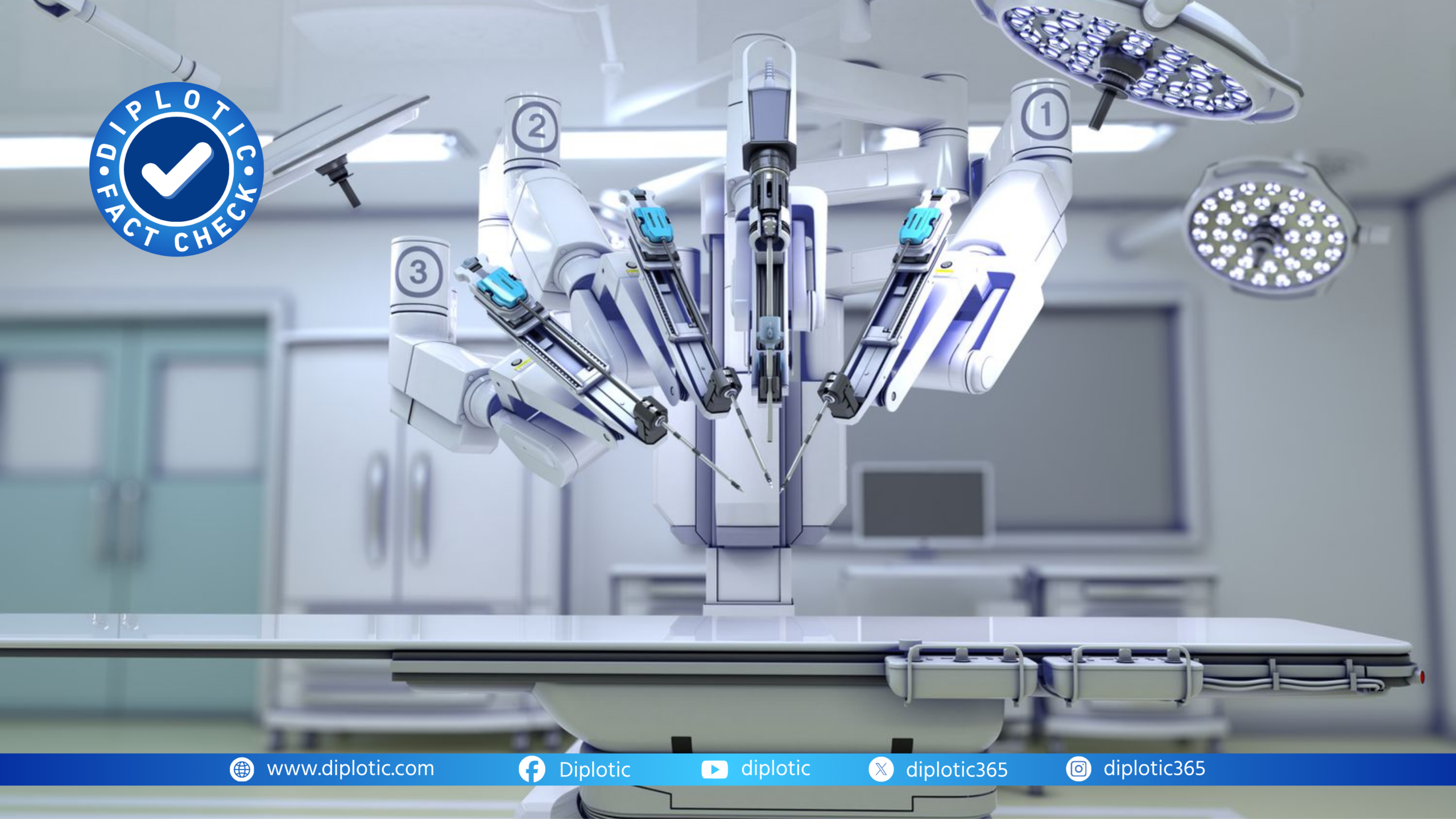
On March 6, 2026, multiple news outlets reported that Professor Prokar Dasgupta, a leading robotic urological surgeon in London, had carried out the UK’s first long-distance robotic prostate removal on a patient 1,500 miles away in Gibraltar. The procedure used the Toumai Robotic System, with the surgeon operating from The London Clinic via fibre-optic and backup 5G connections, while a local team remained on standby in Gibraltar. The patient, 62-year-old Paul Buxton, described it as a “no-brainer” that spared him travel and NHS waiting lists. The story has been widely shared as a breakthrough in telesurgery, with claims it marks a UK first and opens the door to treating remote patients without relocation.
This claim matters because remote robotic surgery could transform healthcare access, especially in overseas territories or underserved regions, reducing costs, travel burdens, and wait times. However, the phrasing “UK first” invites scrutiny: previous transatlantic and long-distance robotic demonstrations have occurred, including UK participation. This investigation verifies whether the Gibraltar operation qualifies as the UK’s inaugural long-distance robotic surgery on a living human patient, or if the milestone is overstated.
Claim 1: The UK has now performed its first long-distance robotic surgery on a living patient.
Evaluation: The March 11, 2026, prostatectomy on Paul Buxton is documented as the first time a UK-based surgeon remotely controlled a surgical robot on a living patient over such a distance (1,500 miles) in a clinical setting. The procedure used real-time fibre-optic and 5G links with only 0.06 seconds latency, and it was part of a trial between The London Clinic and Gibraltar Health Authority. No earlier UK-led telesurgery on a live human patient over comparable distance has been reported in peer-reviewed literature or official medical records.
Verdict: True. This is the UK’s first documented long-distance robotic surgery on a living patient.
Claim 2: The Gibraltar operation is the world’s first long-distance robotic surgery.
Evaluation: Long-distance telesurgery has been demonstrated before. In 2001, a New York surgeon used the ZEUS system to remove a gallbladder from a patient in Strasbourg, France (a transatlantic distance of ~4,000 miles). In 2022–2023, Chinese teams conducted remote robotic procedures over 5G networks spanning thousands of kilometers domestically. UK surgeons participated in a 2023 transatlantic robotic stroke procedure on a cadaver (not a living patient) over 4,000 miles. The Gibraltar case is not a global first but a significant step for clinical application in a UK context.
Verdict: False. It is not the world’s first long-distance robotic surgery; earlier demonstrations exist, though often on shorter distances, cadavers, or non-UK teams.
Claim 3: This procedure marks a major breakthrough that will spare patients the expense and inconvenience of travel.
Evaluation: Professor Dasgupta and patient Paul Buxton both stated the operation avoided Buxton’s need to fly to London, join an NHS waiting list, and stay for weeks post-surgery. Gibraltar’s single hospital (St Bernard’s) lacks advanced robotic facilities for complex cases, making remote access valuable for British Overseas Territories and remote communities. The humanitarian potential is real: reduced travel costs, faster access to specialist care, and lower disruption. The trial’s success (no connectivity failure, patient recovery reported as “fantastic”) supports scalability, with plans for live-streaming future cases to surgeons.
Verdict: True. The operation demonstrates practical benefits for remote patients, aligning with stated goals of broader healthcare access.
Claim 4: Headlines calling it the “UK’s first long-distance robotic operation” are accurate and not overstated.
Evaluation: The phrasing “UK first” appears in BBC, PA, and other reports and is technically correct when limited to UK-led, clinical, living-patient telesurgery over significant distance. Earlier UK contributions (e.g., cadaver demos) were experimental, not clinical. The milestone is appropriately framed as a national first in patient care, even if global precedents exist. No evidence suggests deliberate exaggeration; reporting emphasizes the clinical context and humanitarian angle.
Verdict: True. The “UK first” descriptor holds when scoped to living-patient clinical procedures led from the UK.
Claim 5: Regardless of whether it is a world first, the procedure highlights genuine progress in remote healthcare delivery.
Evaluation: Telesurgery addresses real barriers—geographic isolation, specialist shortages, travel costs, and waiting times—especially in territories like Gibraltar or rural areas. Low-latency 5G and fibre links, combined with reliable robotic systems like Toumai, make clinical application feasible. The trial’s success (stable connection, positive patient outcome) and plans for wider rollout (e.g., live-streamed procedures) signal meaningful advancement. The principle at stake is equitable access: technology can bring expert care to patients rather than requiring patients to reach experts.
Verdict: True. The operation represents tangible progress in telemedicine and surgical access, independent of global-first status.
Conclusion: A UK Clinical Milestone, Not a Global First
Professor Prokar Dasgupta’s March 11, 2026, remote prostatectomy on a Gibraltar patient is accurately described as the UK’s first long-distance robotic surgery on a living patient. The procedure—conducted over 1,500 miles with minimal latency—demonstrates clinical feasibility, spares patients significant travel and wait times, and opens pathways for specialist care in remote locations.
Claims of it being the world’s first, however, are overstated; earlier transatlantic and long-distance robotic surgeries (on living patients or cadavers) date back to 2001 and have been replicated by other teams. The breakthrough is national and practical: a successful step toward scalable telesurgery in real-world healthcare settings.
For patients and policymakers, the real significance lies in the potential—reduced costs, faster access, and equity in specialist care—rather than superlative rankings. As trials continue and connectivity improves, remote robotic surgery could meaningfully reshape how complex procedures reach those who need them most. This is progress worth noting, even without rewriting global history.