

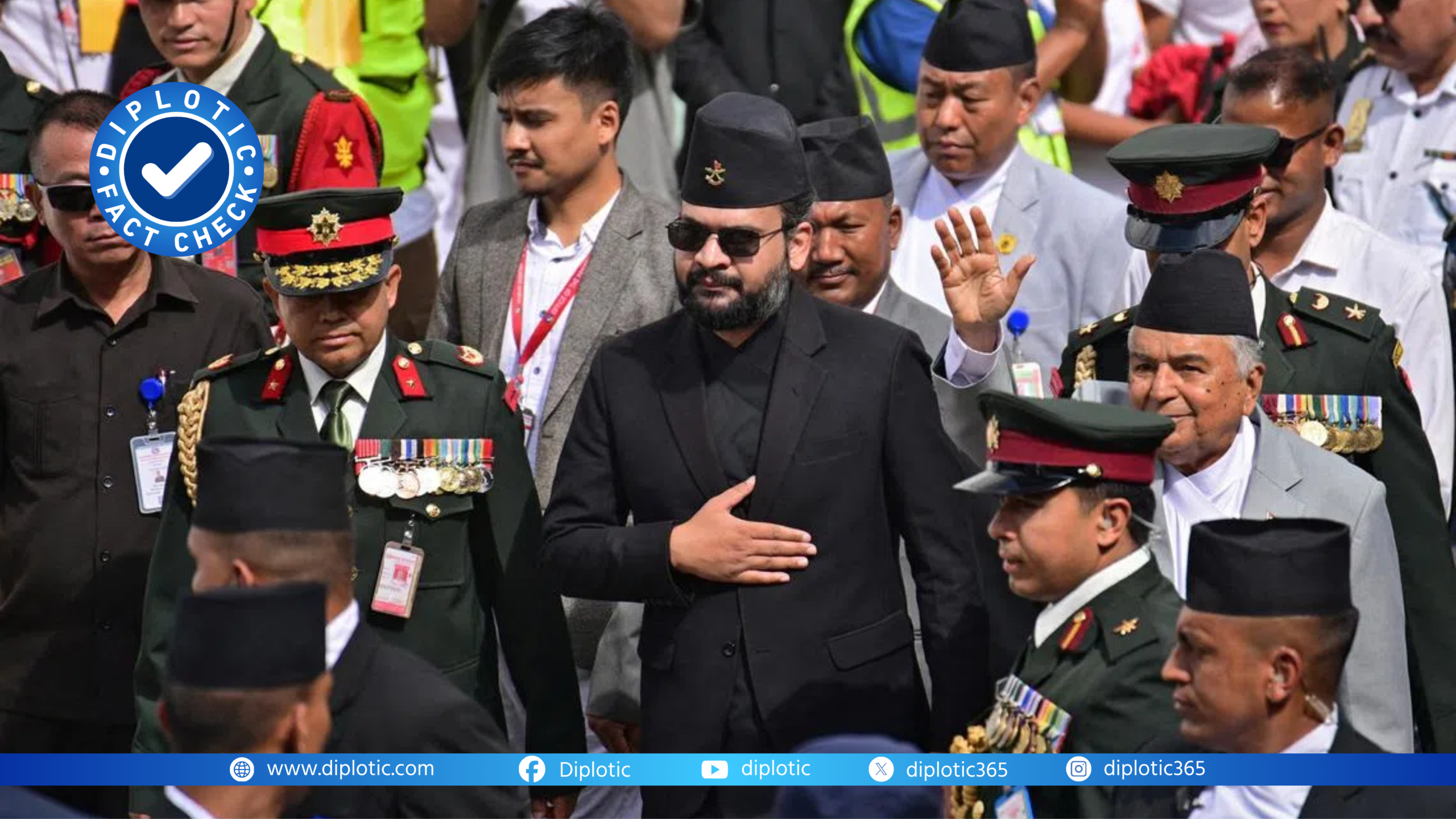
Six months after a Gen Z-led uprising toppled the government and forced the resignation of Prime Minister KP Sharma Oli, Nepal went to the polls on March 5, 2026, in one of the most consequential elections in the Himalayan nation’s history. As vote counting began on March 6, early trends showed a dramatic lead for the Rastriya Swatantra Party and its prime ministerial candidate, Balendra Shah, the 35-year-old former Kathmandu mayor and rapper known popularly as “Balen.” Social media posts and news headlines quickly began declaring that Nepal’s future government had been decided and that the country was set to get a rapper prime minister. This investigation examines the actual election data, the constitutional process for government formation, and the distinction between early leads and final outcomes.
Claim 1: The election results have already decided that Balendra Shah will be Nepal’s next prime minister.
Evaluation: This claim requires careful examination of what the early counting data actually represents and the constitutional process that follows any election. By noon on March 6, 2026, the Election Commission’s early counting trends showed Balendra Shah’s Rastriya Swatantra Party leading in 52 of the 65 seats for which leads were available . Other reports indicated the party was leading in approximately 100 seats . Former Prime Minister KP Sharma Oli’s Communist Party of Nepal (Unified Marxist-Leninist) was leading in just three to four seats, while the Nepali Congress, the country’s oldest party, was leading in five to six seats .
However, these are early leads, not final results. Vote counting was underway for 165 seats filled by direct election from a total of 275 in Nepal’s lower house of parliament . The remaining 110 seats are decided by a system of proportional representation, where voters cast ballots for parties rather than individual candidates . Proportional representation seats are allocated based on each party’s share of the national vote, and counting for these takes longer to compile.
Chief Election Commissioner Ram Prasad Bhandari stated that some winners were expected to be published as early as March 6, but full results may take several days . Officials indicated that results for the direct elections would likely be clear by March 6 evening or March 7 . Even after all results are declared, forming a government requires a party or coalition to demonstrate a majority in the 275-seat house. Analysts had predicted before the election that no party might win an outright majority, requiring negotiations and potential coalition-building .
The Nepali Congress has already conceded defeat, and analysts said the RSP’s dominant showing means it will likely form the next government . “Likely” is not “decided.” The constitutional process of government formation—including potential coalition negotiations, parliamentary voting, and formal appointment by the president—has not yet occurred.
Verdict: Misleading. Early leads show a strong performance by Shah’s party, but final results are not yet complete, and the constitutional process of government formation has not concluded. Declaring the outcome “decided” is premature.
Claim 2: Balendra Shah has already defeated KP Sharma Oli in his home constituency.
Evaluation: This claim refers to one of the most closely watched contests in the election. Shah chose to contest from Jhapa-5, a constituency near the Indian border that has long been considered Oli’s political stronghold . The logic behind this strategic choice, according to Shah’s supporters, was to defeat the former prime minister on his own home turf as symbolic justice for the young protesters who died under Oli’s government .
Early counting trends showed Shah leading Oli in Jhapa-5 . The Express Tribune reported that Shah was leading over Oli in the latter’s home constituency . This represents a significant symbolic victory if it holds, as it would mean the deposed prime minister lost even in the area that traditionally supported him.
However, counting in this constituency was still ongoing as of the most recent reports. While the trend strongly favored Shah, a final official result had not been declared. The constituency has approximately 163,000 voters , and final tallies require verification of all ballot boxes, including potential recounts if margins are close.
The significance of this particular contest extends beyond one seat. If Shah defeats Oli in his home constituency, it would powerfully symbolize the rejection of the old guard by voters even in areas where they were strongest. But as with the national count, a trend is not a final result until officially declared.
Verdict: True as an early trend, uncertain as a final result. Shah was leading in Oli’s constituency, but final certification had not occurred at the time of reporting.
Claim 3: The Gen Z movement that toppled the government in September 2025 has now successfully installed its preferred candidate as prime minister.
Evaluation: This claim connects two distinct events—the September 2025 protests and the March 2026 election—into a single narrative of successful revolutionary transfer of power. The September 2025 uprising was a Gen Z-led movement that began as protests against a social media ban and grew into a broader anti-corruption movement . At least 77 people were killed, and parliament and scores of government buildings were torched . The movement resulted in Prime Minister KP Sharma Oli’s resignation and the installation of former chief justice Sushila Karki as interim prime minister, with a mandate to hold elections within six months .
However, the relationship between the protest movement and Shah’s candidacy is more complex. During the protests, social media called for Balen to “step up and take over the country,” and supporters noted that he had the “mandate of the Gen Z movement” . But Shah was not a formal leader of the protests. The movement was largely leaderless, organized through platforms like Discord and TikTok by groups such as Hami Nepal, a grassroots collective focused on providing emergency aid .
Shah’s political rise predates the protests. He first won election as Kathmandu mayor in 2022, running as an independent and defeating candidates from major parties . He joined the Rastriya Swatantra Party only in December 2025, after resigning as mayor . The RSP itself was founded three years ago, well before the September protests .
The protests created conditions favorable to anti-establishment candidates and intensified youth desire for change. But Shah’s candidacy represents an organized political party’s effort to channel that energy, not the direct installation of a movement-selected leader. The movement’s online vote in September selected Sushila Karki as interim prime minister, not Shah .
Verdict: Overstated. The Gen Z movement created political space for anti-establishment candidates and intensified demand for change, but Shah’s rise predates the protests, and he was not the movement’s chosen candidate. The election represents an institutional transfer of power, not a revolutionary installation.
Claim 4: Balendra Shah’s background as a rapper means Nepal will be led by someone with no political experience.
Evaluation: This claim requires examining Shah’s actual biography and political career. Shah is indeed a rapper who rose to prominence through Nepal’s Raw Barz rap battles and has a song, “Balidan,” with over 14 million views on YouTube . His lyrics critique the establishment: “Let me speak, sir, it is not a crime, Let me open the mind, I am not a curse to the palace” .
However, his background is more varied. He holds a civil engineering degree from Himalayan Whitehouse International College in Kathmandu and a postgraduate degree in structural engineering from Visvesvaraya Technological University in Karnataka, India . He is currently pursuing a PhD at Kathmandu University .
More importantly, he has significant political experience. He was elected Kathmandu mayor in 2022, serving until December 2025 when he resigned to contest the national election . As mayor, he launched high-profile drives against illegal encroachments, pushed for digitization of municipal services, and intensified waste management reforms . While his governance style was described as “assertive” and drew criticism for being confrontational, it provided three years of executive experience at the municipal level .
Supporters point to his record: “What makes Balen special is that he stays connected with the youth through his short messages on social media, but it would not be a cakewalk for him after becoming prime minister” . Critics note that he has faced allegations from Human Rights Watch for using police “to mistreat the urban poor,” including cracking down on street vendors and landless residents .
Verdict: Misleading. Shah is not just a rapper; he is an engineer with a master’s degree, a PhD candidate, and a former mayor with three years of executive experience. Describing him solely as a rapper with no political experience omits his educational background and governance record.
Claim 5: The RSP’s dominant lead means it will govern alone without needing coalition partners.
Evaluation: This claim addresses the crucial question of whether the RSP’s performance is strong enough to form a majority government independently. Nepal’s 275-member parliament requires 138 seats for a majority. Early leads showed the RSP ahead in approximately 100 seats , which would leave it short of an absolute majority.
The proportional representation component, which allocates 110 seats based on each party’s national vote share, will significantly affect the final composition. Even if the RSP performs strongly in direct seats, it will need to combine these with proportional representation seats to reach a majority.
Analysts had widely predicted before the election that it would be “nearly impossible for a single party to get a majority” given Nepal’s two-ballot voting system . The Nepali Congress has already conceded defeat, and analysts said the RSP’s dominant showing means it will “likely form the next government” . “Likely form” implies the need for coalition partners or support from other parties, not an outright majority.
Independent political analyst Puranjan Acharya noted that much of Shah’s success as prime minister “will depend on the talent he surrounds himself with to overhaul a moribund administrative system” . This implies a need for coalition partners who can provide experienced ministers and administrative expertise.
If the RSP falls short of a majority, it will need to negotiate with other parties to form a coalition government. The constitutional process requires a vote of confidence in parliament, which necessitates securing support beyond the RSP’s own seats.
Verdict: Uncertain, but likely overstated. Early leads suggest the RSP will be the largest party but may fall short of an outright majority, requiring coalition negotiations. Declaring that it will govern alone is premature.
Claim 6: A Shah-led government will dramatically reshape Nepal’s foreign policy, particularly toward India.
Evaluation: This claim examines the potential foreign policy implications of a Shah victory. Shah has a history of statements that could be characterized as nationalist or critical of neighbors. In 2023, after India installed a mural depicting “Akhand Bharat” (Greater India) in its parliament, Shah responded by hanging a “Greater Nepal” map in his office showing territories that once belonged to Nepal but now lie within India’s borders .
He has also made provocative statements, including reportedly saying “Fck America, Fck India, F*ck China” in a social media post that was later deleted . He demanded a ban on Indian films in Nepal in 2023, arguing that a film had depicted Sita as a daughter of India when she was born in Janakpur, Nepal .
However, analysts caution against assuming that campaign rhetoric or past statements will determine actual foreign policy. Nepal is geographically sandwiched between two giant neighbors, China and India, and its options are constrained by geography and economics. India remains Nepal’s largest trade partner and a significant source of investment and transit access.
The DNA India analysis notes that Shah’s anti-India rhetoric raises questions for Indian diplomacy, asking “how will ties with Kathmandu reshape?” . But the same analysis acknowledges that Shah completed his master’s degree in India, suggesting personal familiarity with the country.
Whether campaign positions translate into policy depends on multiple factors: the composition of his government, the views of coalition partners, bureaucratic continuity, and the pragmatic requirements of governance. Nepal’s economy remains heavily dependent on trade and transit access through India, and foreign investment from both neighbors is crucial for development.
Verdict: Uncertain. Shah’s past statements suggest a nationalist orientation that could complicate relations with India, but actual foreign policy will depend on coalition dynamics, bureaucratic implementation, and the practical constraints of geography and economics.
Claim 7: The 60 percent voter turnout indicates diminished enthusiasm compared to the protests.
Evaluation: This claim requires analyzing what the turnout figure actually represents. Chief Election Commissioner Ram Prasad Bhandari reported that initial estimates showed turnout had been around 60 percent . This figure has prompted some commentary suggesting that voter enthusiasm may have waned since the September protests that brought thousands to the streets.
However, 60 percent turnout must be contextualized. Nepal’s elections have historically seen varying turnout rates. The 2022 election saw turnout around 61 percent, making the 2026 figure comparable to recent norms . The election took place six months after a violent uprising that resulted in 77 deaths and widespread destruction . Conducting polls under such circumstances, with thousands of soldiers and police deployed for security, represents an institutional achievement.
The “enthusiastic” description from the Chief Election Commissioner, combined with reports of voters dancing in the streets after casting ballots, suggests positive engagement . One voter told reporters, “Today feels like a day of celebration” .
The 60 percent figure also reflects the logistical challenges of voting in Nepal, where helicopters were used to collect ballot boxes from snowbound mountain regions across the country, home to eight of the world’s 10 highest peaks . Turnout in remote areas is typically lower than in urban centers.
Comparing protest attendance (which is self-selecting and involves no cost or effort beyond showing up) to election turnout (which requires registration, travel to polling stations, and time spent queuing) is not an apples-to-apples comparison. Protests attract the most motivated citizens; elections measure participation across the entire population.
Verdict: Misleading. Sixty percent turnout is comparable to recent elections and was described as enthusiastic by officials. Comparing protest attendance to election turnout misrepresents what each metric measures.
Conclusion: A Mandate Taking Shape, Not Yet Delivered
The investigation reveals that while Balendra Shah and the Rastriya Swatantra Party have achieved a stunning early lead in Nepal’s election, declaring the outcome “decided” is premature. The constitutional process requires final counting, official certification, and government formation procedures that have not yet occurred. Early trends are strong but not final.
Shah’s rise represents a genuine political realignment. A 35-year-old engineer, rapper, and former mayor has tapped into youth discontent and anti-establishment sentiment to challenge parties that have dominated Nepali politics for decades. His decision to contest from former Prime Minister Oli’s home constituency symbolizes the generational shift underway. Early leads showing him ahead there and his party leading in a majority of counted seats suggest voters have delivered a clear message.
But translating an electoral lead into governance requires navigating coalition negotiations, bureaucratic institutions, and the practical challenges of running a country of 30 million people with a struggling economy. Independent analysts caution that Shah’s success will depend on the team he assembles and his ability to work within existing state structures.
For the Gen Z protesters who risked their lives in September 2025, the election represents the first test of whether street mobilization can translate into institutional change. Early indications are promising for their aspirations. But as one analyst noted, governing is not a cakewalk. The blood of those who died in September demands results, not just electoral victory. Whether Shah can deliver those results remains to be tested in the months and years ahead.




