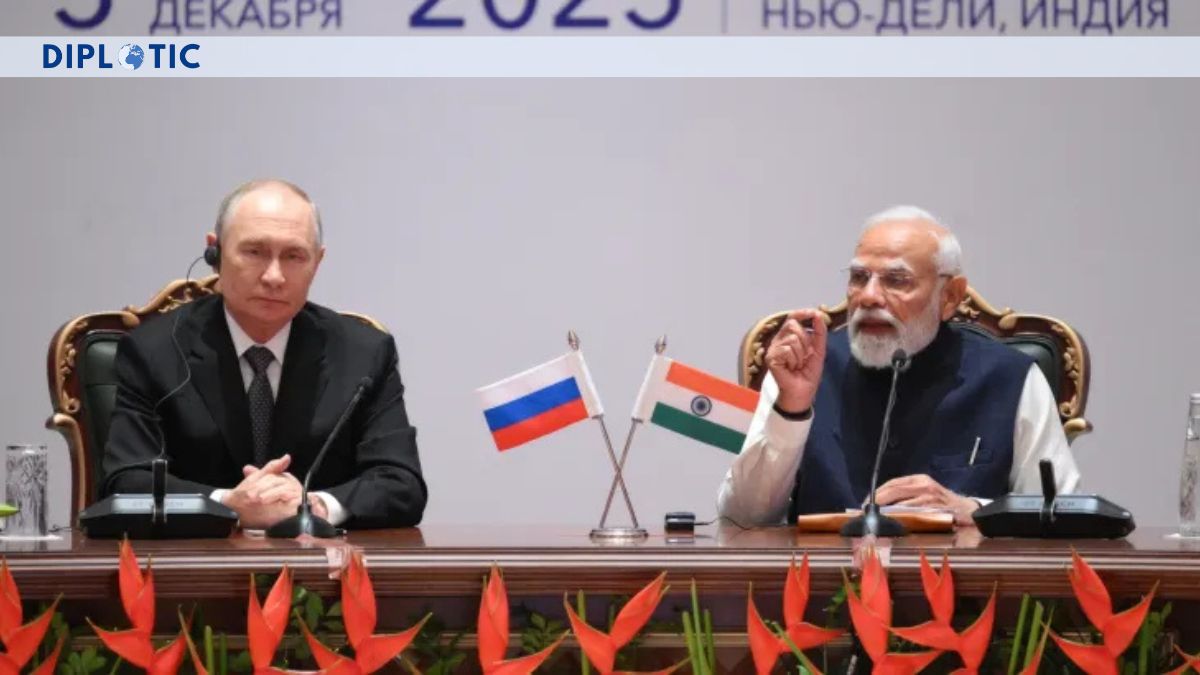
Putin made his first visit to India in December 2025 since the start of Russia’s war in Ukraine. The visit occurs amid intense Western (especially U.S.) pressure on India over its accumulation of discounted Russian oil and defense ties with Moscow. Thus, the 2025 visit is not just ceremonial; it is a strategic act aimed at reaffirming Russia’s relevance, securing economic lifelines, and hedging against diplomatic isolation.
What Putin Wants and What Russia Needs
In the meeting, Putin pledged an uninterrupted fuel supply to India. Besides this, he also reassured New Delhi that Russian energy remains reliable despite sanctions. Both leaders agreed to expand trade beyond energy and defense by 2030 in order to reach a bilateral trade volume of $100 billion USD. Moreover, they are keen to rebalance trade, as Russia currently runs a large trade surplus (mostly in energy), while India seeks better access for its exports to Russia. In this way, Russia is trying to counter Western sanctions by preserving Moscow’s economic resilience.
However, analysts said that the summit was more important as a show of political messaging. According to Harsh Pant, a geopolitical analyst, the biggest takeaway from the summit is the signaling that neither side has any intention to dilute this relationship and is ready to withstand any external pressures.
Moreover, Pant also said that the attempt is to build an economic partnership beyond oil and defense. Robinder Sachdev, president of the Imagindia Institute, said that the summit holds extreme importance due to the greater willingness on the part of both Russia and India to “turbocharge” this relationship. He also noted that both sides want to increase their engagement beyond just government-to-government deals in the oil and defense sectors and boost people-to-people ties.
After the media statements, the leaders did not take any questions. The session concluded with Putin saying that the Russian delegation was pleased with agreements that will “deepen” the bilateral partnership. Besides this, Modi stated that both sides are working towards the early conclusion of a Free Trade Agreement.
Defense and Security Collaboration
Increasing connectivity between Moscow and New Delhi is a major priority for us, noting that energy security has been a strong and important pillar of bilateral relations. Strengthening and advancing defense and military-technical collaboration was also key.
Among both leaders, one of the most important discussions happened on defense cooperation. Most importantly, they discussed cooperation on a second nuclear power plant with Russian-designed reactors in India, and the modernization of Indian forces (fighters, air defense) with Russian technology. As India has long depended on Russian arms and technology, this builds a long-term strategic presence in regions outside Europe.
Geopolitical Pivot
In the face of the protracted war in Ukraine, Russia is reorienting toward Asia and Global South partners. India, with its economy, population, and strategic weight, is central to that pivot. For Russia, long-term survival amid sanctions and conflict depends on global diversification. India helps provide strategic depth outside the European theatre. Cooperation in areas such as nuclear energy, defense production, and technology opens pathways for Russia to remain relevant globally.
Strategic Vulnerabilities and Challenges
While the visit and agreements show promise, multiple risks remain:
Sanctions and Secondary Pressure: The first risk involves Western sanctions and tariffs on India, which create economic and reputational costs. Deepening dependence on Russian energy may jeopardize India’s Western trade goals.
Balancing China: The second challenge is the balance with China. India must juggle its relations; stronger Russia ties may complicate its ties with China, especially if Russia-China competition intensifies over Central Asia or maritime influence.
Domestic Political Backlash: The third risk is domestic political backlash. In India, stronger ties with Russia, at a time when Russia is at war and under global condemnation, may provoke domestic debate about moral and geopolitical alignment.
Economic Volatility: The last risk is economic volatility. Energy and oil markets are volatile; long-term deals can become burdens if global market shifts occur.
Conclusion
Putin’s 2025 visit to India is more than a summit. It is a calculated strategic maneuver. For Russia, it revives an essential global partnership, helps circumvent isolation, and invests in long-term multipolarity. For India, it offers access to energy, defense technology, and economic cooperation while asserting its traditional strategic autonomy