An Investigation Into a Narrative of Geopolitical Supersession
A bold strategic claim has emerged in international diplomacy and economic analysis following the announcement of the India-Middle East-Europe Economic Corridor (IMEC) at the 2023 G20 summit. Proponents and observers frequently assert that this new initiative, backed by the United States, the European Union, India, Saudi Arabia, and the UAE, is designed to—and will—“end China’s Belt and Road Initiative (BRI).” This framing sets up a direct, winner-take-all clash between two visions of Eurasian connectivity. But does this binary narrative hold up under scrutiny, or does it oversimplify the complex realities of global infrastructure, finance, and statecraft? This investigation will dissect the claim by comparing the projects’ structures, examining their distinct objectives, and assessing the realistic prospects of one initiative negating the other.
The context is a world increasingly defined by strategic competition and the quest for economic influence. China’s decade-old BRI has become synonymous with large-scale, debt-financed infrastructure across the Global South, generating both tangible projects and significant controversy over debt sustainability and political leverage. The announcement of IMEC is widely seen as a Western and partner-led response, aiming to present an alternative model. Evaluating the claim requires moving beyond geopolitical theatre to analyze implementation, economic logic, and the multifaceted nature of global development.
Claim 1: “IMEC is a direct and superior replica of the BRI, designed to replace it.”
This claim frames IMEC as a like-for-like competitor that outperforms the BRI on its own terms of building cross-continental trade routes.
The Investigation:
While both are transnational connectivity projects, their core designs and immediate objectives differ fundamentally.
- BRI (2013-Present): This is a sprawling, decentralized umbrella for Chinese-financed infrastructure projects—ports, railways, power plants—across over 150 countries. It is project-led and finance-heavy, often involving direct loans from Chinese policy banks to host governments, with construction typically awarded to Chinese state-owned enterprises. Its geography is global, with a heavy focus on Africa, Central Asia, and Southeast Asia.
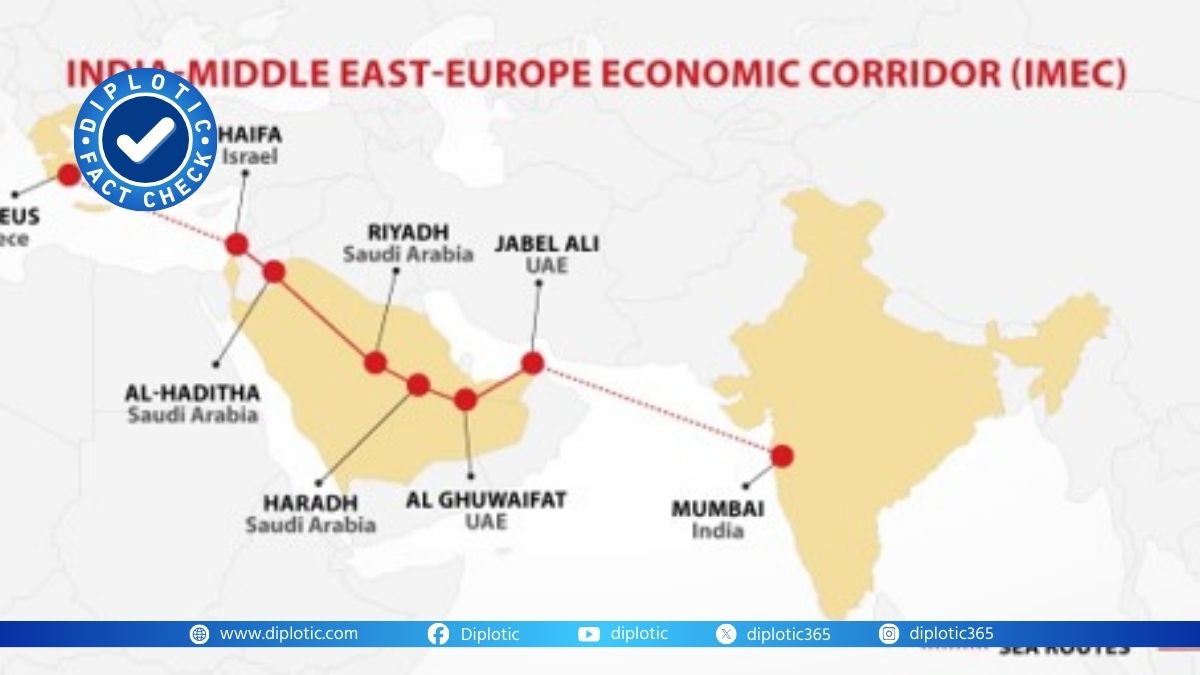
- IMEC (Announced 2023): This is proposed as a tightly coordinated, multi-modal corridor with two primary segments: an eastern maritime link from India to the UAE, and a northern rail link from the UAE through Saudi Arabia, Jordan, and Israel to Europe. Its stated emphasis is on “hard” infrastructure (rail, ports) integrated with “soft” digital and green energy infrastructure. Crucially, its financing model is envisioned as a public-private partnership, relying heavily on attracting Western and Gulf private capital, multilateral development banks, and host-country investment.
IMEC is not a replica; it is a deliberate contrast. It promotes an alternative governance and finance model emphasizing transparency, sustainability, and private sector participation, explicitly countering criticisms of the BRI’s debt-trap diplomacy and environmental standards. However, this model is also more complex to orchestrate among numerous sovereign partners with differing regulations.
Verdict: Misleading.
IMEC is conceived as a strategic counterweight and an alternative model, not a direct replica. Its success is not predicated on replicating BRI’s scale but on demonstrating a different, arguably more sustainable, approach to connectivity. Declaring it a “superior replica” misreads its fundamental architecture and the nature of the competition.
Claim 2: “IMEC’s geography deliberately bypasses and isolates China, cutting it out of key trade flows.”
This claim suggests the corridor’s primary purpose is strategic containment, rerouting Eurasian trade away from Chinese-dominated pathways.
The Investigation:
The map of IMEC is indeed significant. It creates a southern corridor that connects India to Europe via the Arabian Peninsula, circumventing traditional routes that either go through Chinese territory (the ancient Silk Road) or through its strategic investments (like Pakistani ports under the China-Pakistan Economic Corridor, CPEC).
The strategic intent is clear: to enhance the connectivity and economic integration of a coalition of like-minded partners (India, Gulf states, Europe, the U.S.) while providing an alternative for trade and energy flows that might otherwise be reliant on routes influenced by Beijing. It strengthens the economic axis between India and the Gulf, two rapidly growing regions.
However, the claim of “cutting China out” is an overstatement. Global trade is not a zero-sum switch that flips from one corridor to another; it is additive and multimodal. The BRI has created substantial physical infrastructure; goods can flow through multiple routes. Furthermore, China remains the EU’s and many Asian nations’ top trading partner. IMEC may provide an additional, competitive option, reducing but not eliminating reliance on China-centric routes. It seeks to diversify, not wholly replace, existing networks.
Verdict: Partially True, but Overstated.
The route has clear strategic diversification aims and reduces relative dependence on China-influenced transit corridors. However, it cannot “isolate” the world’s manufacturing hub and a continental power. Its effect will be to rebalance, not replace, Eurasian connectivity.
Claim 3: “IMEC’s ‘high standards’ model will automatically attract nations disillusioned with BRI debt.”
This claim assumes that the alleged superiority of IMEC’s transparent, green, and privately-financed model will cause a stampede away from Chinese financing.
The Investigation:
This claim tests a core hypothesis of the Western alternative: that “quality infrastructure” will outcompete “cheaper, faster” BRI projects. The reality is more nuanced.
- The Appeal of Speed and Sovereignty: BRI projects are often attractive because Chinese banks can approve large loans quickly, with fewer political conditionalities related to governance reform compared to Western institutions. For leaders facing urgent infrastructure gaps, this is a powerful draw, despite long-term debt risks.
- The Challenge of IMEC’s Model: Coordinating multiple democracies and monarchies, aligning regulatory standards, conducting lengthy feasibility studies, and securing returns for private investors is a slower, more complex process. The 2023-2024 Gaza conflict has already highlighted the geopolitical fragility of the proposed corridor’s northern land route through Jordan and Israel, demonstrating a key vulnerability.
- Pragmatic Hedging, Not Ideological Choice: Many developing nations, including potential IMEC participants like the UAE and Saudi Arabia, practice “multi-alignment.” They are actively engaged with both initiatives—taking BRI investments while also partnering in IMEC. They seek the best deal for specific projects, not an exclusive ideological allegiance. The choice is often “both/and,” not “either/or.”
Verdict: Uncertain and Overly Simplistic.
While the high-standards model has moral and theoretical appeal, its practical ability to outcompete the BRI is unproven. It faces significant challenges in speed, complexity, and geopolitical stability. Nations are likely to continue engaging with both, using IMEC as leverage for better terms from China, rather than making a wholesale switch.
Claim 4: “The very announcement of IMEC has already diminished the BRI’s global standing and influence.”
This claim assesses the symbolic and perceptual impact, arguing that the launch of a rival project alone constitutes a major defeat for the BRI.
The Investigation:
The announcement of IMEC was undoubtedly a geopolitical signal of the first order. It demonstrated an ability by the U.S., EU, and partners to coordinate a grand strategic vision and secured buy-in from key Gulf states. This challenged the narrative that China was the only game in town for large-scale infrastructure visioneering.
However, the BRI is a ten-year-old, operational reality with hundreds of completed projects. IMEC remains, as of mid-2024, a memorandum of understanding and proposed map. Its impact on BRI’s standing is therefore currently more psychological than material.
The greater impact is in shaping the future framework of competition. IMEC has:
- Cemented connectivity as a central arena for U.S.-China rivalry.
- Potentially raised the bar for future infrastructure discussions, pushing the BRI and other initiatives to more openly address sustainability and debt concerns.
- Validated the strategic importance of the India-Gulf economic axis.
It has not, however, cancelled existing BRI contracts, halted ongoing projects, or recovered loans. The BRI’s “standing” has been complicated and challenged, not ended.
Verdict: Misleading.
While IMEC has shifted the geopolitical narrative and introduced a competing vision, declaring it has already materially diminished the BRI confuses a powerful announcement with on-the-ground reality. The BRI retains massive entrenched influence. IMEC’s success in altering that will depend entirely on its execution over the coming decade.
Conclusion: A Marathon, Not a Knockout Blow
The claim that the “India-Middle East-Europe Corridor will end China’s Belt and Road” is False as a near-term proposition and Misleading as a strategic certainty. It mischaracterizes a nascent, alternative-model initiative as a ready-made replacement for a vast, entrenched network.
The more accurate description is that IMEC inaugurates a new and enduring phase of systemic competition in global infrastructure development. It represents not an ending, but the start of a long-term contest between different models of finance, governance, and strategic alignment. The BRI will not be “ended” by a declaration, but it may be shaped, constrained, and compelled to adapt by the presence of a credible alternative.
The real test lies ahead: in laying the first mile of track, securing the first private-sector financing package, and navigating the first regional political crisis. IMEC’s ultimate impact will be determined not by its elegant maps announced at summits, but by its ability to demonstrate that its model can deliver tangible, profitable, and sustainable connectivity in a complex world. Until then, it remains a powerful counter-narrative and a promising blueprint—but not a proven successor.