

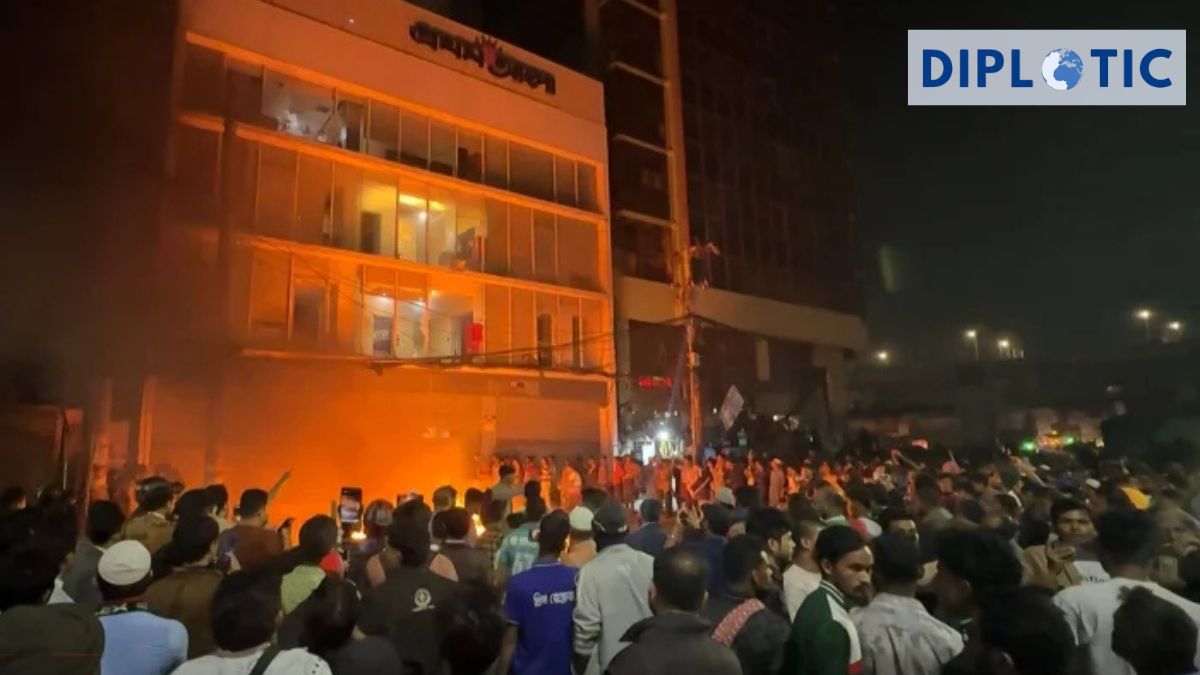
Violent attacks on the offices of two of Bangladesh’s leading newspapers, Prothom Alo and The Daily Star, following the reported death of Inquilab Mancha spokesperson Osman Hadi, have intensified concerns about press freedom and political stability ahead of the national election scheduled for February.
The incidents involving vandalism and arson occurred within hours of the news of Hadi’s death circulating online. At the time, authorities had not released a confirmed account of the cause of death, nor had any official investigation findings been made public. Yet social media platforms were already flooded with accusations, speculation, and emotionally charged narratives targeting sections of the media.
A Rapid Escalation
The speed with which anger translated into organized violence has prompted questions about whether the attacks were spontaneous or coordinated. Witness accounts and video footage shared online suggest groups assembled quickly, chanted similar slogans, and dispersed soon after the attacks, a pattern analysts say merits closer scrutiny.
Security officials have not publicly detailed whether the perpetrators were identified or how the attacks were logistically carried out. The absence of timely, transparent information has fuelled further speculation, complicating efforts to separate verified facts from rumors.
The Role of Online Narratives
In the hours following Hadi’s death, commentary from prominent online political commentators gained traction across Facebook and YouTube. While none issued explicit calls for violence, their rhetoric was sharply critical of mainstream media, portraying certain outlets as hostile actors rather than neutral observers.
Media analysts warn that such framing can have real-world consequences. “When journalism is cast as an enemy, it lowers the threshold for attacks on reporters and newsrooms,” said one Dhaka-based media researcher, speaking on condition of anonymity.
Whether these narratives directly influenced the violence remains unproven, but investigators are under pressure to examine how online mobilization intersected with events on the ground.
Election Context
The attacks come at a sensitive political moment. With national elections approaching, Bangladesh is already experiencing heightened political polarization. Historically, periods leading up to elections have seen spikes in unrest, often accompanied by attempts to discredit institutions seen as shaping public opinion, including the media.
Targeting major news organizations raises broader concerns. Independent media play a critical role in election coverage, voter information, and accountability. Disrupting their operations risks undermining the integrity of the electoral process itself.
Who Benefits?
A key question remains unanswered: who stands to gain from this escalation? The violence has drawn international attention to Bangladesh’s media environment, prompting renewed scrutiny from rights groups and foreign observers. Such attention can affect a country’s democratic image at a critical juncture.
Political observers caution against premature conclusions but note that instability often benefits actors seeking to delegitimize elections, depress voter turnout, or create justification for extraordinary political measures.
Calls for Accountability
Press freedom organizations have condemned the attacks and urged authorities to ensure the safety of journalists and media institutions. They are also calling for a swift, impartial investigation into both the death of Osman Hadi and the subsequent violence.
For now, many questions remain unresolved. Without credible, transparent investigations, analysts warn, misinformation is likely to fill the vacuum, further inflaming tensions.
As Bangladesh moves closer to election day, the handling of this episode may prove decisive. Whether the country can protect its media, uphold the rule of law, and maintain a credible electoral environment is a test not only for the authorities but also for the resilience of its democratic institutions.




