A gripping deep dive into the Maldives’ iconic 2009 underwater cabinet meeting: how it was planned, why it mattered, the global shockwaves it sent through climate politics, and why its legacy remains both powerful and controversial today.
The Maldives has long been held up as a symbol of what the climate crisis threatens to erase. Yet nothing captured this looming danger as vividly as the 2009 underwater cabinet meeting, an event so bold and unexpected that it changed how the world understood the stakes for small island nations. What began as a risky communications experiment soon became one of the most famous climate photographs in history. Sixteen years later, its impact still resonates, raising questions about climate action, political symbolism, and the future of nations disappearing beneath rising seas.
A Nation Running Out of Time: The Urgent Message Behind the Stunt
When Maldivian officials planned the underwater cabinet meeting, the world still debated whether 2°C of warming was the right threshold for climate policy. For the Maldives, that number was a death sentence. With most islands barely one meter above sea level, even small increases in global temperature translate into accelerating and devastating sea-level rise.
The science was already clear by 2009. As oceans warmed and expanded, and as ice sheets melted, projections showed global sea levels could rise by about half a meter by the end of the century. That may seem small, but for the Maldives, with villages, farmland, and critical infrastructure scattered across fragile coral atolls, it represented a point of no return. Flooding would become chronic. Freshwater would turn salty. Storm surges would swallow entire coastlines. Tourism, the backbone of the economy, would collapse.
Shauna Aminath, then deputy undersecretary for policy, remembers the frustration of trying to get the world to take this seriously. “People saw the Maldives as a honeymoon destination,” she later recalled. “They didn’t see families, schools, or futures at risk.”
The global campaign from vulnerable nations, “1.5 to stay alive,” was just beginning to take shape. But numbers alone were not enough. The world needed a picture that made the climate threat human, visual, and impossible to ignore.
Planning the Impossible: How the Cabinet Went Underwater
The idea was revolutionary: have the entire Maldivian cabinet convene on the seafloor, sign a climate declaration underwater, and broadcast it to the world. But the logistics were daunting.
Most ministers had never worn scuba gear. Some had health concerns. All were middle-aged or older. And the press, already tipped off by an early announcement, was gathering in droves. Suddenly the stunt was not just a message—it was a global event.
Training the ministers to dive took months. They had to master skills like hovering, descending safely, and avoiding kicking up sand, which would cloud the water and ruin the shot. Journalists were barred from entering the water to prevent chaos and preserve visibility.
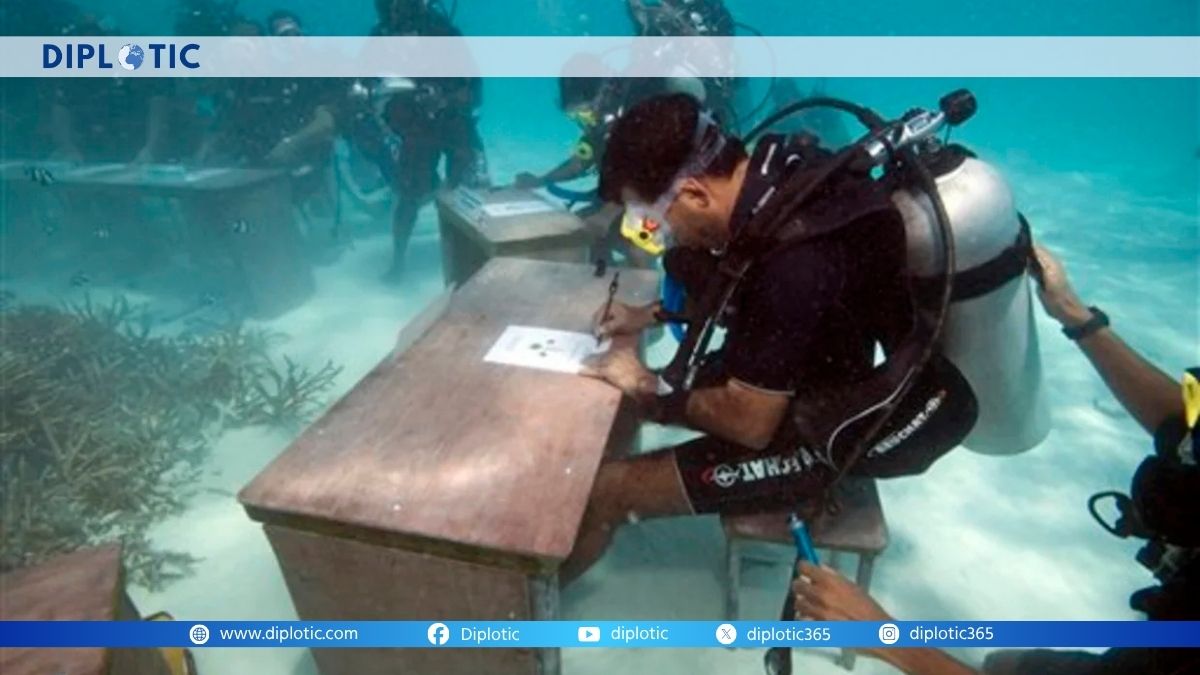
When the day arrived, 17 October 2009, the scene was both surreal and cinematic. Eleven ministers descended to a seabed clearing where tables, nameplates, and chairs had been anchored. Coral framed the meeting space. Schools of fish drifted through. Ministers used hand signals and waterproof slates to communicate. When they resurfaced, they had signed a document urging world leaders to lower carbon emissions.
President Mohamed Nasheed delivered the message bluntly:
“If we cannot save the Maldives today, we cannot save the world tomorrow.”
The photograph of blue water surrounding suited officials seated at a coral table spread across front pages worldwide. News broadcasters replayed the footage for days. The world finally saw climate change not as an abstract threat, but as a story about people fighting for survival.
A Legacy of Power and Controversy
The underwater meeting reshaped global climate communication. For years, climate imagery focused on melting glaciers and stranded polar bears, distant symbols, emotionally powerful but disconnected from human experience. The Maldives forced a shift. Climate change became about communities, cultures, and nations on the brink.
The stunt also inspired others. Nepal held a cabinet meeting on Mount Everest to highlight melting glaciers. Tuvalu’s foreign minister delivered a speech knee-deep in seawater in 2021. The message was clear: climate change is already altering lives.
But the image carried contradictions. Climate law experts later pointed out that the Maldives was simultaneously expanding its international airport to accommodate millions more tourists. Aviation drives roughly 4% of global warming. Critics wondered: Could a nation dependent on long-haul travel also claim moral authority on climate?
The tension highlighted a deeper global truth: small island states are both victims of climate change and participants in a global economy built on emissions-intensive industries. The Maldives’ underwater meeting symbolized their desperation but also the complexity of real climate politics.
Did the Stunt Change Global Climate Policy? Experts Say Yes
Climate scientist Joeri Rogelj, who later served on the scientific review team comparing 1.5°C and 2°C warming outcomes, says the image helped make the lower target central to global negotiations. It humanized the issue, making “1.5°C” more than a technical benchmark; it became a moral threshold.
Two years after the photograph, at COP16 in Cancun, countries agreed to study the impacts of 1.5°C warming. The findings were alarming:
“2°C is not safe,” Rogelj explains. “It is a line we should stay as far away from as possible.”
By 2015, at the landmark Paris Agreement, 1.5°C became an official global target, the most ambitious climate goal ever adopted. Many observers credit the Maldives for helping to push that outcome into mainstream global policy.
Today, however, the world is racing past that line. Current policies project roughly 2.8°C of warming by 2100. And 2024 became the first year in recorded history to exceed 1.5°C of warming over a full calendar year, even though the threshold is only officially crossed when long-term averages pass it.
The Maldives’ original warning is now unfolding in real time.
The Picture That Forced the World to Look
Sixteen years after the Maldives plunged its cabinet underwater, the photograph remains one of the most iconic images in climate history. It was a dramatic, strategic, and deeply human message from a nation facing extinction to a world still debating its responsibilities.
Its legacy is both celebrated and questioned, yet its impact is undeniable. It changed how climate change was communicated. It helped push the 1.5°C target into global policy. And it forced millions to confront a future they had never imagined.
The underwater meeting was never just a stunt. It was a warning.
And today, as seas rise and global temperatures climb, that warning feels more urgent than ever.