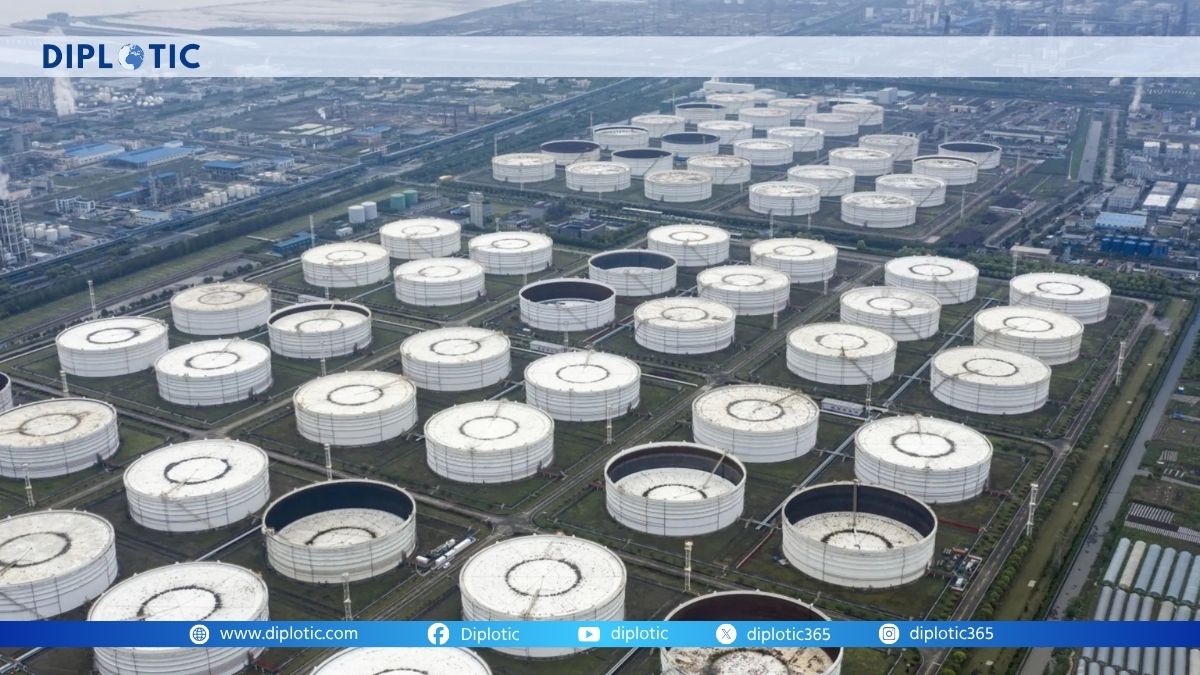
After Russia’s and Ukraine’s war invasion started, China started to build oil reserve sites at a rapid speed as part of a campaign to boost crude stockpiles. According to public sources, Chinese oil companies such as Sinopec and CNOOC will add at least 100 million barrels of storage across 11 sites by 2025 and 2026. Its oil demand increased by 8 more than 50% between 2023 and 2023, with an average annual increase of 542,000 barrels per day. According to Beijing’s reserve-building, S&P Global Commodity Insight predicted that China had stockpiled an average of 5,130,000 barrels per day last month in 2023. According to the traders, the stockpiling pattern by prices recently below $70 per barrel is an order that will be continued until first quarter of 2026.
China’s dependency on foreign oil
According to the data, China imported 11.1 million barrels per day in 2023; that is 74 percent of the country’s external oil consumption. China imports two-thirds of its crude oil from five of the largest countries, like Russia, Saudi Arabia, Malaysia, Iraq, and Oman. Again, according to the data, China imported 90% of its crude oil last year by sea. The remainder arrived by land from Russia, Kazakhstan, and Mongolia. Among this 70%, China imported almost 25% of crude oil from Russia.
Because of US and Western sanctions over Venezuela and Iran, China is using its third largest oil supplier, Malaysia, as a medium to buy oil from those countries. Again, after US and Western sanctions over Russia, China started to import oil from Russia in cheap price.
China’s Oil Supply Security
China’s oil supply security dependent on import that is concerned by Beijing. Xi Jinping who is China’s supreme leader has expressed concern over China’s dependence on imported oil in recent years. In 2023, while visiting Shengli oilfield, he pointed that the other to bolstering China’s oil supply securities lies in expanding domestic output. According to data, he told oil workers that “oil and energy construction is very important to our country. As a major manufacturing power, China has to secure its energy supply in its own hand.” He also added that “solving the core demand for oil and gas is an important task we face.” China produced 233 million tons of crude oil in 2023 that is almost equalling the historical peak of peak 235 million tons in 2015. Then China’s national oil companies developed their first-ever seven-year action plans to increase domestic reserves and production for the period 2019-2025. At that time, the companies invested heavily in exploration and production that helps of China’s oil output to grow by almost 500,000 bpd.
Energy and Modern Warfare
Energy matters greatly in a new era of industrial warfare. Russia’s massive strike campaign against Ukraine’s electricity and gas systems affirms their strategic “importance to kyiv’s war fighting capacity.” Killing technologies have involved dramatically over the past 80 years, but physical raw material balances needed to sustain industrial war have not changed substantially. So, China started to solve their energy problem by stockpiling crude oil.
Lessons from Recent Wars
Two primary lessons jump out. First, for energy storage infrastructure underground = survivable. Russia’s strike campaign against Ukrainian underground gas storage infrastructure has been far less impactful than attacks on exposed power grid and generation assets. Second, in perhaps the most graphic display of how using the “fourth dimension” of underground facilities wartime survival, Hamas has retained a meaningful degree of military capability and continues fighting despite an Israeli air campaign whose strike density is among the most intense in history.
Chinese energy planners were already working to expand underground storage for both crude oil and natural gas. The two ongoing wars will intensify the push given the lesson that underground storage supercharges survivability. Underground oil storage also frees up surface land for other uses in high value, crowded coastal zones, has lower operational costs over time and enjoy longer service life and a lower maintenance burden. Chinese firms are working to build underground gas storage in salt domes near Jintan in Jing Jiangsu Province. Chinese sources have previously discussed storing crude oil in that area, but it is unclear whether firms are presently seeking to build underground salt dome crude storage there now.