

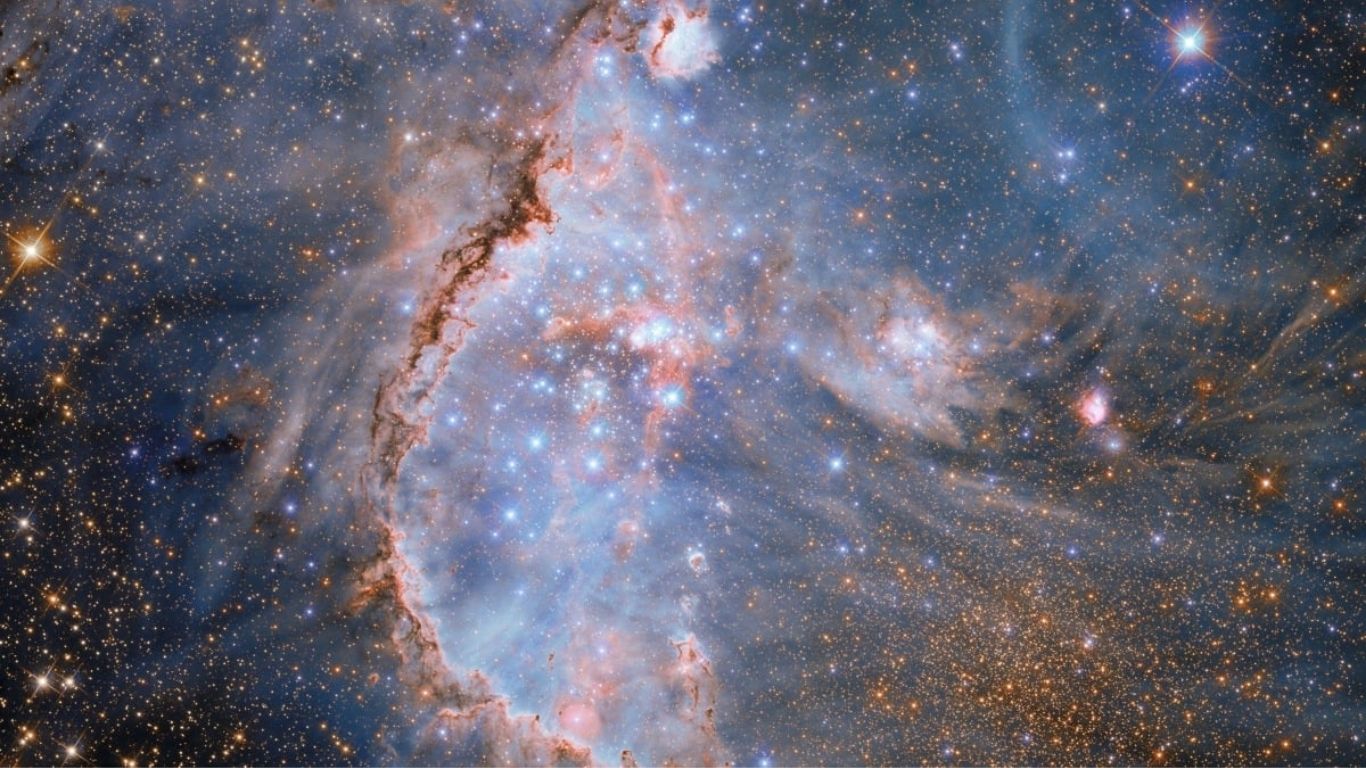
In the grand stage of the universe, every galaxy tells a story, some loud and fiery, others gentle and ancient. Recently, the NASA/ESA Hubble Space Telescope turned its gaze toward a mesmerizing spiral galaxy named NGC 6000, and what it saw was nothing short of breathtaking: a cosmic canvas where old and new stars collide in color.
Located about 102 million light-years away in the constellation Scorpius, NGC 6000 appears like a swirl of gold and sapphire. At first glance, it’s simply beautiful. But to astronomers, that blend of colors speaks volumes a tale of time, evolution, and the ceaseless rhythm of the cosmos.
A Symphony of Color and Time
In Hubble’s image, the golden core of the galaxy glows with the soft light of old, cooler stars that have been burning for billions of years. Surrounding it, the blue-tinted spiral arms shine with the brilliance of young, massive stars, hot, short-lived, and born from swirling clouds of gas and dust.
Those contrasting hues aren’t just artistic touches; they’re astrophysical signatures. The yellow center tells the story of maturity and calm, while the blue spirals hum with the energy of youth and chaos. Together, they form a living portrait of creation and decay, a delicate balance of endings and beginnings. It’s almost poetic: the heart of NGC 6000 carries the wisdom of ancient stars, while its arms dance with the light of fresh cosmic life.
Traces of Ancient Explosions
This galaxy has also witnessed moments of incredible violence. Astronomers have recorded two supernovae within NGC 6000 SN 2007ch and SN 2010as. These were once massive stars that reached the end of their lives in spectacular explosions, briefly outshining the entire galaxy before fading into ghostly remnants.
Hubble’s sharp vision still picks up faint traces of these events. Such remnants aren’t just beautiful leftovers; they are scientific gold mines, offering clues about the mass, age, and composition of the progenitor stars. Their explosions scattered heavy elements like carbon, oxygen, and iron that later became the building blocks of new stars, planets, and perhaps even life itself.
A Tiny Asteroid’s Big Entrance
Not everything in this image lies millions of light-years away. Look closely, and you’ll notice thin streaks crossing the frame trails left by a small asteroid from our own Solar System that happened to pass through Hubble’s line of sight during observation.
Because Hubble captures several exposures through different color filters, the asteroid’s movement shows up as multiple colored streaks. In a way, it “photobombed” this intergalactic masterpiece a playful reminder that even as we study distant galaxies, we’re still part of a vibrant and moving neighborhood of our own.
Building on Centuries of Curiosity
This image of NGC 6000 stands as part of a much larger human story one that began centuries ago with simple telescopes and boundless curiosity. In the 17th century, Galileo Galilei first pointed his telescope toward the Milky Way and discovered it was made up of countless stars a revelation that forever changed our understanding of the night sky. Then, in the 1920s, Edwin Hubble, using the Hooker Telescope at Mount Wilson Observatory, proved that galaxies like NGC 6000 are “island universes” beyond the Milky Way vastly expanding our view of the cosmos. His discovery paved the way for the space telescope that now bears his name. Later experiments like COBE (1989) and WMAP (2001) mapped the cosmic microwave background the faint afterglow of the Big Bang helping scientists understand how galaxies formed from tiny ripples in the early universe. And since its launch in 1990, the NASA/ESA Hubble Space Telescope has carried that legacy forward, revealing not only the structure of galaxies but the evolving story of the universe itself. Each of these experiments adds a verse to the same cosmic poem one written in light, data, and wonder.
A Universe Still Writing Its Story
At first glance, Hubble’s image of NGC 6000 might look like a simple photograph, but it’s far more than that. It’s a time capsule of cosmic evolution, capturing billions of years of history, the birth and death of stars, and even the passing wink of a nearby asteroid. It’s a reminder that the universe isn’t frozen in time it breathes, moves, and transforms. Old stars fade, new ones ignite, and galaxies like NGC 6000 become bridges between the past and the future. As Hubble continues to peer into the cosmos alongside its successor, the James Webb Space Telescope, each new image deepens our understanding of how the universe lives, grows, and dreams.
And perhaps most beautifully, it reminds us that even in the vast silence of space, the story of light never truly ends.




