

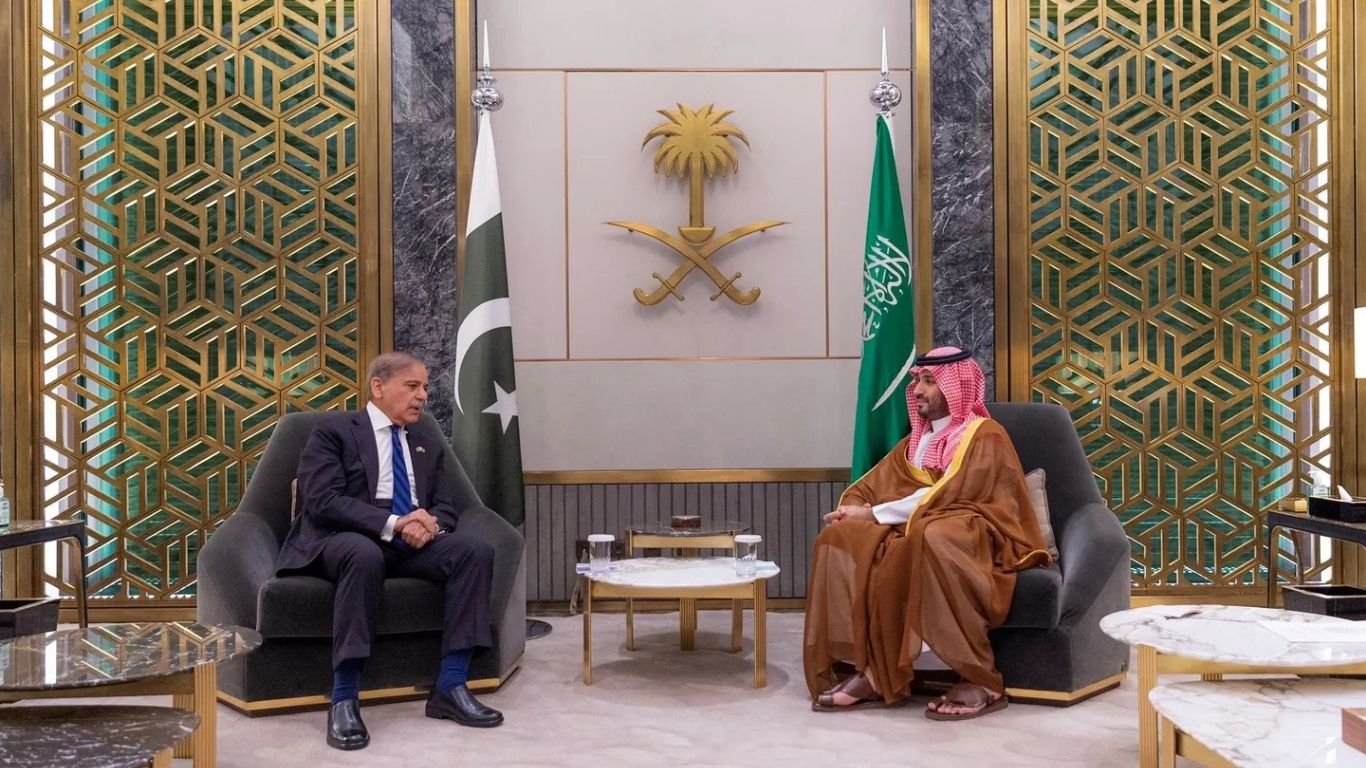
In a development that could reshape South Asian and Middle Eastern geopolitics, Pakistan and Saudi Arabia have officially signed a mutual defense treaty. The agreement marks a significant milestone in the already strong bilateral ties between Islamabad and Riyadh, raising critical questions about regional security dynamics and the potential implications for India.
The Defense Treaty: What It Means
According to official statements, the Pakistan-Saudi Arabia defense treaty covers joint military cooperation, intelligence sharing, defense technology transfer, and coordinated efforts against external threats. The pact emphasizes mutual assistance in times of conflict, essentially binding both nations to come to each other’s aid in the event of a security crisis.
For Pakistan, this treaty secures a powerful regional ally with vast financial resources and growing military ambitions. For Saudi Arabia, it brings the strategic advantage of Pakistan’s battle-hardened military, nuclear expertise, and defense production capabilities. Together, the two countries aim to create a framework of deterrence that could shift the balance of power in the broader region.
Why Now? Timing and Strategic Motives
The timing of this pact is particularly significant. The Middle East is undergoing rapid change with the realignment of alliances, ongoing tensions with Iran, and uncertainty in global energy markets. Saudi Arabia, long dependent on Western defense support, is now diversifying its security partnerships. Pakistan, struggling with economic instability and seeking fresh strategic leverage, sees Riyadh’s embrace as both a financial lifeline and a geopolitical win.
The treaty also comes as both countries attempt to counter growing regional rivalries. For Riyadh, it’s about reducing reliance on Washington and asserting greater autonomy in defense affairs. For Islamabad, it’s about consolidating ties with a wealthy ally who can provide both military funding and political cover on international platforms.
India’s Perspective: A Growing Security Concern
For India, the Pakistan-Saudi defense pact could represent a new strategic challenge. India has long monitored Pakistan’s military partnerships with close scrutiny, particularly when they involve financial backing and advanced technology transfers. The addition of Saudi Arabia a country with deep pockets and strategic influence complicates the calculus.
New Delhi’s concerns are threefold:
Enhanced Military Capabilities: Saudi funding could boost Pakistan’s defense modernization programs, particularly in missile systems, drones, and advanced weaponry.
Geopolitical Alignment: A stronger Pakistan-Saudi bloc could undermine India’s efforts to court Gulf states as economic and security partners.
Nuclear Dimension: Although not officially part of the treaty, analysts worry about the long-speculated Saudi interest in Pakistan’s nuclear expertise. Even a symbolic association raises alarm in New Delhi.
Regional Repercussions
The defense pact is likely to intensify strategic competition in South Asia and the Gulf. Iran, Saudi Arabia’s long-time rival, will view this development with suspicion, especially given Islamabad’s proximity and military ties to Riyadh. Tehran may deepen its cooperation with India, seeing New Delhi as a balancing force against a Pakistan-Saudi axis.
Other Gulf nations, particularly the United Arab Emirates and Qatar, will also be watching closely. The Gulf region has traditionally been a battleground of influence, and a solidified Pakistan-Saudi military alliance could disrupt existing power equations.
The Economic Dimension
Beyond the military angle, the treaty also opens doors for stronger economic cooperation. Saudi Arabia has already pledged billions in investments in Pakistan’s energy and infrastructure sectors. Tying military cooperation to economic aid makes the relationship more comprehensive and less transactional.
Pakistan, grappling with financial instability, inflation, and IMF pressure, will welcome Saudi investments as a stabilizing factor. Riyadh, in turn, secures a reliable military partner at a time when its Vision 2030 agenda aims to reduce dependency on oil revenues and build a diversified, modern economy backed by strong security foundations.
How India May Respond
India has several potential strategies to counterbalance the Pakistan-Saudi defense pact:
Deepening Ties with Gulf States: India may intensify partnerships with the UAE, Oman, and Qatar to offset Pakistan’s influence in the Gulf.
Strengthening Defense Posture: Accelerating indigenous defense production, acquiring advanced systems, and enhancing border security with Pakistan.
Expanding Strategic Partnerships: Leveraging ties with the United States, France, and Israel to deter any aggressive posturing by Pakistan.
Engagement with Iran: Strengthening India-Iran relations, particularly in the Chabahar Port project, could counterbalance the Saudi-Pakistan nexus.
The Global Context
The defense treaty also reflects broader shifts in global geopolitics. With Washington recalibrating its role in the Middle East and China’s growing footprint in both South Asia and the Gulf, Pakistan and Saudi Arabia are hedging their bets. Beijing, already a major investor in Pakistan through the China-Pakistan Economic Corridor (CPEC), may quietly support this new alliance as it undermines U.S. influence in the region.
Russia, too, may see opportunities in the evolving security dynamics. As Moscow deepens ties with both Tehran and Riyadh, the Pakistan-Saudi pact adds another layer of complexity to the already intricate web of alliances.
Public Opinion and Political Fallout
In both Pakistan and Saudi Arabia, the treaty is being celebrated as a step toward greater self-reliance and regional leadership. However, in India, the announcement is likely to fuel political debates about national security preparedness. Opposition parties may use the development to criticize the government’s foreign policy, pushing for stronger action to safeguard India’s interests.
Global public opinion may remain divided. While some view the treaty as a stabilizing measure, others see it as an escalation that could heighten tensions in already volatile regions.
Conclusion: A Game-Changer with Uncertain Outcomes
The Pakistan-Saudi Arabia mutual defense treaty is a landmark development with far-reaching implications. For Islamabad, it provides strategic depth and much-needed economic backing. For Riyadh, it ensures access to a reliable military partner as it navigates uncertain regional waters. For India, however, it introduces a new variable into an already complex security environment.
Whether this alliance becomes a stabilizing force or a destabilizing factor depends on how the involved nations manage their commitments and interactions with other powers. What is undeniable is that this pact has injected fresh uncertainty into South Asia and the Middle East, making it one of the most closely watched geopolitical developments of the year.




