

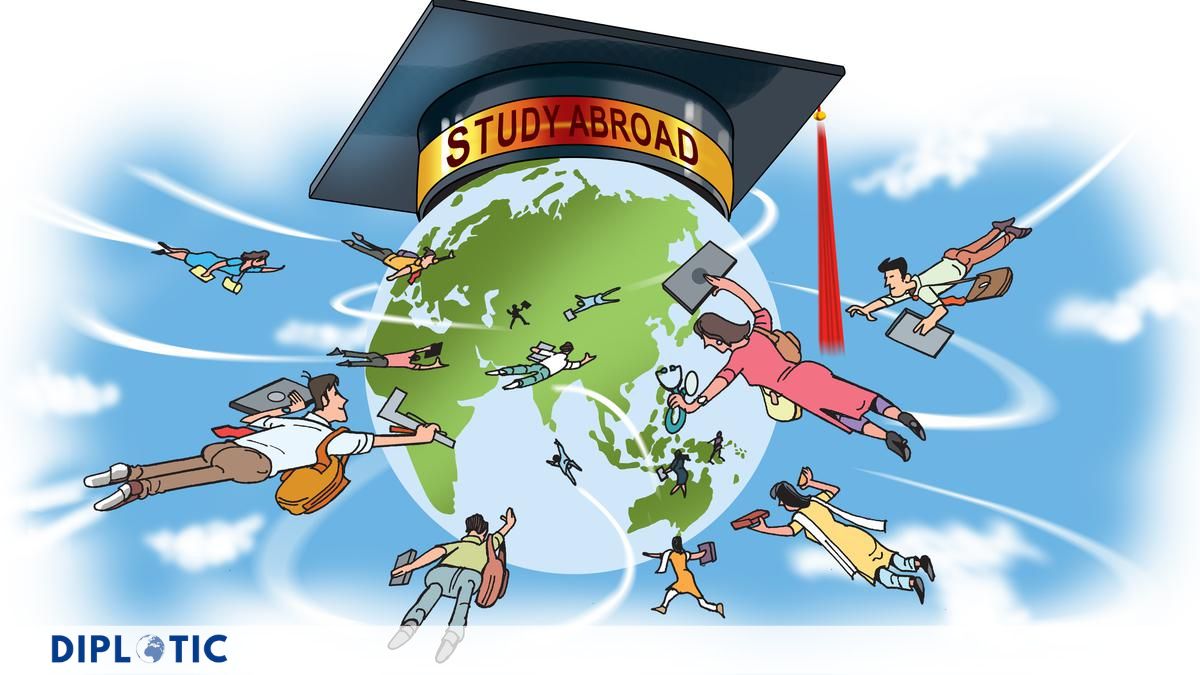
The Erosion of the Anglosphere’s Academic Monopoly
For decades, the dreams of Indian students were tied to a narrow corridor of destinations: the United States, the United Kingdom, Canada, and Australia. These countries became the default choices for higher education abroad, offering strong institutions, job opportunities, and the prestige of globally recognized degrees. But the gatekeepers of this system have shifted their priorities. Immigration laws have hardened. Visa rules once seen as mere formalities have become unpredictable hurdles. Post-study work rights are being cut back, as governments signal to their electorates that international students are no longer a priority. The most dramatic example came in the United States, where the number of Indian student visas fell by nearly 28 percent in 2024, dropping from 354,000 to 255,000 in a single year. Britain, facing similar domestic pressures, issued 10 percent fewer study visas in 2024–25 compared with the year before.
This shift is not a coincidence. It reflects deeper political choices. Western countries are trying to balance their need for skilled workers with voter anxieties about migration. International students, once courted as symbols of global competitiveness, are now treated with suspicion, their presence recast as a burden on housing, healthcare, and jobs. The old promise—that a foreign degree would open doors to settlement and long-term careers in the host country—is now eroding. This erosion creates space for new players.
Into this vacuum steps the United Arab Emirates. Unlike the Anglosphere, the Emirates is not constrained by the same domestic political battles over immigration. It has positioned itself as pragmatic, business-like, and open to those who can contribute. The question now is whether this policy shift marks the beginning of a new education hub for Indian students, one that can challenge the old monopoly of the West.
The UAE’s Bid for Academic Credibility
The UAE has spent the past two decades crafting itself into more than an oil-driven economy. A crucial part of that project has been education. Branch campuses of leading universities—New York University, Sorbonne, Heriot-Watt, and Birmingham, among others—have taken root in Abu Dhabi and Dubai. These are not token outposts. NYU Abu Dhabi functions as a full-service liberal arts university, offering an experience close to its New York campus. Sorbonne’s Abu Dhabi branch teaches humanities and law with French academic rigor. British institutions have focused on business, engineering, and applied sciences. The strategy is clear: import Western credibility, but anchor it in Emirati soil.
The results are showing. Institutions such as Khalifa University have risen in global rankings, moving up 30 places in the Centre for World University Rankings 2025 and securing a top-200 position in the QS World University Rankings 2026. While such rankings can be contested for their methodology, they matter in perception. For students and families in India—who often see higher education as both an investment and a status marker—the signal is unmistakable. A degree from the UAE is not a downgrade. It is increasingly seen as equivalent to a degree from London, New York, or Sydney, only closer and often cheaper.
One cannot underestimate geography in this equation. The UAE sits just three hours away from Indian metros, unlike the long-haul flights to Western campuses. Add to this the sheer scale of the Indian diaspora in the Emirates—about 3.6 to 4 million people, constituting more than a third of the total population—and the picture sharpens. For Indian students, this is not an unfamiliar environment. It is a place where family networks, language comfort, and cultural familiarity make transition easier. For parents, it is a compromise between global education and proximity to home.
Visa Liberalism as Strategy, Not Charity
Where Western governments have made student visas a symbol of restriction, the UAE has chosen the opposite path. It has created a streamlined, predictable, and flexible visa system tailored for students. Work rights are embedded into study permits. Branch campuses report spikes in applications from Indians—53 percent higher at Heriot-Watt Dubai, double at Sorbonne Abu Dhabi—after the Anglosphere tightened its rules. Indian students now account for 42 percent of international enrollments in some Emirati universities.
This surge is not accidental. The Emirates has aligned its visa policies with its labor market needs. Its economy requires a steady inflow of skilled professionals, especially in engineering, technology, and healthcare. Education becomes a pipeline for talent, not a temporary transaction. The Golden Visa program, which offers 10-year renewable residencies for outstanding students and graduates, underscores this approach. Unlike Western systems where students often face years of uncertainty before gaining residency, the UAE frontloads its offer: study here, excel, and the country will keep you.
Dubai’s Post-Graduate Work Permit, introduced in 2024, provides a two-year stay for foreign graduates, further integrating them into the economy. Scholarships, often covering 80–100 percent of tuition, strengthen the appeal. This is less about altruism and more about strategy. The Emirates sees education as a gateway to long-term soft power, a way to bind young, skilled foreigners into its economy and society. It is an investment in human capital, but also in influence. For Indian families weighed down by the costs of U.S. or U.K. education, the proposition is simple: debt-free degrees, global recognition, and real pathways to jobs and residency.
Education as Soft Power and Future Leverage
The Emirates’ education push cannot be separated from its larger geopolitical play. The country ranks tenth in the Global Soft Power Index 2025, a position built not only on its oil wealth and financial hubs but increasingly on cultural, diplomatic, and educational outreach. Hosting branch campuses of elite universities signals to the world that the UAE is not just a transit economy but a knowledge hub. For Indian students, the attraction is clear. But for the Emirates, the payoff is strategic.
By absorbing large numbers of Indian students, the UAE deepens its already vast ties with India. The Indian diaspora there is not just a labor force; it is a political and economic bridge. Education adds another layer. Graduates who build careers in the UAE are more likely to remain tied to its economy, politics, and networks. In the long run, this creates influence that is subtle but powerful. Just as the United States built influence over generations of foreign students who studied at its universities, the UAE may be cultivating its own cohort of global alumni.
There is a paradox, however. While the Emirates offers opportunity, it is still an authoritarian state with restrictions on free expression, academic freedom, and political activity. Students who choose it over the West may gain security and jobs but lose exposure to the free intellectual environment that Western universities, for all their flaws, still embody. This raises a difficult question: will the next generation of Indian professionals educated in the UAE emerge as global leaders with open-world perspectives, or as skilled workers molded within a controlled environment?
The answer may lie in the balance between imported Western academic standards and the political framework of the Gulf. History shows that education hubs often reshape their host societies as much as they serve foreign students. When British universities expanded globally during the colonial period, they exported not only skills but also ideologies, shaping the politics of entire regions. Whether the UAE follows a similar trajectory remains to be seen. What is clear is that in the struggle between restriction and openness, the Emirates has turned higher education into an instrument of statecraft—challenging the West’s hold on the Indian imagination.




