

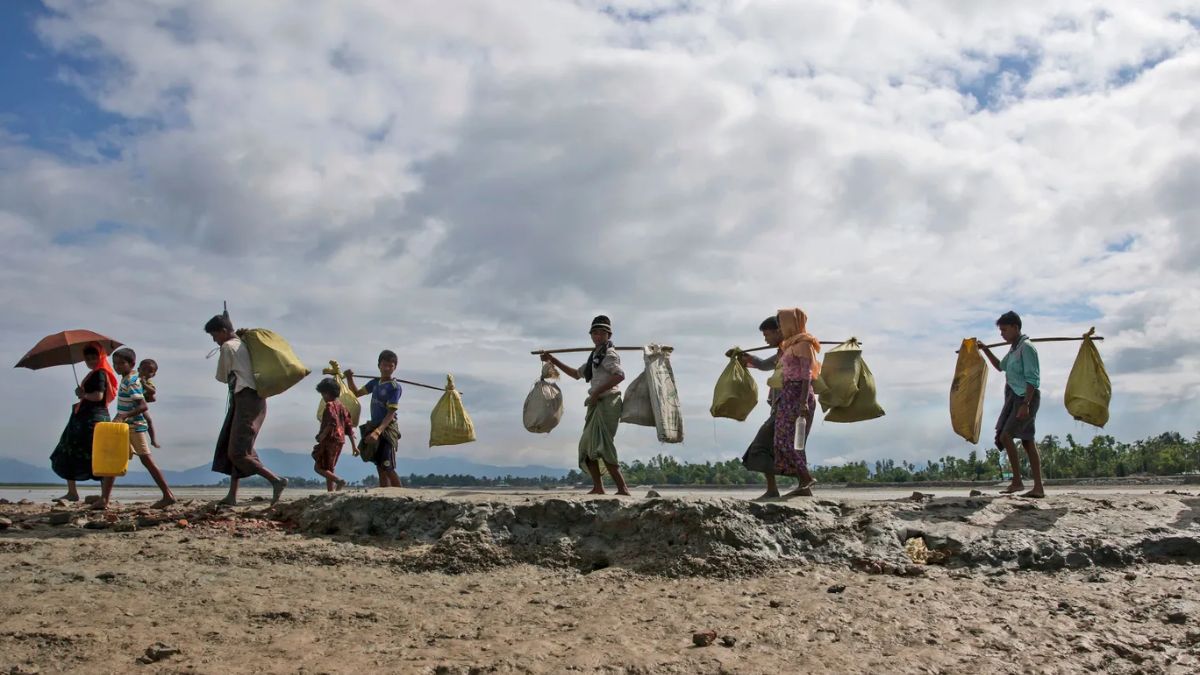
A Humanitarian Catastrophe
For decades, the Rohingya Muslims of Myanmar’s Rakhine State have been subjected to state-sponsored discrimination, deprivation of rights, and military oppression. Since the horrific military campaign of 2017, global media, human rights organizations, and the United Nations have identified it as a planned genocide. Hundreds of thousands have lost their lives, while millions have been forced to take refuge in Bangladesh and other countries. This genocide has repeatedly knocked at the door of the world’s conscience, yet effective actions remain absent.
History of Denial of Citizenship
The Council on Foreign Relations (CFR) reports that in 1982 the Rohingya were stripped of their citizenship under Myanmar’s Citizenship Law.
Human Rights Watch (HRW) notes that since then they have been deprived of education, healthcare, and property rights. By declaring them illegal immigrants, the state attempted to erase the Rohingya identity.
The Deadly Military Campaign of 2017
An investigative report by Reuters revealed that during so-called “clearance operations,” the military burned down villages, committed mass rapes, and indiscriminate killings.
BBC and Al Jazeera described it as “ethnic cleansing.” The United Nations termed it a “textbook example of ethnic cleansing.”
Documented Atrocities and Massacres
Tula Toli Massacre (30 August 2017): According to the BBC, over 500 people were killed and the village destroyed.
Gu Dar Pyin Massacre: Associated Press published photos of mass graves; estimates of the death toll range between 75 and 400.
Maung Nu Massacre: The Guardian reported that 82 people were either killed or disappeared.
Inn Din Massacre: Reuters published photographic evidence of 10 Rohingya men being executed and buried in a mass grave. For the first time, the military admitted responsibility.
International Response and Judicial Actions
United States (2022): Secretary of State Antony Blinken declared, “Myanmar’s military committed genocide and crimes against humanity.”
International Court of Justice (ICJ): In the case filed by Gambia, the court dismissed Myanmar’s objections.
International Criminal Court (ICC, 2024): The prosecutor sought an arrest warrant for Commander-in-Chief Min Aung Hlaing.
Germany: With the support of Fortify Rights, Rohingya victims filed genocide cases in German courts.
Ongoing Oppression
Human Rights Watch (2025): Reported that both the Myanmar military and the Arakan Army continue to oppress the Rohingya population.
ReliefWeb (June 2025): Documented the use of starvation as a weapon to push the Rohingya toward death.
The Diplomat (May 2025): Highlighted the crisis as a “second genocide.”
Refugee Crisis and Humanitarian Disaster
Nearly one million Rohingya have taken shelter in Bangladesh.
Reuters (August 2025): Reported that around half a million children in Cox’s Bazar refugee camps are out of school, leading to rising rates of child labor and child marriage.
Reuters (August 2025): Also revealed that the UN’s Independent Investigative Mechanism for Myanmar (IIMM) is facing a $6.2 million funding shortfall, threatening the preservation of genocide evidence.
The World’s Inaction
The UN, the United States, and the European Union have issued statements and condemnations, but little else.
AP News and The Guardian reported that political hesitation and financial constraints are slowing the pursuit of justice.
The absence of effective measures has only prolonged the suffering of the Rohingya people.
Conclusion
The massacre of Rohingya Muslims in Arakan is an ongoing humanitarian catastrophe. Hundreds of global media reports, mass grave evidence, satellite imagery, and eyewitness accounts leave no room to deny that this is genocide. Even today, the Rohingya live under hunger, deprivation of education, and constant fear of death. If the conscience of the world fails to act decisively now, this atrocity will be remembered as one of humanity’s darkest failures in history.




