

The Indus Waters Treaty (IWT) is often hailed as one of the most successful water-sharing agreements in the world. Signed in 1960 between India and Pakistan, it has survived wars, diplomatic crises, and decades of hostility. For over six decades, the treaty kept water separate from politics, allowing two bitter rivals to cooperate even when everything else fell apart.
But times have changed. Rising nationalism, religious extremism, and climate change are putting unprecedented pressure on the treaty. In 2025, India even suspended its obligations, citing cross-border terrorism and declaring that “blood and water cannot flow together.” That single move has placed the future of the IWT in jeopardy, sparking across South Asia, a crucial question emerges: Can the Indus Waters Treaty survive in an era of hardline politics?
This article explores the roadmap of the Indus River, the reasons the two rival neighbors sat down at the negotiation table, India’s massive financial investment in the treaty, and the possibility of India cutting Pakistan’s water supply. Finally, we’ll unpack how Pakistan reacts whenever New Delhi hints at using water as a weapon.
The Roadmap: How the Indus Flows from India to Pakistan
The Indus River system is the lifeline of South Asia, sustaining hundreds of millions of people. Rising from Tibet’s Lake Manasarovar, the Indus enters India through Ladakh, then flows into Pakistan via Gilgit-Baltistan, before finally emptying into the Arabian Sea near Karachi.
It isn’t just one river but a network of six: Indus, Jhelum, Chenab, Ravi, Beas, and Sutlej. Of these, the three western rivers (Indus, Jhelum, Chenab) primarily flow into Pakistan, while the three eastern rivers (Ravi, Beas, Sutlej) run through India before crossing over.
This natural divide placed Pakistan in a vulnerable position as the lower riparian state, dependent on India to let its water flow. That dependency became the seed of conflict and eventually the reason for negotiation.
How Water Brought India and Pakistan to the Negotiation Table
When the British left in 1947, Partition created not only political chaos but also water insecurity. The new boundary cut across canal systems, leaving Pakistan downstream and dependent on India’s upstream control.
In April 1948, India briefly stopped canal waters flowing into Pakistan. The shock was immediate: Pakistan’s farms faced drought, and its leaders saw the move as an existential threat.
To prevent a full-blown water war, the World Bank stepped in. After years of technical and political talks, India’s Prime Minister Jawaharlal Nehru and Pakistan’s President Ayub Khan signed the Indus Waters Treaty on September 19, 1960.
The deal:
- India got exclusive rights over the eastern rivers (Ravi, Beas, Sutlej).
- Pakistan received control of the western rivers (Indus, Jhelum, Chenab).
- India retained limited rights on the western rivers for hydropower and non-consumptive use.
It was hailed as a masterpiece of water diplomacy, allowing cooperation even amid wars.
India’s Massive Investment in Pakistan’s Water Security
A little-known fact: India didn’t just sign the treaty it funded Pakistan’s water infrastructure.
To help Pakistan make up for losing the eastern rivers, India invested more than ₹1,400 crore a staggering amount at the time to finance dams, canals, and reservoirs. This money helped build iconic projects such as the Mangla Dam (Jhelum) and the Tarbela Dam (Indus).
In effect, India bankrolled Pakistan’s irrigation backbone. It was a remarkable act of cooperation in an otherwise hostile relationship.
Can India Break the Treaty or Stop the Flow?
The short answer: Not easily.
Whenever tensions rise, Indian leaders often threaten to “review” or “revoke” the treaty. But the reality is: India cannot simply walk away from the ground reality is complicated. International law makes unilateral withdrawal almost impossible. The treaty was brokered by the World Bank, making it binding under international arbitration. If India were to cut off water supplies, it would not only trigger a diplomatic storm but could also face global backlash.
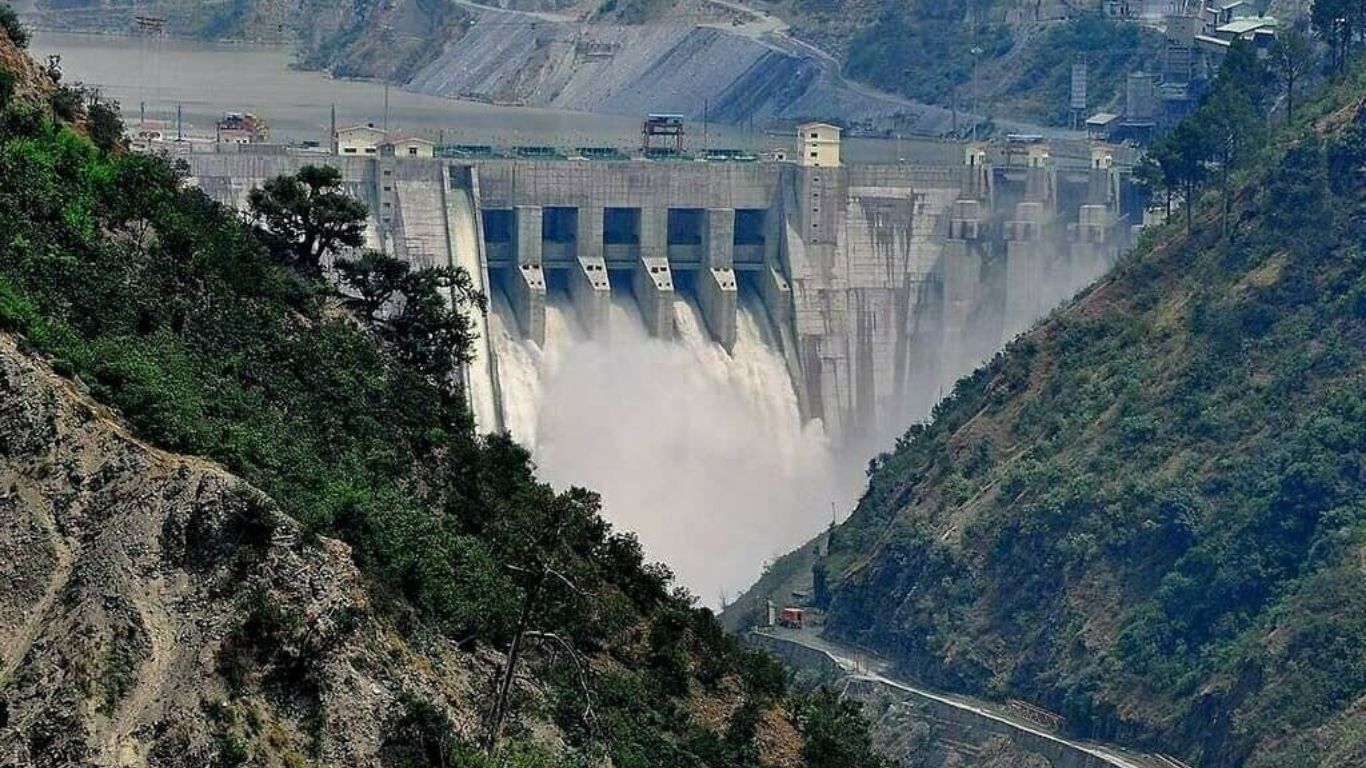
That said, the treaty does allow India to maximize its use of eastern rivers and build run-of-the-river hydroelectric projects on western rivers. India has been gradually moving in that direction building dams like Kishanganga and Baglihar which Pakistan often contests in international courts.
Theoretically, India could increase pressure by expediting dam projects or diverting eastern river flows to its own drought-prone states like Punjab, Haryana, and Rajasthan. But completely choking Pakistan’s waters? Not legally or practically possible.
Pakistan’s Reaction Whenever Water Becomes a Political Weapon
For Pakistan, water is not just a resource it’s a lifeline. Nearly 90% of its agriculture depends on the Indus basin. Whenever Indian politicians threaten to “turn off the tap,” Pakistan reacts with alarm, often escalating rhetoric to international platforms.
Islamabad views any move by India to alter water flows as an “existential threat.” Pakistani media amplifies such issues, painting them as proof of Indian aggression. The government usually responds by lodging complaints with the World Bank or seeking arbitration through neutral experts.
Beyond diplomacy, the issue also stirs domestic nationalism in Pakistan. Politicians rally people around the narrative that India is trying to “weaponize water.” This makes the Indus Waters Treaty not just a technical agreement but a flashpoint in the India-Pakistan rivalry.
Rising Nationalism and Treaty Suspension
The rise of hardline nationalism in India has shaken the treaty more than ever. In April 2025, after a militant attack in Kashmir, India suspended the IWT the boldest move since its signing.
By tying water-sharing to terrorism, India placed the treaty in uncharted territory. The declaration that “blood and water cannot flow together” sent shockwaves across the world. Experts warned that for the first time, the treaty was on the brink of collapse.
This move was more than legal maneuvering it was symbolic. It turned water into a weapon of nationalism.
Religious Extremism and the Weaponization of Water
Complicating matters further is the rise of religious nationalism, especially under Hindu nationalist rhetoric. Water has been reframed not just as a resource but as a symbol of sovereignty and cultural pride.
Some narratives now portray the IWT as a concession to a Muslim-majority Pakistan. After the 2025 suspension, government rhetoric explicitly fused religion and security, reducing water diplomacy to a battlefield of ideology.
This has created three major challenges:
- Politicization of Water Diplomacy – Treating rivers as weapons rather than shared resources.
- Weaponization of Water – Using flows as leverage against Pakistan.
- Marginalization of Moderates – Sideling scientists and cooperative voices in favor of nationalist hardliners.
Together, these trends make the IWT more fragile than ever.
What Happens Next?
Despite India’s suspension, its current infrastructure means it cannot completely stop Pakistan’s supply; most dams are run-of-the-river without massive storage capacity. But the threat itself destabilizes trust.
For Pakistan, with no upstream control, options are limited. For India, water as a weapon risks global backlash. The stalemate is dangerous: every drought or flood could spark diplomatic or even military escalation.
The Path to Survival: Reforming the Treaty
If the IWT is to endure, it must adapt to 21st-century realities. Experts propose:
- Climate Intelligence: Add real-time data, forecasting, and adaptive management for changing monsoons and glacial melt.
- Include Groundwater & Ecology: Go beyond surface water to cover aquifers and environmental sustainability.
- Strengthen the Indus Commission: Give it teeth for faster dispute resolution.
- Neutral Mediation: Use trusted international bodies to depoliticize disputes.
- People-to-People Diplomacy: Build trust through farmer, scientist, and community-level cooperation.
Conclusion: A Treaty at the Crossroads
The Indus Waters Treaty has been called a miracle of diplomacy, surviving wars and rivalries that crushed almost everything else between India and Pakistan. But today, nationalism, religious extremism, and climate change threaten to tear it apart.
If leaders in New Delhi and Islamabad treat water as a weapon, the rivers may still flow but the peace they symbolize will dry up.
If they choose cooperation, the IWT can be reborn as a climate-smart, future-ready framework a model for global water diplomacy.
The choice is stark: will the Indus remain a river of life, or become the next flashpoint of conflict in South Asia?




