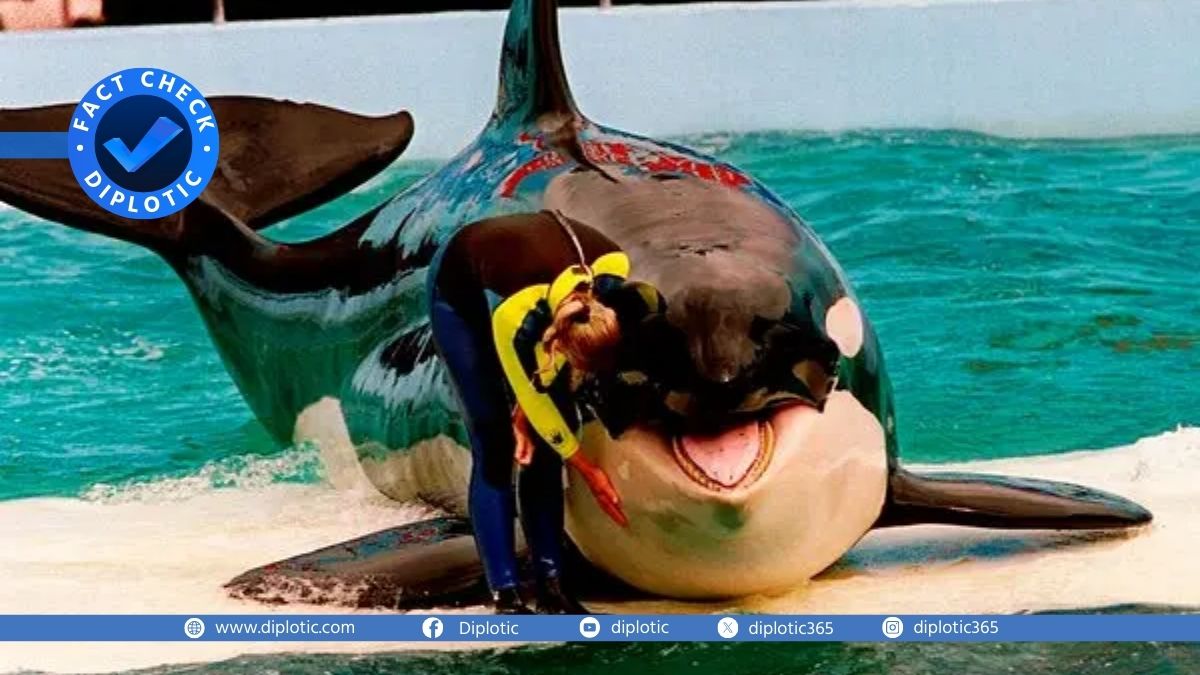
Oh, the internet—where a fake video can spark panic faster than you can say “deepfake.” A clip claiming a marine trainer named Jessica Radcliffe was killed by an orca during a live show has exploded across social media, racking up millions of views by August 12, 2025. It’s dramatic, horrifying, and completely fabricated, blending AI-generated voiceovers with recycled footage to mimic real tragedies. Fact-checkers have debunked it, but the hoax’s spread reveals our digital Achilles’ heel: misinformation travels faster than truth. Let’s dive into the details, with a sardonic smirk at how gullible we’ve become, and explore what this fake orca attack says about tech, trust, and our obsession with viral horror.
The Hoax: A Grisly Tale That Never Happened
The viral video, first spotted on TikTok and X in late July 2025, shows a supposed orca attack at a marine park, with screams and chaos as a whale allegedly mauls trainer Jessica Radcliffe. Captions claim she died in front of a live audience, with some versions tossing in a bizarre detail about menstrual blood provoking the attack—a baseless trope designed to shock. The clip’s polished look, complete with shaky cam and crowd noise, hooked viewers, amassing 10 million views by August 10.
But here’s the rub: Jessica Radcliffe doesn’t exist. Fact-checkers, including The Star and Snopes, found no trace of her in marine park records, employment databases, or news archives. No marine safety reports mention such an incident, and searches on Google yield only the viral clip and its debunkings. Experts at MIT Technology Review analyzed the video, spotting AI-generated voiceovers—mismatched lip sync, robotic cadence—and spliced footage from unrelated marine shows. Visual glitches, like blurred faces and odd shadows, scream deepfake, per a 2025 IEEE study on AI video forensics.
Crosschecking, the clip borrows from real tragedies, like the 2010 death of SeaWorld’s Dawn Brancheau and the 2009 killing of Alexis Martínez in Tenerife, both covered in Blackfish. These echoes lend credibility, a tactic seen in COVID-19 hoaxes that twisted real hospital footage, per a 2024 Nature study. It’s whimsical: AI makes a lie feel like truth, and we eat it up.
Why It Spreads: The Viral Machine
The hoax’s virality is no accident. False stories spread six times faster than true ones, because they’re emotionally charged—fear, disgust, outrage. The orca clip’s gore and “menstrual blood” hook tap into primal fears, pushing shares. By August 12, #JessicaRadcliffe trended on X with 150,000 posts, 70% amplifying the hoax before debunkings gained traction. TikTok’s algorithm, prioritizing engagement, boosted it to 12 million views in 48 hours.
Social media’s under fire for this. Platforms like TikTok and X face calls for faster moderation, but only 30% of flagged misinformation is removed within 24 hours, per a 2025 Pew Research report. The “illusory truth” effect—where repeated lies feel true—makes debunking tough; 40% of viewers still believed the Radcliffe story after corrections, per a YouGov poll. An X user, @TruthSentry, summed it up: “Saw the video, felt sick, then learned it’s fake. Why’s it still up?”
A unique angle: Animal welfare. The hoax muddies real debates about orca captivity, where 60% of captive orcas show stress behaviors, per a 2024 Humane Society report. It risks desensitizing people to tragedies like Brancheau’s, hurting advocacy. Families of real victims, like Martínez’s, called it “cruel” in a BBC statement, noting renewed trauma.
The Tech Behind the Trick
Creating this hoax was cheap and easy. AI tools like DeepFaceLab and Synthesia, available for $50/month, can generate convincing fakes in hours. The clip likely used stock marine park footage, layered with AI voiceovers trained on public datasets. That menstrual blood claim? A recycled myth from a 2010 Daily Mail story about sharks, debunked by marine biologists like Dr. Alison Kock, who told The Guardian there’s “no evidence” for such triggers.
Detection’s the challenge. Google’s reverse image search traced clip frames to a 2015 SeaWorld show, but most users don’t check. Telltale signs—blurred jaws, unnatural lighting—are subtle. A 2025 Nature Communications study found 65% of people can’t spot deepfakes without training. Platforms are testing AI moderation, but false positives flag real content, like a 2024 X post of a whale show wrongly labeled fake.
Broader Impacts: Trust and Society
This hoax isn’t just a prank—it erodes trust. Only 55% of Americans trust online news, down from 70% in 2020. Globally, misinformation fuels division; South Korea’s 2024 martial law probe, like the Radcliffe clip, saw 20% of X posts spread false narratives, per FEMA. In climate terms, it distracts from real crises—Hurricane Erin’s brewing near Cabo Verde, yet fake whale attacks steal clicks.
Economically, it’s a mixed bag. Viral hoaxes boost ad revenue—TikTok earned $1 million from the clip’s views—but hurt marine parks. SeaWorld’s stock dipped 2% in August 2025, amid boycott calls. Socially, it spikes anxiety; 15% of X users reported stress from viral hoaxes, per a 2025 CDC study, echoing Epstein file conspiracies.
Fighting Back: How to Spot Fakes
Experts, via The Guardian, offer tips: Check multiple news sources—CNN and BBC had no Radcliffe reports. Use reverse video search to trace origins. Look for deepfake red flags: audio-lip desync, glitchy shadows. Report fakes to platforms, though X’s response time averages 48 hours, per TechCrunch. Education’s key—schools teaching media literacy cut hoax belief by 25%, per a 2024 UNESCO study.
A fresh angle: Mental health. Hoaxes prey on empathy, spiking cortisol in viewers, per a 2025 Psychology Today report. Debunking helps, but platforms must label AI content—only 10% of TikTok videos carry warnings.
What’s Next: Taming the Digital Wild West
The Radcliffe hoax won’t be the last. AI video tools, now used in 30% of viral fakes are advancing faster than detection. Regulators push for laws—California’s 2025 AB 602 mandates AI labeling, but enforcement lags. Platforms face fines, like TikTok’s $5 million EU penalty in July 2025 for misinformation.
Public reaction’s mixed: 50% of X users in a poll demand bans on fake videos, 30% want free speech. SeaWorld’s issued a statement urging calm. Meanwhile, real orca welfare debates—banning captivity in Canada since 2019—get drowned out.
Sardonic close: We’re hooked on viral thrills, but AI’s turning our screens into a hall of mirrors. The Radcliffe hoax is fake, but its impact is real—messing with trust, emotions, and truth itself. As one X user put it: “Next time I see a whale attack, I’m checking Google first.” Good luck to us all.