

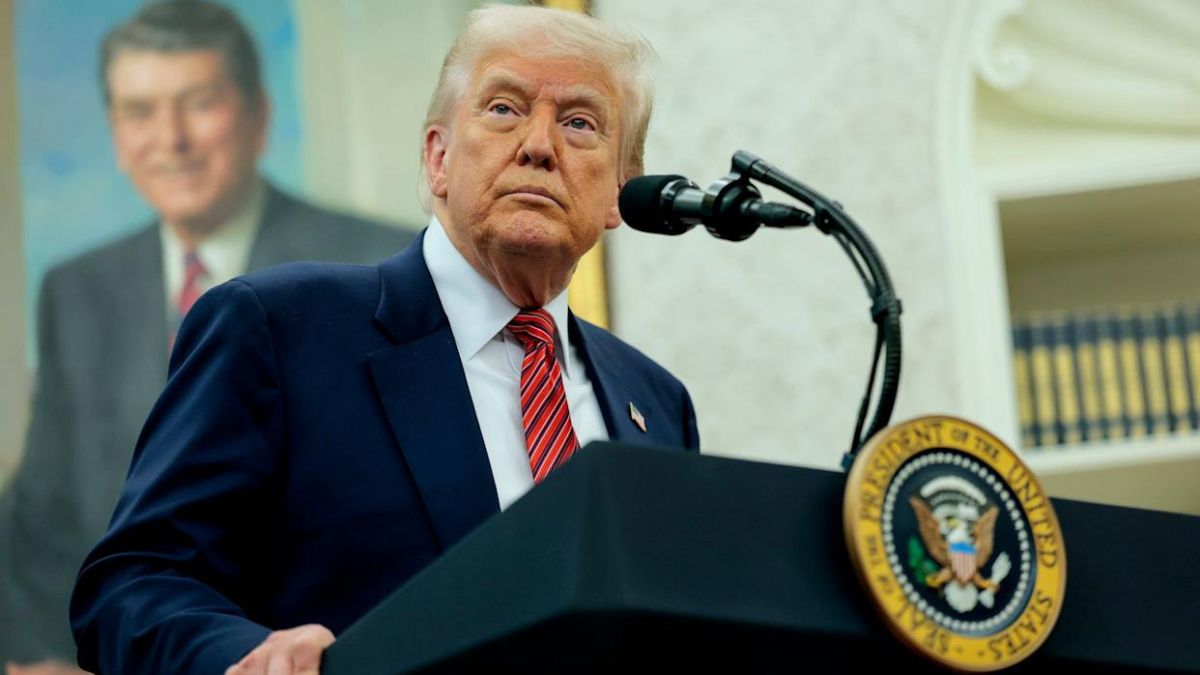
Here we are in August 2025, and President Donald Trump is back at it, mixing business with politics in a way that’s got everyone from Wall Street to Washington raising eyebrows. Reports surfaced on August 10 that Trump struck a deal with Nvidia, letting the chipmaker sell its H20 AI chips to China in exchange for a 15% slice of the sales pie going straight to the US government. Trump himself confirmed it the next day, admitting he started by asking for 20% but settled after some haggling with CEO Jensen Huang. He even tossed in a jab, calling the H20 “essentially an old chip” that’s already matched by Huawei’s offerings. But is this savvy deal-making or just another chapter in the endless US-China tech tussle? Let’s sift through the mess, with a wink at how these high-stakes games often leave us mere mortals scratching our heads.
The Deal: From 20% Demand to 15% Compromise
Trump didn’t shy away from the details in his August 11 press conference at the White House. “I said, ‘listen, I want 20% if I’m going to approve this for you, for the country,'” he recounted, explaining how Huang talked him down to 15%. This unusual setup—think of it as a government royalty on private sales—clears the way for Nvidia to get export licenses for the H20, a chip designed specifically for China to skirt US restrictions. Without this green light, Nvidia was staring at a $8 billion hole in its quarterly sales, as Huang noted back in May when exports stalled.
The agreement isn’t just for Nvidia; AMD’s in on it too, paying 15% on sales of its Instinct MI308 chip to China, as a White House official confirmed. It’s a reversal from the Biden era’s tough stance, where export controls in 2023 and April 2025 aimed to hobble China’s AI ambitions by capping chip performance. Trump, ever the negotiator, framed it as a win: US firms get to sell, the government gets a cut, and China gets yesterday’s tech. But sardonic as it sounds, this “pay to play” model raises questions about whether national security is now up for bid.
Crosschecking the facts, this deal stems from Huang’s White House visit on August 9, where he pitched the benefits of letting US tech flow to China—better for monitoring and keeping American firms ahead, he argued. Nvidia’s stock ticked up 0.51% on August 11, closing at $185.20, showing investors like the access to China’s massive market, worth $7 billion in AI chips last year despite curbs. Yet, Trump’s quip about the H20 being “obsolete” hits home—it’s a nerfed version of the H100, with performance slashed by up to 70% to comply with rules, making it no match for Nvidia’s latest Blackwell chip.
The Chip War Backstory: A Decade of Tension
To grasp why this matters, rewind to the roots of the US-China chip war. It kicked off under Trump’s first term in 2018 with tariffs on Chinese goods, including tech, to counter what he called unfair trade practices. But the real escalation came under Biden, who in October 2022 banned exports of advanced AI chips to prevent China from building military-grade systems. By 2023, firms like Nvidia had to create China-specific chips like the H20, which debuted in February 2024 but faced further blocks in April 2025.
Nvidia, the king of AI hardware with a $3 trillion market cap as of August 2025, relies on China for 20% of its revenue—$22.6 billion in fiscal 2024. Huang has long argued that blanket bans backfire, pushing China to speed up its own tech, like Huawei’s Ascend 910B, which Trump nodded to as a H20 rival. “Denying access would encourage the Chinese chip industry to catch up,” Huang said in a May earnings call. Trump’s deal seems to echo that, allowing sales of “old” tech while guarding crown jewels like Blackwell, set for full release in Q4 2025 with 30% better performance than predecessors.
It’s whimsical how this flips the script on security fears. The US worries China’s AI could boost surveillance or military ops, yet Trump’s taking a cut suggests economics trumps all. As one analyst put it on X, “It’s like charging tolls on a bridge you built to keep enemies out.” And self-deprecatingly, isn’t it odd that the government now acts like a silent partner in private deals?
Economic Angles: Wins for Treasury, Worries for Tech
From Trump’s view, it’s a cash cow. At 15%, if Nvidia sells $8 billion in H20 chips quarterly to China, that’s $1.2 billion flowing to US coffers—potentially $4.8 billion annually. Add AMD’s share, and it’s a tidy sum for infrastructure or debt reduction, aligning with Trump’s “America First” ethos. Nvidia’s happy too—Huang’s White House schmooze unlocked a market frozen since May, boosting stock 0.28% intraday on August 11.
But zoom out, and cracks appear. This sets a precedent—will other US firms face similar “taxes” for foreign sales? Analysts warn it could chill innovation, as companies factor in government cuts. For China, it’s a mixed bag: access to H20 helps AI firms like Baidu, but at a premium, and it underscores reliance on US tech amid Huawei’s push for self-sufficiency. Huawei’s Ascend series, rolled out in 2023, now powers 40% of China’s data centers, closing the gap on Nvidia.
Another angle: jobs and supply chains. Nvidia’s deal could preserve US manufacturing roles—its chips are made by TSMC in Taiwan—but Trump’s hint at “enhanced in a negative way” versions for Blackwell suggests future downgrades, potentially hurting revenue. Whimsically, it’s like selling a Ferrari with a speed limiter—still fast, but not the real deal.
Security and Ethical Twists: Protection or Profiteering?
The core fear driving controls: China’s AI edge could threaten US security. Biden’s bans aimed to keep a 3-5 year lead, per Commerce Department memos. Trump’s approach—sell but skim—raises ethical flags. Is this protectionism or profiteering? Critics on X call it “shakedown diplomacy,” likening it to mob protection rackets. Legally, it’s grounded in the International Emergency Economic Powers Act, but experts question if “cuts” fit without Congressional approval.
Sardonically, Trump’s calling H20 “obsolete” while approving sales feels like having your cake and eating it. Huawei begs to differ—its Kirin chips powered 2024’s Mate 70, rivaling Apple’s A18. This deal might accelerate China’s independence, as state subsidies hit $47 billion in 2024 for domestic semiconductors. For the US, it’s a short-term gain but long-term risk—losing market share as China builds its own ecosystem.
Global Ripples: Tech Stocks and Trade Wars 2.0
Nvidia’s shares rose modestly, but the sector felt jitters—AMD up 0.3%, Intel flat amid its own China woes. Broader markets? Trump’s trade talk often sparks volatility; the S&P 500 dipped 0.2% on August 11 amid fears of escalating tariffs. This fits Trump’s playbook—his first term saw $380 billion in tariffs on China, cutting bilateral trade by 15%. Now, with 2025’s “America First 2.0,” similar deals could spread to autos or EVs.
An overlooked angle: AI ethics. Selling chips, even downgraded, aids China’s surveillance state, raising human rights concerns. Groups like Amnesty have called out US firms for enabling Uyghur monitoring. Trump’s focus on cash over caution might fuel that fire.
Huang’s Next Visit: Blackwell on the Table?
Trump teased Huang’s return to discuss Blackwell exports—a chip 30% faster than H100, launching Q4 2025. “I think he’s coming to see me again about that,” Trump said, vowing no full-strength sales but open to “negative enhancements” like 30-50% performance cuts. Nvidia’s spokesperson echoed hopes for fair rules: “We hope export control rules will let America compete in China and worldwide.”
If approved, it could net billions, but at what cost? China’s SMIC is ramping 7nm production, aiming for 5nm by 2026—closing the gap Trump’s deals might widen. Whimsically, it’s like arming your rival with slingshots while hoarding guns—smart short-term, risky long.
The Bigger Picture: Trade, Tech, and Trump’s Legacy
This Nvidia saga is a microcosm of Trump’s trade vision—deals over dogma. By taking a cut, he’s blending tariffs with tolls, potentially adding $4 trillion to US coffers over a decade if scaled. But critics see hypocrisy: bashing China while profiting from sales. For tech, it’s a lifeline—Nvidia’s China revenue could hit $12 billion in 2025 with the deal.
Self-deprecatingly, it’s amusing how chips, tiny as they are, dictate global power plays. Trump’s quip about Blackwell—”super-duper advanced”—highlights the whimsy: in AI arms races, today’s cutting edge is tomorrow’s obsolete. As Huang preps his next pitch, the world watches—will Trump hold firm, or cut another deal? In this game, the only certainty is uncertainty, and the stakes are nothing short of tech supremacy.




