

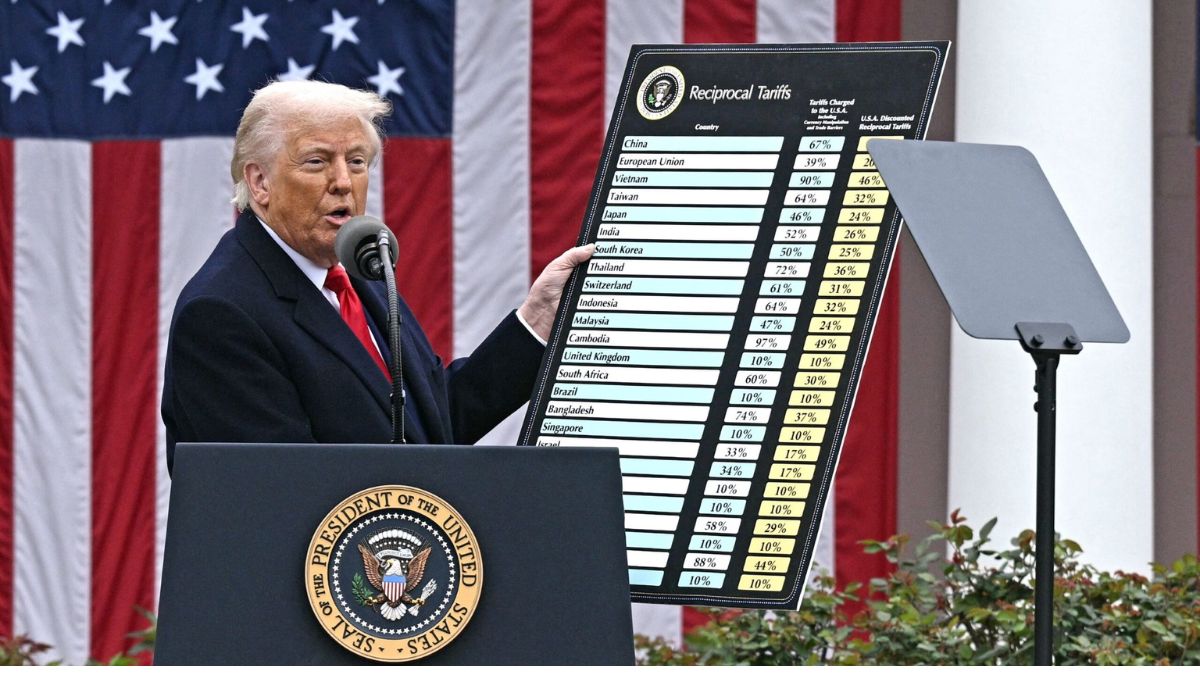
Donald Trump’s back in the White House, and he’s swinging his tariff hammer like a wrecking ball, reshaping global trade with a ferocity that’s got everyone from Beijing to Brussels on edge. Eight months into his second term in August 2025, he’s not just tweaking trade deals—he’s ripping them up, even ones he signed, like the 2018 US-Mexico-Canada Agreement (USMCA). His approach? A relentless, unpredictable “forever war” in trade, driven by executive whim, that’s leaving allies and rivals scrambling. With tariffs hitting dozens of countries and legal challenges looming, the global economic order is wobbling. Is this chaos a masterstroke or a reckless gamble? Let’s dive into the fray, unpack the stakes, and see what’s driving this commercial combat.
Tearing Up the Playbook: Trump’s Tariff Blitz
Trump’s trade policy is less a strategy, more a blitzkrieg. Since January 2025, he’s slapped tariffs on over 90 countries, ranging from 10% to 50%, targeting everything from steel to semiconductors. The USMCA, once hailed as his fix for the “worst trade deal ever” (NAFTA), got shredded when he hit Canada and Mexico with 25% tariffs on steel and aluminum, plus 35% on Canadian goods and 30% on Mexican ones by August 1. Japan and South Korea, who inked “fair and reciprocal” deals in 2018, now face 25% tariff threats despite their handshake agreements. Even the EU, which cut a deal for 15% tariffs on its goods, stares down a potential 35% hike if a $600 billion investment fund doesn’t materialize to Trump’s liking.
This isn’t business as usual. Trade negotiations, which typically take years, are being squeezed into weeks, causing chaos. Japan’s Prime Minister Shigeru Ishiba, in a rare blunt jab, called Trump “not a normal person” in August 2025, lamenting the shaky “handshake deal” with Washington. The EU’s grappling with confusion over that $600 billion fund, which Trump claims he can spend “on anything I want,” while Brussels insists it can’t force private investment. The result? A trade landscape where deals are temporary, trust is thin, and uncertainty reigns.
Economic Ripples: Winners, Losers, and Bitter Allies
The fallout’s already hitting. In the US, businesses feel the pinch. “Fortune 500 companies in Omaha are losing business in Canada right now,” Rep. Don Bacon told Quartz in July 2025, citing Canadian bitterness over new tariffs. Ford shelled out $800 million in Q2 2025 tariff costs, with projections of $3 billion for the year; GM’s facing $4-5 billion in 2025 hits. Caterpillar warned of a $1.5 billion blow, and Apple’s Tim Cook reported $800 million in Q2 alone. Consumers aren’t spared—Yale’s Budget Lab estimates an 18.3% average tariff rate, the highest since 1934, costing households $2,400 annually, with shoe prices up 40% and clothes 38% in the short term.
Globally, it’s a mixed bag. China’s retaliated with 10% tariffs on US goods, escalating to 125% in April before a May truce dropped them to 10%. Brazil and India, part of the BRICS bloc, are mulling their own duties but treading lightly. Switzerland got slammed with a 39% tariff, up from 31%, threatening its pharmaceutical exports. Meanwhile, the Falkland Islands, of all places, dodged a bullet, seeing tariffs drop from 41% to 10%. The IMF slashed its 2025 global growth forecast to 2.8%, citing US-China trade tensions and tariff uncertainty.
Trump’s team sees gold in the chaos. Commerce Secretary Howard Lutnick projects $50 billion monthly tariff revenue, potentially hitting $1 trillion total. Council of Economic Advisors’ Stephen Miran ups that to $4 trillion over a decade, shrugging off inflation fears. The pitch? Tariffs force investment in US manufacturing, creating jobs. Yet, manufacturing employment remains flat at 12.7 million in July 2025, per BLS data.
The “Forever War” Concern: No End in Sight
Here’s the kicker: there’s no off-ramp. Brad Setser of the Council on Foreign Relations calls it a “big concern”—Trump’s tariffs lack a ceasefire or end date, hinging on his mood. “Most trading partners recognize any deal is temporary,” Setser noted, as countries rush to cut short-term bargains. The USMCA’s unraveling proves it—Canada and Mexico thought they were safe, but double-digit tariffs hit anyway. This volatility spooks markets: the S&P 500 wiped out post-election gains by March 2025, per AP reports.
The WTO’s Dispute Settlement Mechanism, already crippled since 2019, can’t rein Trump in—its Appellate Body is paralyzed, leaving disputes in limbo. A US legal challenge, sparked by a May 2025 Court of International Trade ruling, questions Trump’s emergency powers under the IEEPA, but a federal appeals court’s temporary hold keeps tariffs flowing. “There’s enormous uncertainty,” Setser warns, as Trump could pivot to other trade tools if courts clip his wings.
Global Pushback and Strategic Shifts
Most countries are playing nice—for now. Retaliation’s muted, with only China consistently hitting back. Canada’s Justin Trudeau threatened $100 billion in tariffs but paused after talks, while Mexico’s Claudia Sheinbaum delayed her response, eyeing de-escalation. The EU’s deal, including $750 billion in US energy purchases, aims to soothe Trump, but critics like France’s François Bayrou call it capitulation.
Trump’s logic is simple: the US, as a net importer, holds leverage. “The American consumer is the most powerful factor on Earth,” Lutnick boasted on Fox Business. He’s not wrong—US imports dwarf exports, giving Trump room to squeeze. But critics, like Senate Democrat Chuck Schumer, slam the “destructive trade war” for tanking jobs, with July 2025’s weak BLS report fueling fears.
Is This Sustainable? The Big Picture
Trump’s shaking the global trade tree, and while some apples fall his way—$136 billion in tariff revenue by July 2025—others roll elsewhere. Supply chains are diversifying; Vietnam and Indonesia snagged deals with 19-20% tariffs, luring investment from China. But the cost is steep: higher prices, jittery markets, and strained allies. The IMF warns of a global trade volume drop, with US-China merchandise trade down 80%.
Historical context bites hard. The Smoot-Hawley Tariff Act of 1930 deepened the Great Depression, a cautionary tale economists like Douglas Irwin raise. Yet Trump’s betting on a different outcome: re-industrialization. Early wins—like a 2.1% manufacturing output bump—hint at potential, but it’s a gamble. If courts or markets turn sour, his “forever war” could backfire, leaving the US isolated and consumers poorer.
For now, Trump’s tariffs are a high-stakes poker game—bold, messy, and divisive. Allies adapt, rivals brace, and the world watches, wondering if this is genius or madness. One thing’s sure: trade’s no longer free, and the rules are whatever Trump says they are—until someone calls his bluff.




