

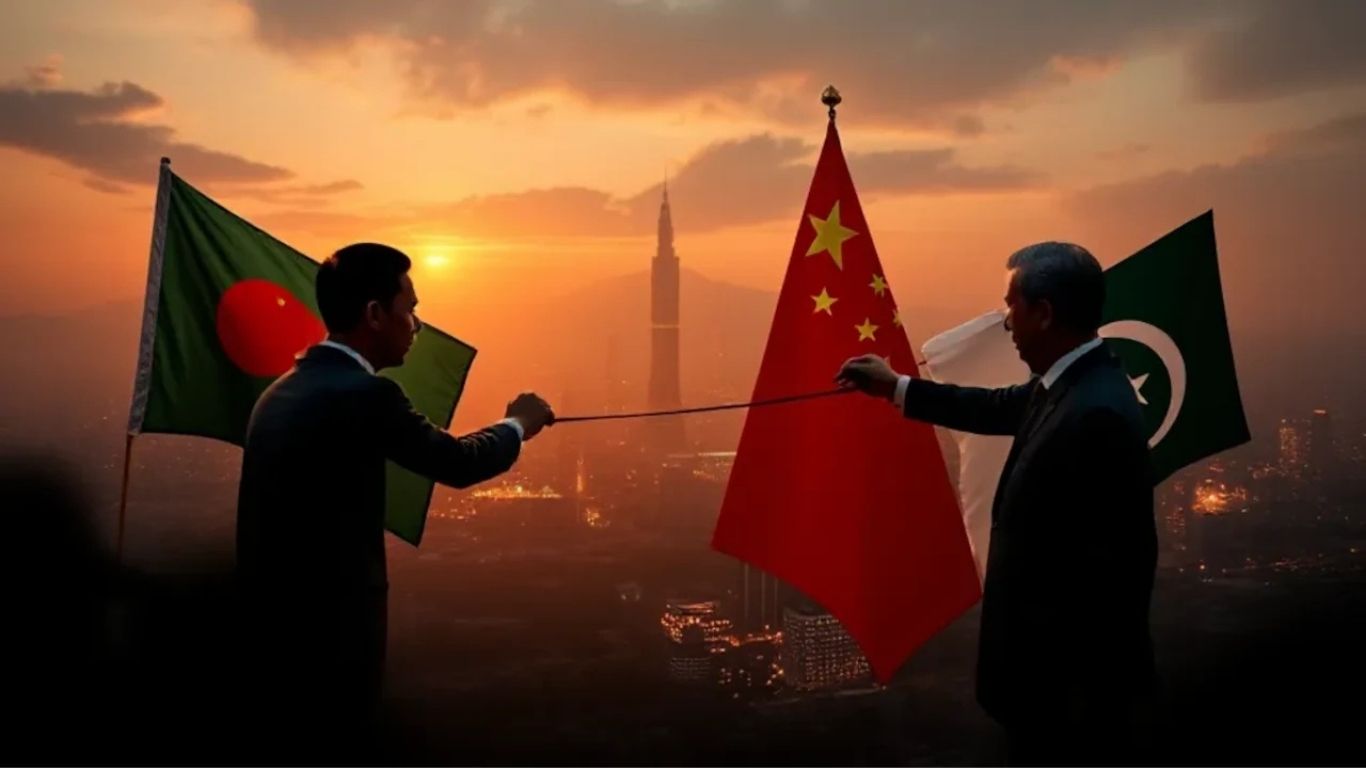
A subtle yet seismic shift is underway in South Asia’s geopolitical landscape. The recent trilateral meeting in Kunming between China, Bangladesh, and Pakistan signals the emergence of a new axis with the potential to upend regional stability and challenge both Indian and American strategic interests in the Indo-Pacific.
The Quiet Birth of a Strategic Triangle
On June 19, 2025, senior officials from China, Bangladesh, and Pakistan convened in Kunming, Yunnan province. While the joint statement from the meeting emphasized “true multilateralism and open regionalism,” the context and composition of this trilateral dialogue suggest a calculated move to reshape South Asia’s power dynamics. The involvement of Bangladesh’s unelected interim government, led by Chief Adviser Muhammad Yunus, raises questions about the legitimacy and long-term durability of Dhaka’s commitments especially given the lack of parliamentary oversight.
Bangladesh’s initial hesitation to publicize the meeting, and Pakistan’s subsequent independent release of its own statement, point to underlying tensions and the sensitive nature of this new alignment. Prominent Bangladeshi economist Dr. Selim Raihan has openly questioned whether such high-stakes decisions should be made without an elected government, echoing broader civil society concerns about the direction of Bangladesh’s foreign policy.
CPEC and the Eastward Expansion
Central to the trilateral agenda is the proposed “eastward extension” of the China–Pakistan Economic Corridor (CPEC), which would link Pakistan’s infrastructure networks with Bangladesh. While not explicitly mentioned in the joint statement, this ambition is deeply contentious for India. The CPEC passes through Pakistan-occupied Jammu & Kashmir territory India claims as its own. Any move to integrate Bangladesh into this corridor would not only deepen China’s strategic presence in India’s neighborhood but also directly challenge New Delhi’s core security and territorial interests.
Undermining India’s Regional Influence
This trilateral initiative threatens to dilute India’s influence in established regional groupings such as SAARC, BIMSTEC, and the Indian Ocean Rim Association. By creating a parallel framework dominated by China, the new axis could erode India’s strategic depth and introduce a new layer of complexity to South Asian geopolitics. For Beijing, the benefits are clear: access to the Bay of Bengal via Bangladesh and to the Arabian Sea through Pakistan, effectively surrounding India and enhancing China’s leverage in the region.
Bangladesh’s Strategic Drift
Historically, Bangladesh has enjoyed deep people-to-people, economic, and security ties with India. Successive governments in Dhaka have avoided moves that could destabilize India’s sensitive Northeast or threaten the Siliguri Corridor the narrow “Chicken’s Neck” connecting mainland India with its northeastern states. However, the interim government’s participation in this trilateral initiative, coupled with provocative statements by Chief Adviser Yunus and reports of revived military infrastructure near the Indian border, signal a worrying shift.
The possibility of China-assisted upgrades to the Lalmonirhat airfield, just kilometers from India’s border, has alarmed Indian security analysts. Such developments could enable Chinese surveillance and rapid military deployment near the strategically vital Siliguri Corridor, heightening India’s vulnerability to encirclement.
The Encirclement Concern
Military experts warn that this emerging axis could evolve into a “devil triangle” aimed at India’s encirclement, leveraging economic connectivity for potential military advantage. The informal inclusion of CPEC in trilateral talks, even if not officially acknowledged, is viewed as a red flag for India’s national security. Analysts argue that these moves fit a broader pattern of Chinese encirclement, exploiting India’s eastern and western flanks under the guise of civilian projects that could be rapidly militarized.
Implications for the Indo-Pacific and U.S. Strategy
The significance of this trilateral initiative extends beyond South Asia. If institutionalized, it could undermine the U.S. Indo-Pacific Strategy, which seeks to maintain a balance of power and ensure a free, open, and rules-based order. A China-led regional framework would reduce American strategic space and challenge Washington’s influence in the Indian Ocean region.
China’s long-term objective is clear: to weave a web of economic, military, and diplomatic ties that diminish both Indian and U.S. influence, consolidating Beijing’s leadership in South Asia and the Indo-Pacific. This makes it imperative for India and the U.S. to align their strategies, reinforce regional partnerships, and counterbalance China’s growing reach.
Conclusion: A Test for Regional Stability
The China-Bangladesh-Pakistan trilateral framework is more than a diplomatic experiment; it is a strategic maneuver with the potential to redraw South Asia’s security architecture. Despite official denials, the initiative’s timing, context, and content unmistakably point to a challenge aimed at India’s core interests.
India must not remain a passive observer. It should redouble efforts to strengthen existing regional platforms, invest in connectivity and security cooperation, and engage Bangladesh to preserve the trust and goodwill built over decades. For the United States, the evolving axis underscores the urgency of deeper engagement in South Asia to uphold a stable and inclusive Indo-Pacific order.
Diplomatic language may obscure intentions, but the strategic realities are clear. The stakes for India, the U.S., and the region have never been higher and the time to respond is now.




