

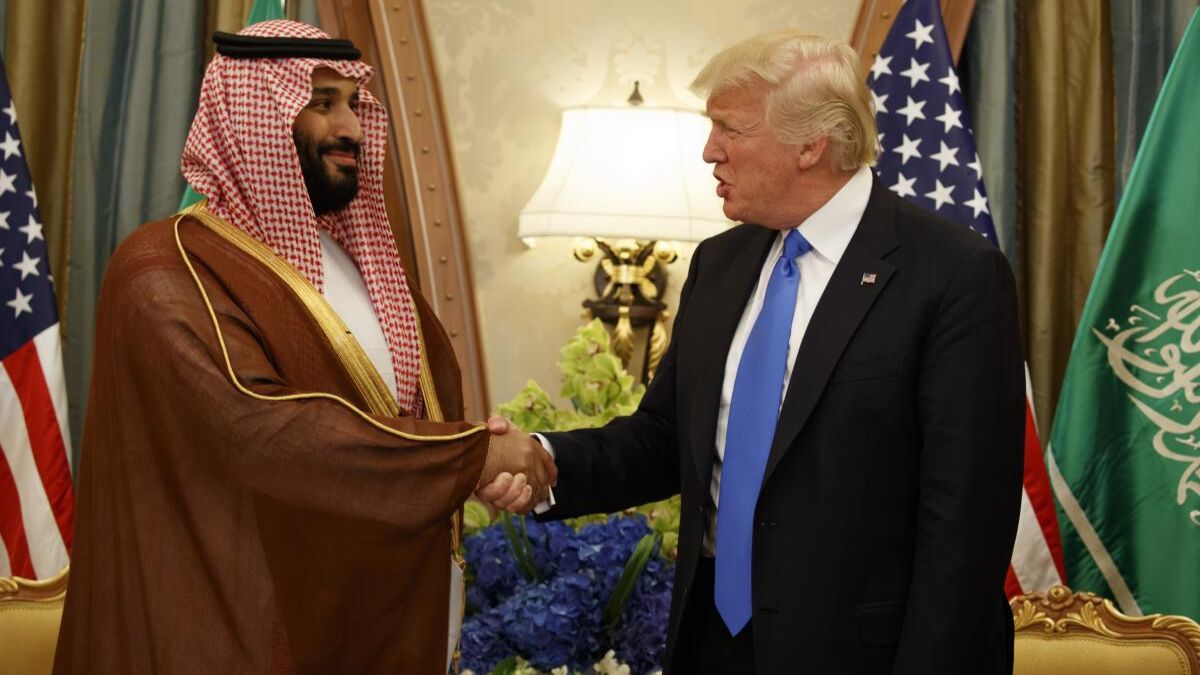
President Trump’s $600B investment deal with Saudi Arabia includes a $20B promise for AI data centers—but is it real, new, and enforceable? This in-depth analysis reveals what’s missing, what’s misleading, and why it matters for America’s AI future.
Global Partnerships, National Consequences
In a bold announcement, President Donald Trump unveiled a sweeping $600 billion U.S.–Saudi investment pact, branding it a milestone for America’s AI and tech dominance. Front and center in the press release: a $20 billion pledge from Saudi-owned DataVolt to build data centers across the United States, aimed at supercharging AI capabilities and economic growth.
While the dollar amount is headline-worthy, the real story lies beneath the surface—and it’s riddled with ambiguity, questionable timing, and uncomfortable comparisons to past failures like Foxconn’s ill-fated Wisconsin project.
AI Hype or Hardware Reality? Unpacking the $20B Commitment
DataVolt, a Saudi-based data center developer, is the central player in this supposed AI infrastructure expansion. According to the White House, the company is set to invest $20 billion in constructing new, liquid-cooled data centers across the U.S., with Supermicro tapped as a key supplier.
But what we still don’t know includes:
- Where these centers will be built
- How many jobs they will create
- When construction will begin
- Whether this is truly “new” capital or previously planned investment repackaged
In contrast, industry leaders like Amazon Web Services, Microsoft, Google, and Meta have already committed over $300 billion to data center development for 2025 alone, largely in response to booming AI demands and soaring GPU needs.
Is Trump Claiming Credit for Already-Planned Projects?
This brings us to the central concern: Are these Saudi-backed projects additive, or are they simply being rebranded for political optics?
According to Synergy Research Group, the number of planned data center builds worldwide rose from 314 in 2022 to 504 as of March 2025—a 60% surge. And while Trump’s deal adds gloss to these stats, there’s no definitive evidence that the DataVolt facilities represent entirely new capacity rather than previously mapped initiatives now being repackaged under a diplomatic banner.
If these centers were already part of the global tech industry’s roadmap, Trump’s announcement may be little more than a ceremonial relabeling, giving him political capital without real new gains for the U.S. AI ecosystem.
The Foxconn Warning: When Big Promises Go Bust
The specter of Foxconn looms large over this announcement. In 2017, Trump pledged a $10 billion factory in Wisconsin, heralded as a transformative tech hub that would create 13,000 jobs. What followed was a staggering collapse of those promises:
- The site remained mostly empty for years.
- Foxconn never built the promised LCD factory.
- Employment never crossed 1,500 jobs.
- Microsoft eventually acquired the site to build its own data center, salvaging some value years later.
If the DataVolt investment lacks contractual enforcement, history risks repeating itself.
The Enforcement Gap: Where Are the Safeguards?
Here’s what makes this deal potentially dangerous: No clear accountability measures appear to be in place.
There’s no public indication of:
- Penalty clauses for non-delivery
- Job guarantees or targets
- Timeline benchmarks
- Public-private auditing mechanisms
With $20 billion on the line—purportedly going toward critical AI infrastructure—the absence of such safeguards is deeply concerning. The Foxconn precedent demonstrates that lofty foreign-backed projects without enforceable conditions can collapse under their own hype, leaving local communities with nothing but broken promises and empty lots.
Strategic Timing: PR Blitz Ahead of the Election
This investment announcement arrives strategically ahead of the 2025 election cycle, where AI, economic nationalism, and U.S.–China competition are hot-button issues.
Touting a $600 billion deal with a major geopolitical player like Saudi Arabia positions Trump as a tech-forward leader, at a time when concerns over AI compute scarcity, data center lag, and GPU bottlenecks threaten American competitiveness.
But voters and tech stakeholders should ask: Is this partnership grounded in strategy or showmanship?
The Real Stakes: AI Compute Power Is Not Optional
This deal comes during a critical shortage of AI computing infrastructure in the United States. Startups and enterprises alike face long wait times and rising costs for training advanced models, with many forced to rely on overseas compute capacity—particularly from China.
A genuine $20 billion injection into new, high-density data centers equipped with GPUs and liquid cooling could help ease these pressure points—if the projects materialize.
Failing to deliver won’t just impact Trump’s legacy—it could slow the progress of American AI innovation, which in turn affects:
- National security
- Job creation
- Economic competitiveness
- Scientific advancement
A Deal with Potential, But No Margin for Deception
If DataVolt and its partners truly break ground and deliver infrastructure at scale, this deal could indeed move the needle in America’s fight to lead in AI.
But without transparency, milestones, or safeguards, the deal is perilously close to becoming just another political prop—like so many tech deals of the past that were all announcement, no delivery.
The difference between hype and history is execution.
Conclusion: The U.S. Needs More Than Empty Promises
With the AI era in full swing and infrastructure demand skyrocketing, the U.S. cannot afford to gamble on vaporware investment deals. Whether the Trump–Saudi AI partnership becomes a cornerstone of U.S. tech leadership or fades into the annals of political PR depends on the next 12–24 months.
America’s future in artificial intelligence doesn’t need symbolic victories—it needs real steel, real servers, and real strategy.
Key Takeaways:
- $600B U.S.–Saudi investment deal includes a $20B AI data center pledge from DataVolt.
- Lack of detail raises concerns about whether projects are new or rebranded.
- No enforcement mechanisms or timelines have been disclosed.
- History warns us: remember Foxconn’s broken promises in Wisconsin.
- U.S. AI competitiveness depends on actual infrastructure, not press releases.
#Trump AI investment, #Saudi data center deal, #Trump $600B pact.




