

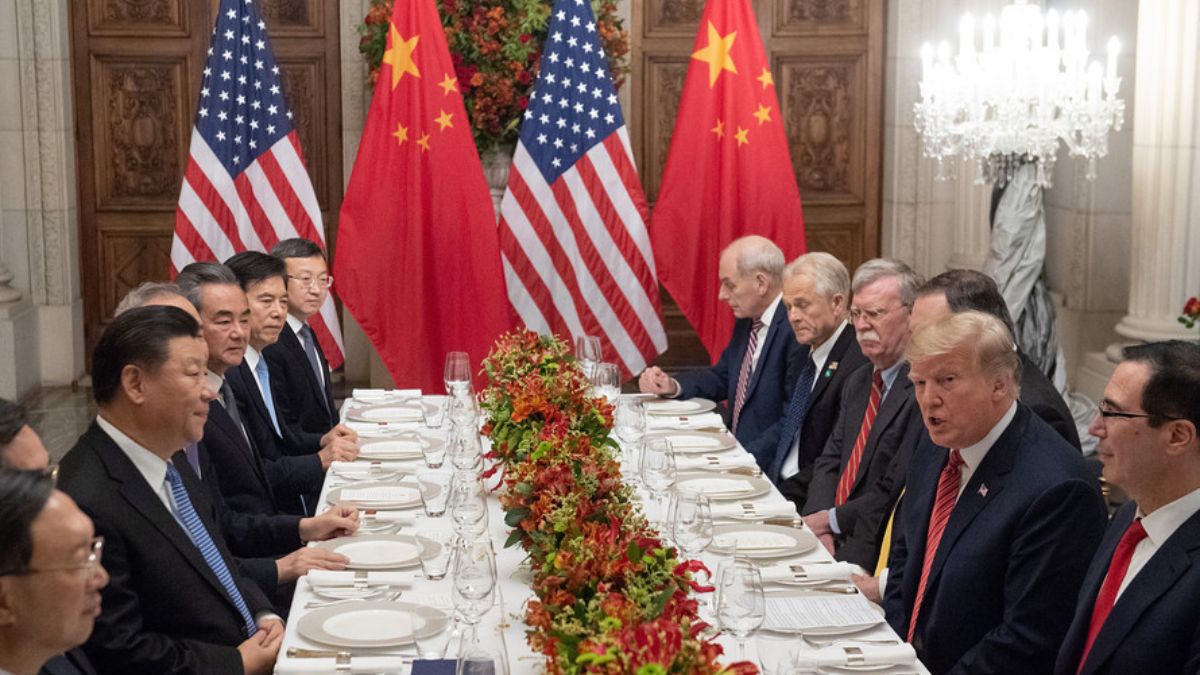
The truce reached in Geneva between the United States and China was met with visible relief across global markets. Stock indices surged, and commentators were quick to herald the “breakthrough.” Yet amid this post-truce optimism, it’s crucial to remember that what we are witnessing may not be the end of a crisis, but rather, the eye of the hurricane. And as with any storm, the back half could be far more destructive.
From the return of Donald Trump to the White House in January to the early-April “Liberation Day” tariff blitz, U.S. trade policy has raged through the global economy. Tariffs on Chinese imports climbed swiftly to 145%, sparking fierce countermeasures from Beijing. Now, with the announcement of a 90-day truce, which rolls tariffs back to 30%, temporarily lifts China’s retaliatory curbs on rare earth exports, and pledges ongoing dialogue, Washington seeks praise for containing the chaos it helped unleash.
But make no mistake: the underlying structure of the U.S.-China trade relationship remains damaged, fragile, and highly susceptible to renewed escalation. If substantive progress isn’t made by August 10, the U.S. default tariff of 34% or something closer to 60% or even 80% could snap back into place.
Treasury Secretary Scott Bessent made one of the few honest admissions in this episode, conceding that the previous tariff escalation was “the equivalent of an embargo.” He acknowledged that a mechanism for sustained dialogue should have preceded such drastic action. That long-overdue mechanism now exists: the “Geneva Mechanism.” But its success depends entirely on follow-through and worryingly, on the temperaments and tactics of the two leaders at the helm. That alone should give us all pause.
Strategic Decoupling and the Shadow Over Tech Giants
Bessent also drew a key distinction in public remarks between “general decoupling,” which neither the U.S. nor China reportedly seeks and “strategic decoupling,” which remains an active U.S. policy goal. The difference matters, especially for sectors deemed strategically sensitive: advanced semiconductors, pharmaceuticals, medical supplies, steel, and aluminum.
These areas are now considered too crucial to allow continued reliance on China or, conversely, to permit unrestricted supply to China. That’s why companies like Nvidia, despite recent gains tied to chip export controls, still face an uncertain future. The market euphoria following the Geneva announcement may have obscured the long-term national security agenda. But make no mistake the intent to de-risk and decouple in key sectors is deeply embedded in U.S. strategic thinking.
Simultaneously, Beijing is interpreting this truce not as a step toward interdependence but as a buffer period for internal strengthening. Chinese state media, including Xinhua and Global Times, have emphasized “strategic autonomy” and “dual circulation.” One Weibo commentator put it plainly: this is a window for China to harden its supply chains and fortify its innovation ecosystem. U.S. firms should read that message clearly and act accordingly.
Non-Tariff Barriers and the Fentanyl Trap
Among the issues slated for discussion under the Geneva Mechanism are non-tariff barriers, opaque and insidious tools China has long used to shield its markets. These include vague licensing processes, forced technology transfers, unfair procurement policies, data localization requirements, and compliance burdens that disproportionately affect foreign firms. Addressing these in 90 days is ambitious and likely unrealistic.
Then there’s fentanyl. The inclusion of China’s Minister of Public Security in the Geneva talks signaled an intent to address this pressing issue. But this isn’t the first time Beijing has pledged cooperation. In 2019, China banned all fentanyl-class substances only to ease enforcement as political tides shifted. In 2023, at the APEC summit in San Francisco, China made similar promises during high-level talks with President Biden. Each time, the U.S. welcomed these pledges, only to see them quietly shelved. Unless this round produces measurable benchmarks and enforcement mechanisms, any new commitments risk being performance over policy.
The Fading Appeal of China’s Market
There is another narrative that demands reevaluation the idea that gaining access to China’s domestic market remains a major win for U.S. companies. That was perhaps true in 2001 when China joined the WTO or even in 2018 during the initial stages of the trade war. But the landscape has changed.
Today, China’s markets are highly competitive, advanced, and infused with rising nationalism. U.S. firms face strong headwinds from well-positioned Chinese competitors and operate in a climate where foreign branding may be a liability. In the wake of escalating U.S. rhetoric, including Trump’s combative tone, nationalistic fervor in China has only intensified. The risks of market entry from consumer backlash to regulatory entanglements now outweigh many of the advantages.
This Is the Window Not the Win
This trade truce should not be seen as a reprieve but as a brief, strategic window. The lessons of the 2018 trade war, the COVID disruptions, and continued geopolitical instability are clear. Yet many firms remain dangerously overexposed to China, seduced by short-term access or cost advantages. That complacency could prove costly.
Over the next 90 days, companies should be doing two critical things. First, fortify short-term plans and supply chains against renewed volatility. Second and more important — accelerate long-term diversification. Whether it’s Southeast Asia, Latin America, or reshoring to the U.S., now is the time to act. Structural dependence on China is no longer merely a business issue. It is a strategic liability.
Yes, this moment may feel calm, but it is not peace. It is the eye of the storm. The next wave may come fast and hit harder.




