

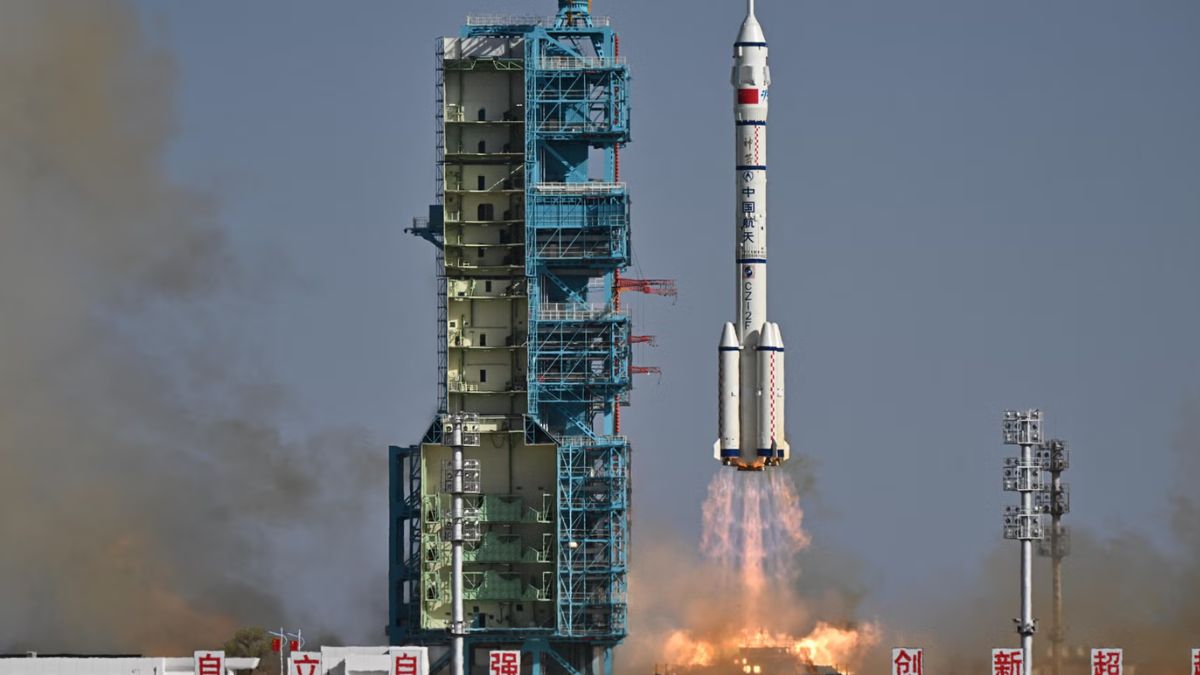
April 24, 2025 — With another powerful stride into space, China has launched Shenzhou 20, its latest crewed mission to the Tiangong space station, for a six-month mission, marking a major milestone in human spaceflight and international collaboration. Signaling a deepening commitment to space science, international cooperation, and permanent orbital presence.
A Smooth Launch and Quick Docking
Launched aboard a Long March 2F rocket from the Jiuquan Satellite Launch Center in northwest China at 5:17 p.m. Beijing time, Shenzhou 20 soared into orbit with flawless precision. Just over six hours later, the spacecraft docked with Tiangong, showcasing China’s ability to rapidly and reliably support crew transfers in low Earth orbit.
The Crew: A Fusion of Experience and New Energy
The Shenzhou 20 mission is led by Chen Dong, a seasoned astronaut on his third journey to space. He previously flew on Shenzhou 11 in 2016 and Shenzhou 14 in 2022, during which he oversaw crucial stages of Tiangong’s assembly. His leadership ensures stability and guidance as China’s orbital ambitions expand.
Joining him are two first-time astronauts: Chen Zhongrui, a former pilot with the People’s Liberation Army Air Force, and Wang Jie, an aerospace engineer with China’s main space contractor, CASC. Together, they represent the third generation of Chinese astronauts bringing technical depth, scientific curiosity, and new perspectives to the mission.
Mission Goals: Science, Operations, and Long-Term Presence
This six-month mission is focused on more than just maintaining the space station. The astronauts will conduct experiments across multiple scientific disciplines, including stem cell behavior, radiation effects, fluid mechanics, metallurgy, and space medicine. Their work will deepen our understanding of how biological and physical systems behave in microgravity.
The crew is also responsible for receiving the upcoming Tianzhou 9 cargo ship, which will deliver fresh supplies, scientific equipment, and fuel. Spacewalks may also be on the agenda to maintain or upgrade Tiangong’s external systems.
Tiangong: From Construction to Application
The Tiangong space station, completed in 2022, now enters its “application and development” stage. Orbiting at altitudes between 340 and 450 km, the station comprises three modules: Tianhe (core), Wentian, and Mengtian.
Although only about 20% as massive as the International Space Station, Tiangong is built with flexibility and expansion in mind. plans are in motion to attach new modules, including a space telescope named Xuntian, which will fly in formation with the station and enable on-orbit maintenance.
Space Diplomacy: China’s Expanding Global Reach
China is using Tiangong not only for national advancement but also for strategic outreach. The China Manned Space Agency (CMSA) is preparing to host the first foreign astronaut aboard Tiangong in collaboration with Pakistan, marking a significant step in its space diplomacy.
China has already forged cooperative space agreements with numerous nations across Asia, Africa, and Latin America, positioning itself as an alternative partner to the West for emerging spacefaring countries.
Looking Ahead: Lunar Dreams and Martian Goals
Shenzhou 20 is part of a broader roadmap that includes crewed Moon landings, the establishment of a lunar base, and Mars sample-return missions. China is also developing advanced propulsion systems, robotic explorers, and commercial low-Earth orbit platforms to support public-private innovation in space.
The country’s recent successes with its Chang’e lunar program, the Tianwen Mars mission, and the expanding Tiangong station indicate a clear intention: to play a leading role in the next era of human space exploration.
A New Chapter in Space Exploration
As the Shenzhou 20 astronauts settle into their orbiting home, they carry with them not only the dreams of a nation but the ambitions of a rising global space power. Their mission reflects a confident stride toward sustained human presence in orbit, cutting-edge science, and a redefined vision of international collaboration.
In a world increasingly looking toward the stars, Tiangong stands as a bold symbol of China’s place among the pioneers and the Shenzhou 20 crew are its newest trailblazers.




