

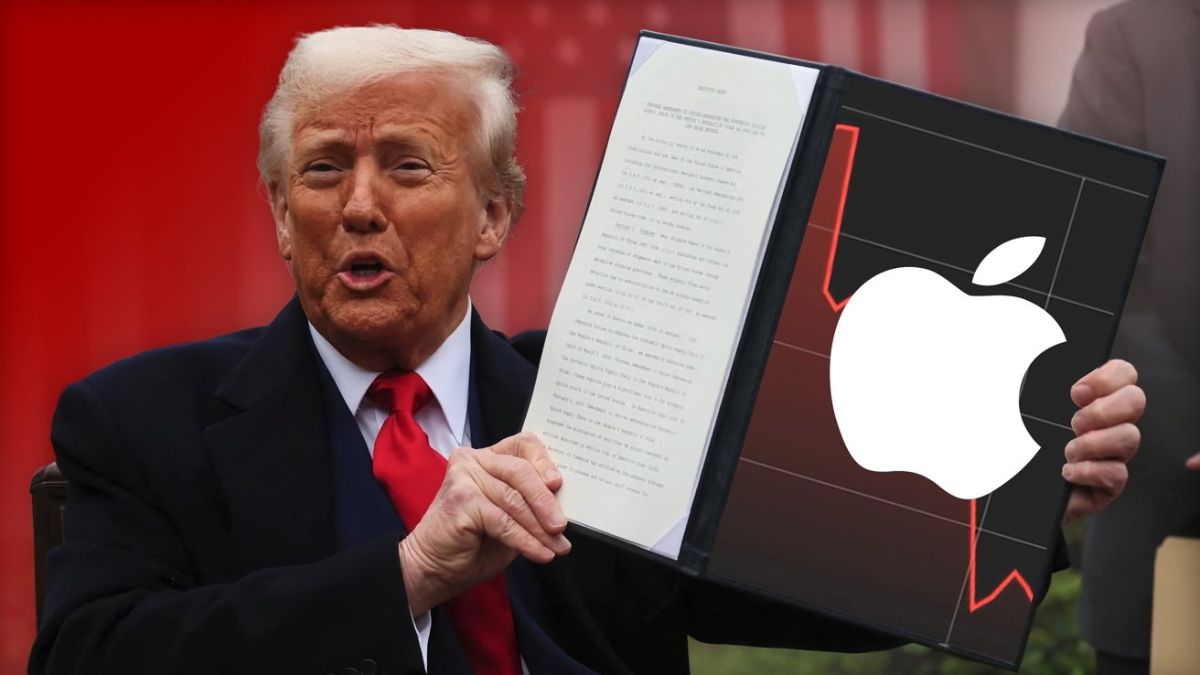
Designed in California, Assembled in a Tariff Minefield
Every iPhone comes with a proud little label: Designed in California. But let’s not kid ourselves—these shiny slabs of aluminum and glass are born far from Silicon Valley. Try China. The very place now staring down the barrel of Trump’s latest tariff tantrum up to a brutal 245% on certain imports.
Let’s talk numbers. Apple pumps out over 220 million iPhones a year. Nine out of ten are made in China. From the screens to the soldered guts inside, most components are sourced, built, and jammed together somewhere between Zhengzhou and Shenzhen. And then they’re shipped right back to the States the biggest market in Apple’s ecosystem.
Sure, Trump waved a temporary white flag last week, sparing smartphones and laptops from his tariff sledgehammer. But don’t get too comfy. He quickly turned around and snarled on Truth Social:
“NOBODY is getting ‘off the hook.’”
Translation: expect more tariffs. This time, he’s looking at the whole electronics supply chain. Yes, the same global web Apple has boasted about for years is now a potential noose around its neck.
How China Became Apple’s Lifeline and Now Its Liability
Let’s rewind to the late ’90s. Apple was gasping for air, barely staying afloat while rivals swam laps around it. China, still shaking off its planned economy hangover, was opening up to foreign investment like it had just discovered capitalism.
Enter Apple.
At first, it trickled into China through third-party vendors, selling Macs and praying someone would buy them. But by 2001, it had set up shop in Shanghai and partnered with Foxconna Taiwanese giant with boots on Chinese soil. The iPod came first. Then the iMac. Then the iPhone. The rest is sweatshop history.
And no, China wasn’t exactly ready for Apple. But Apple didn’t wait. It made its suppliers ready.
Take Beijing Jingdiao, for instance. A nothing-special shop that once cut acrylic. Apple needed glass-cutting machines. So Jingdiao became that. Today, it’s one of China’s top high-speed machine tool makers. That’s what a trillion-dollar company can do it builds its own ecosystem.
Fast forward to 2008. Beijing hosted the Olympics, China was the West’s favorite golden child, and Apple opened its first official store. Then 50 more. Chinese folks stood in line for hours to grab a piece of Cupertino cool.
And in Zhengzhou? Foxconn built the world’s biggest iPhone factory. It’s been dubbed “iPhone City.”
Yes, you read that right. A literal city devoted to assembling iPhones. Think that’s moving to Kentucky next year?
“Bring the Screws Back to America!” (A Comedy in One Act)
Trump’s dream: factories on American soil with workers tightening screws on iPhones, one by one. Cue Commerce Secretary Howard Lutnick declaring:
“The army of millions and millions of human beings screwing in little screws to make iPhones that kind of thing is going to come to America.”
Sure it is, Howard.
Even Apple’s biggest defenders snort at this idea. Eli Friedman, who once sat on Apple’s academic advisory board, called the notion of shifting assembly to the U.S. “pure fantasy.”
Apple’s been trying to lessen its China addiction since 2013. A decade later? Vietnam and India got a little more action. But the heavy lifting still happens in China. Always has.
So while Trump threatens 245% tariffs with one hand, Apple tries to thread the needle with the other dodging penalties without torching its entire business model.
Apple didn’t respond to questions (because of course it didn’t), but its website says its supply chain involves “thousands of businesses and more than 50 countries.” Neat. But 150 out of its top 187 suppliers in 2024 had plants in China. The numbers speak louder than marketing fluff.
China’s Not Taking It Lying Down
This isn’t a one-way street. China has slapped the U.S. back with 125% levies on American goods. Plus, they’ve restricted exports of rare earth minerals the magic dust inside your iPhone’s speakers and cameras. Without them, your iPhone is just a very expensive brick.
So while Trump tries to choke China’s exports, China’s retaliating by tightening the screws on critical parts.
And don’t assume Apple can just jump over to Vietnam or India. Trump already threatened 46% tariffs on Vietnamese-made electronics before hitting pause for 90 days. No safe harbor in sight.
“All conceivable places for the huge Foxconn assembly sites… are in Asia,” Friedman says. “And all these countries are facing higher tariffs.”
Translation: There’s no easy exit from this mess.
Apple’s Chinese Competitors Smell Blood
Here’s the kicker. Apple helped China build the very machine that might kill it.
Today, firms like Huawei, Xiaomi, and Oppo aren’t just competing they’re winning. With Apple’s playbook in hand, Chinese brands are using the same supply chains Apple built to churn out solid phones at lower prices.
In 2024, Apple lost its crown as China




