

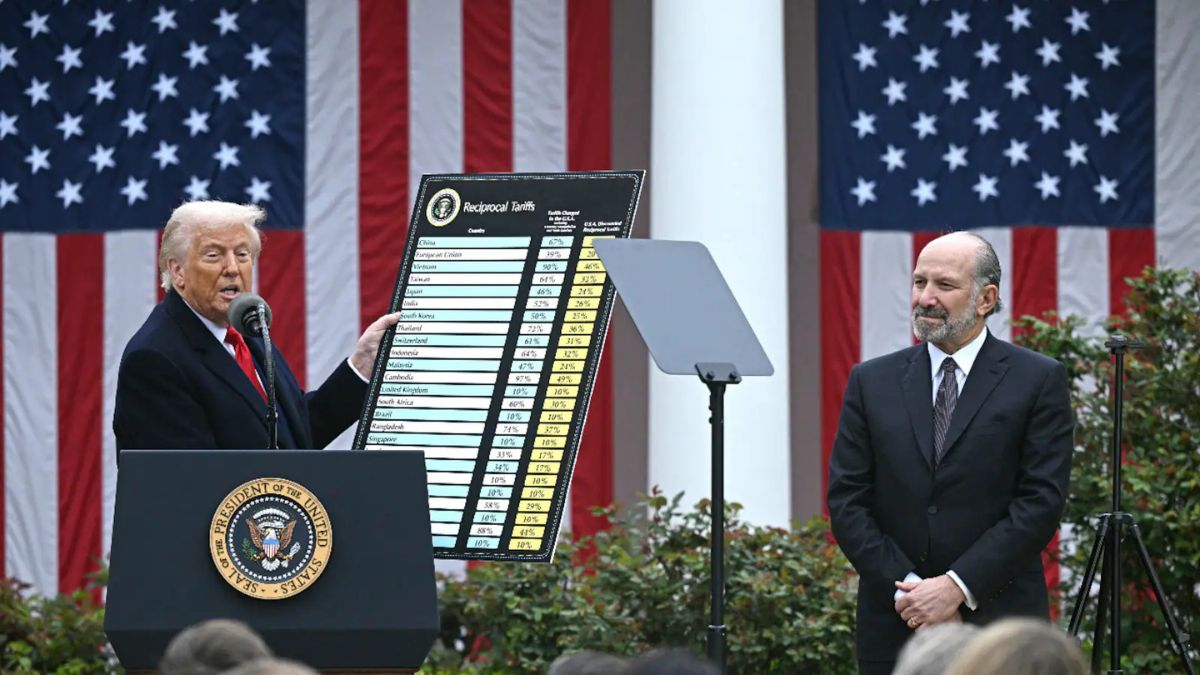
President Donald Trump’s aggressive rollout of a sweeping new tariff regime has set off alarm bells across the globe. With full duties set to take effect by Wednesday, world markets are reeling, foreign governments are scrambling to respond, and businesses of every size are left on edge uncertain of what lies ahead. Despite mounting economic pressure, the Trump administration shows no signs of slowing down.
This isn’t just another headline-grabbing policy. This is the dawn of a global economic realignment.
Economic Shock: Wall Street’s Whiplash and Growing Recession Fears
Markets experienced a wild rollercoaster ride this week as investors grappled with Trump’s unpredictable trade strategy. The S&P 500 briefly dipped into bear market territory, only to recover after a false report surfaced about a possible 90-day delay in the tariffs. The Nasdaq even ticked up slightly, but the volatility sent a clear message: Wall Street is terrified of uncertainty.
According to Morning Money’s Sam Sutton, this seesawing reflects one major truth: “There’s enormous demand for clarity and relief.” The Trump administration’s “reciprocal” tariffs meant to counter foreign duties are already constraining investment, weakening business confidence, and throwing hiring plans into chaos. Analysts warn that we’re not just looking at short-term turbulence we could be staring down a full-blown recession if the situation escalates.
And it’s not just financial markets showing signs of strain. Consumers will soon feel the impact as prices on everything from smartphones to cars begin to spike. Layoffs are expected. Inflation is already high. Now, fears of stagflation are entering the conversation.
Political Divides Within the White House: “Protectionism vs. Fair Trade”
Inside Trump’s own administration, the once tightly unified front is beginning to show cracks. White House reporter Megan Messerly reveals that two distinct camps are forming: the hardline protectionists, led by trade adviser Peter Navarro, and a more pragmatic “fair trade” faction focused on dealmaking.
Although Navarro and U.S. Trade Representative Jamieson Greer have largely dictated policy so far, President Trump’s recent mention of “negotiations” during an Oval Office appearance with Israeli Prime Minister Benjamin Netanyahu marks a subtle but critical shift. While the president insists that some tariffs will be permanent, the door is now slightly ajar for possible deals, especially with strategic partners.
This pivot is not lost on markets or voters. The administration’s messaging has moved from “grin and bear it” to hinting at selective negotiations, especially as Republicans brace for a difficult midterm cycle. The big question now: How much economic pain can Trump’s coalition endure before it fractures?
Diplomatic Fallout: Allies Reassess Their Relationship with Washington
Canada: Quiet Retaliation and Careful Optics
In Ottawa, Prime Minister Mark Carney is walking a tightrope. Canada’s economy is particularly exposed to U.S. tariffs, especially in the auto and lumber sectors. With just weeks to go until a hotly contested national election, Carney has sought to appear tough while avoiding direct confrontation with the White House.
Behind the scenes, however, Canada is quietly coordinating with allies in Europe and the Indo-Pacific to explore countermeasures. Foreign Minister Mélanie Joly has been vocal about strengthening partnerships and trade diversification a direct pivot away from heavy reliance on American markets.
According to Nick Taylor-Vaisey, Canada’s strategy is clear: “Make more friends, don’t escalate with Trump, and hope he inflicts pain elsewhere.”
United Kingdom: A Risky Trade Gamble
British Prime Minister Keir Starmer is still holding out hope for a bespoke trade deal with the U.S., but political costs loom large. Concessions over Online Safety legislation and U.S. beefaccess are sparking public backlash. For Starmer, this is a delicate balancing act between economic necessity and domestic political survival.
Trade insiders in London liken this moment to Brexit 2.0 only this time, the economic barriers are being thrown up by the U.S., not Europe. The broader sentiment among U.K. businesses and trade lawyers is grim: Trump’s tariffs are worse than Brexit.
Indo-Pacific and CPTPP: A Global Realignment?
Perhaps the greatest geopolitical irony is that the successor to the abandoned Trans-PacificPartnership (TPP) now known as CPTPP may emerge as a vehicle to counterbalance U.S. trade aggression. Members like Japan, Canada, Mexico, and the U.K. are exploring tighter economic ties within the bloc as a hedge against Trump’s economic nationalism.
This represents a historic reversal: a trade framework once envisioned to contain China may now serve as a bulwark against American protectionism.
Corporate America: From Confidence to Caution
As first-quarter earnings season kicks off, the real impact of Trump’s tariffs will start surfacing. Many companies are expected to downgrade forward guidance, delay investment plans, and halt factory expansions due to the uncertainty surrounding supply chains.
Major voices in the business world including Bill Ackman and Elon Musk are now openly criticizing the policy. Musk even took to Twitter/X to slam Peter Navarro, pointing out that techcompanies like Apple and Google are being hit across their entire supply chains, from chips in Taiwan to assembly in China and India.
In other words: there is no safe harbor in this trade war.
What Comes Next: Predictions and Political Reality
The Trump administration appears dug in not just on policy but on ideology. According to Graham Lanktree, “This is the new normal.” The administration sees tariffs as the only path toreindustrialize America and plug revenue gaps left by tax cuts.
But that vision comes with enormous risks. Trump is losing ground in the polls, with voter sentiment souring over inflation and job insecurity. If economic pain deepens, and layoffs rise, Republicans could face devastating electoral consequences.
The international response will also intensify. Countries once afraid to defy the U.S. are now exploring new alliances some even talking about long-term decoupling from American supply chains.
A Global Trade War for a New Era
Trump’s tariffs have upended the status quo. What began as a campaign promise has morphed into a full-scale economic, political, and diplomatic shockwave.
Whether this gamble will ultimately revive American manufacturing or plunge the global economy into deeper chaos remains to be seen. But one thing is certain:
The era of predictable, rules-based global trade is over and the world is scrambling to write the next chapter.




