

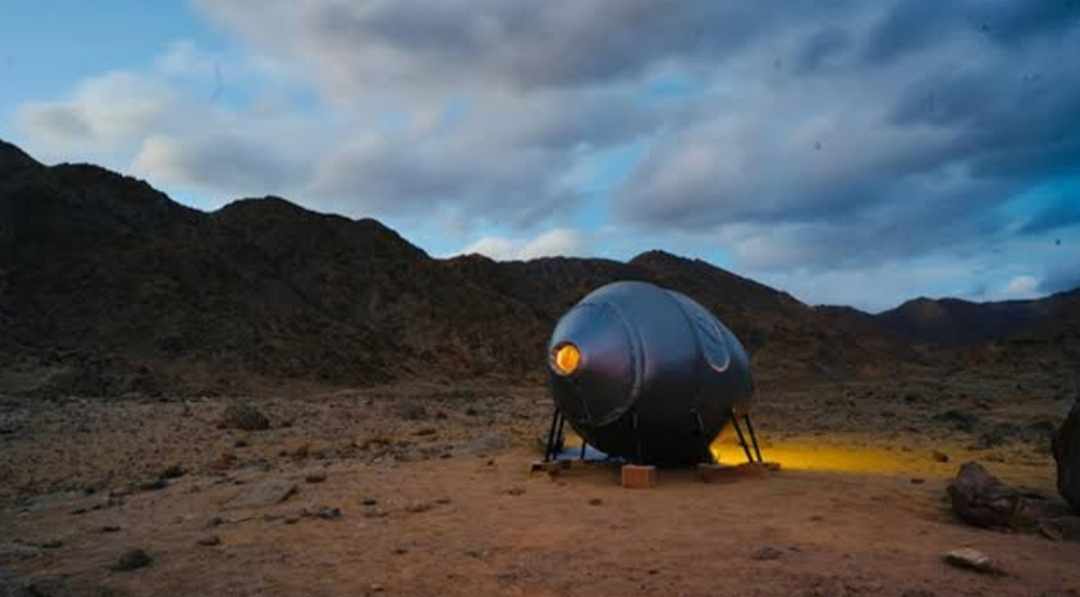
The Habitat-1, known as Hab-1, marks a significant milestone as India’s inaugural “analog mission” conducted by the Indian Space Research Organization. This initiative simulates space conditions to enhance preparedness for upcoming space missions. Recently a comprehensive three-week trial was conducted in the high-altitude region of Ladakh, nestled within the Himalayas.
Design Features of Hab-1
The Hab-1 egg-shaped structure was constructed using space-grade Teflon and includes essential amenities like-
- A sleeping area
- A kitchenette for meals
- A retractable workspace
- Storage units for supplies and emergency kits
- Dry toilet facilities are an effective waste disposal system for maintaining hygiene.
The facility is designed to accommodate an astronaut for extended periods, allowing for a realistic simulation of space life. Hab-1 is designed keeping in mind that space is going to be very limited on the Moon or Mars.
Purpose of Hab-1
Analog missions like Hab-1 are crucial for understanding the psychological and physical effects of isolation in space. They provide vital information about how astronauts cope with confinement and limited resources.
This preparation is essential as India aims to send astronauts into low-Earth orbit at an altitude of 400 km (248 miles) for three days sometime next year if the preparations go according to plan. Two Indian astronauts selected for Gaganyaan are currently training at NASA. The development of Hab-1 reduces reliance on foreign agencies for astronaut training. This facility will enable India to conduct its own simulations, enhancing the training process for future missions.
Geographic Relevance of Ladakh
Ladakh’s unique terrain resembles that of Mars and the Moon. The region’s extreme weather conditions and barren landscape provide an ideal environment for simulating space conditions. Soil samples collected during the mission are being analyzed to explore the feasibility of using local materials for future space habitats. The region on the India-China border stands at an altitude of 3,500 meters, presenting extreme weather conditions that challenge human endurance. Temperatures in the region, close to the Chinese border, can oscillate between -18C and 20C—not quite the mind-blowing lows of a minimum -250C on the Moon or -153C on Mars.
As India gears up to send its first set of astronauts into Earth’sorbit through the Gaganyaan mission, anticipated to launch next year, the nation is establishing long-term goals. If all goes well, the country is then planning to set up its first space station in 2035 and land its first man on the moon by 2040.
“Once we have our own simulation mission, we won’t have to depend on foreign space agencies to train our astronauts,” says Prof. Subrat Sharma, Dean of Research Studies at Ladakh University, which collaborated on the project.
Psychological Aspect of Space Missions
Understanding the psychological impacts is a key focus of analog missions. Astronauts in Hab-1 are monitored for stress levels, sleep patterns, and overall health. This data is vital for developing strategies to support astronauts during long-duration missions.
Future Aspiration
Following the success of this mission, discussions are underway for establishing a permanent simulation facility in Ladakh. The data collected from Hab-1 will contribute to advancements in medical technology and astronaut support systems. This would further enable training for astronauts in conditions similar to those they would experience in actual space exploration. The Hab-1 mission represents a very important moment for India’s space ambitions.
As the global space race intensifies, with various nations aiming to establish human presence on the moon and beyond, India is committed to advancing its space exploration capabilities through innovative training methods and research initiatives.




