

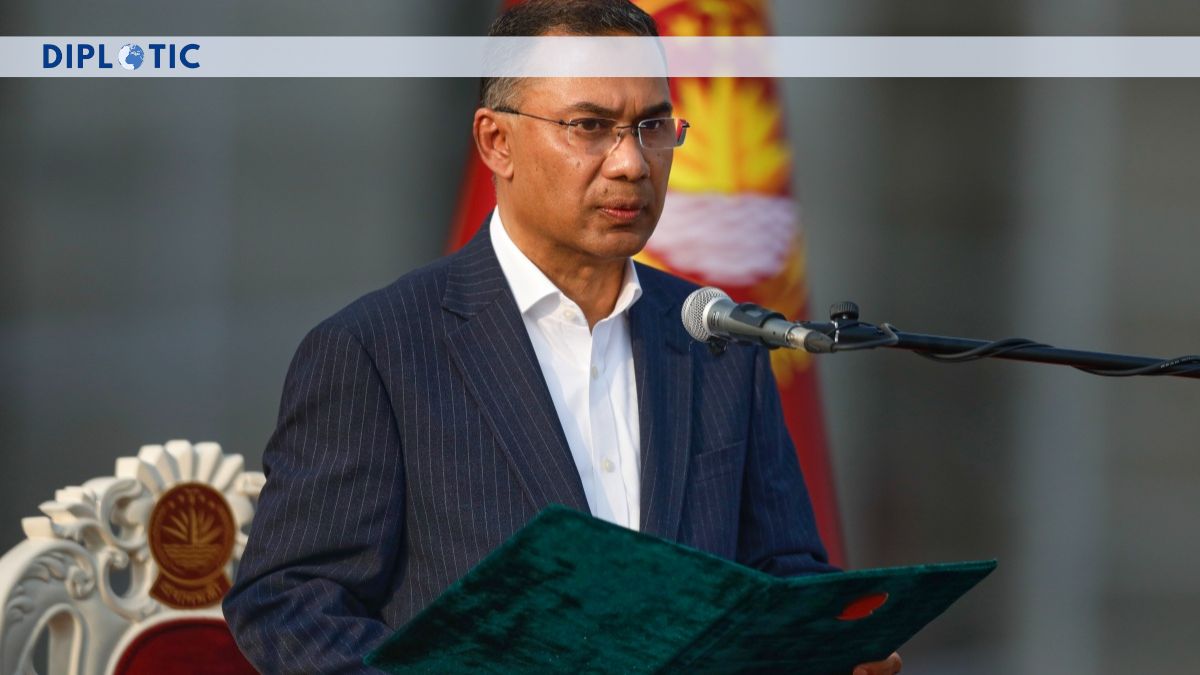
Bangladesh’s 2026 election aftermath has triggered a dramatic political shift, with Tarique Rahman’s victory reshaping domestic power dynamics and redefining regional diplomacy across South Asia. The geopolitical consequences, India–China recalibrations, economic strategy changes, and the future of Bangladesh’s foreign policy.
A Historic Electoral Turning Point
The 2026 general election in Bangladesh marked one of the most consequential political transitions in the nation’s recent history. The victory of Tarique Rahman signaled not only a domestic power shift but also a profound recalibration of regional diplomacy.
For years, Bangladesh’s foreign policy operated within a delicate balancing framework, maintaining strong economic ties with India while expanding infrastructure and trade partnerships with China. Rahman’s ascent to leadership has introduced new strategic calculations that are already rippling across South Asia.
The election aftermath is more than a change of government; it represents a potential diplomatic reset with far-reaching implications.
Domestic Mandate and Political Realignment
Rahman’s electoral win, under the banner of the Bangladesh Nationalist Party (BNP), reflects voter demand for political reform, economic stabilization, and institutional restructuring. His campaign emphasized governance transparency, economic revitalization, and a more assertive foreign policy posture.
The new administration inherits complex challenges: inflationary pressures, youth unemployment, currency volatility, and infrastructure financing demands. These domestic priorities will inevitably shape Bangladesh’s external engagements.
Political stability following the election has reassured markets temporarily, yet international observers remain watchful regarding policy continuity and democratic institutions.
Recalibrating Relations with India
Perhaps the most closely scrutinized diplomatic relationship is with neighboring India. Under previous administrations, Dhaka maintained robust security and trade cooperation with New Delhi, including transit agreements and counterterrorism collaboration.
Rahman’s political history suggests a more nationalist tone, which may introduce friction in certain bilateral areas such as water-sharing agreements and border management. However, economic interdependence remains a powerful stabilizing force.
India relies on transit connectivity through Bangladesh to access its northeastern states, while Bangladesh benefits from cross-border electricity trade and investment flows. A dramatic rupture appears unlikely, but diplomatic recalibration is probable.
The coming months will test whether strategic pragmatism overrides historical political rivalries.
The China Factor
China’s expanding footprint in Bangladesh through infrastructure financing, port development, and energy projects has transformed the country into a key node within Beijing’s regional connectivity ambitions.
Rahman’s government faces a delicate balancing act. Maintaining Chinese investment while avoiding overdependence will be critical. Infrastructure projects tied to Chinese funding are central to Bangladesh’s development trajectory, yet geopolitical competition in the Indo-Pacific intensifies scrutiny.
Beijing’s response to the new leadership has been measured but attentive. Continuity in economic engagement appears likely, though renegotiation of certain project terms could emerge as part of a broader sovereignty-focused narrative.
Bangladesh’s strategic geography ensures that both India and China will compete to preserve influence.
The United States and Western Engagement
The United States remains an important economic and security partner for Bangladesh, particularly in trade and labor markets. Washington’s emphasis on democratic governance and human rights may shape early diplomatic engagement with the new administration.
Rahman’s foreign policy team has signaled interest in strengthening ties with Western economies to diversify trade beyond traditional partners. The ready-made garment sector, Bangladesh’s export backbone, depends heavily on access to U.S. and European markets.
Navigating labor rights reforms and democratic accountability will influence the tenor of Western diplomatic relations in the post-election landscape.
Regional Cooperation and SAARC Dynamics
Rahman’s victory also reopens questions about regional institutions such as the South Asian Association for Regional Cooperation (SAARC). Bangladesh has historically supported deeper regional integration, particularly in trade and climate cooperation.
With shifting leadership dynamics in South Asia, Dhaka may seek to revive dialogue mechanisms or promote subregional groupings to enhance economic resilience. Strengthened engagement with Nepal, Bhutan, and Sri Lanka could diversify diplomatic capital.
Whether SAARC regains momentum will depend largely on broader India–Pakistan relations, yet Bangladesh’s leadership voice could shape regional agendas on climate adaptation and digital trade.
Economic Diplomacy in a Volatile Era
Bangladesh’s economic diplomacy now stands at a pivotal juncture. Foreign direct investment, debt sustainability, and export diversification require careful strategic alignment.
Rahman’s administration has indicated plans to renegotiate certain large-scale infrastructure contracts to ensure fiscal sustainability. Transparent debt management will be essential to maintaining investor confidence.
Additionally, expanding trade with Southeast Asia and the Middle East could reduce vulnerability to regional shocks. Strategic port modernization and logistics upgrades will play a critical role in positioning Bangladesh as a competitive manufacturing hub.
Economic pragmatism may ultimately define the success of the new diplomatic approach.
Security and Strategic Stability
Security cooperation remains a cornerstone of Bangladesh’s regional posture. Counterterrorism collaboration, maritime surveillance in the Bay of Bengal, and border stability will require continued coordination with neighbors.
The Bay of Bengal itself is emerging as a strategic theater, with increasing naval activity from regional and global powers. Bangladesh’s maritime strategy under Rahman will signal whether Dhaka leans toward deeper security partnerships or maintains a strictly balanced posture.
Ensuring internal stability while avoiding entanglement in great-power rivalries will test diplomatic skill.
Climate Diplomacy and Global Leadership
Bangladesh is among the world’s most climate-vulnerable nations. Rising sea levels, cyclones, and river erosion pose existential threats.
Rahman’s administration has the opportunity to elevate Bangladesh’s voice in global climate negotiations. Climate financing, adaptation funds, and renewable energy investment can serve as pillars of foreign engagement.
Building coalitions with other vulnerable states may strengthen bargaining power in international forums. Climate diplomacy could become a defining feature of Bangladesh’s post-2026 global strategy.
The Road Ahead
The aftermath of the 2026 election represents both uncertainty and opportunity. Tarique Rahman’s leadership marks a generational shift in Bangladesh’s political landscape, with tangible implications for South Asian diplomacy.
The core challenge will be balancing balancing domestic reform with foreign commitments, balancing India and China, and balancing sovereignty with economic interdependence.
Bangladesh’s geopolitical importance ensures that every diplomatic gesture will be closely analyzed. Yet the country’s strategic leverage also provides room for maneuver.
If managed prudently, this political transition could position Bangladesh as a more assertive, diversified, and resilient regional actor. Missteps, however, could amplify tensions in an already fragile geopolitical environment.
In a region defined by complexity and competition, Bangladesh’s 2026 electoral shift may prove to be one of the most pivotal diplomatic turning points of the decade.




