

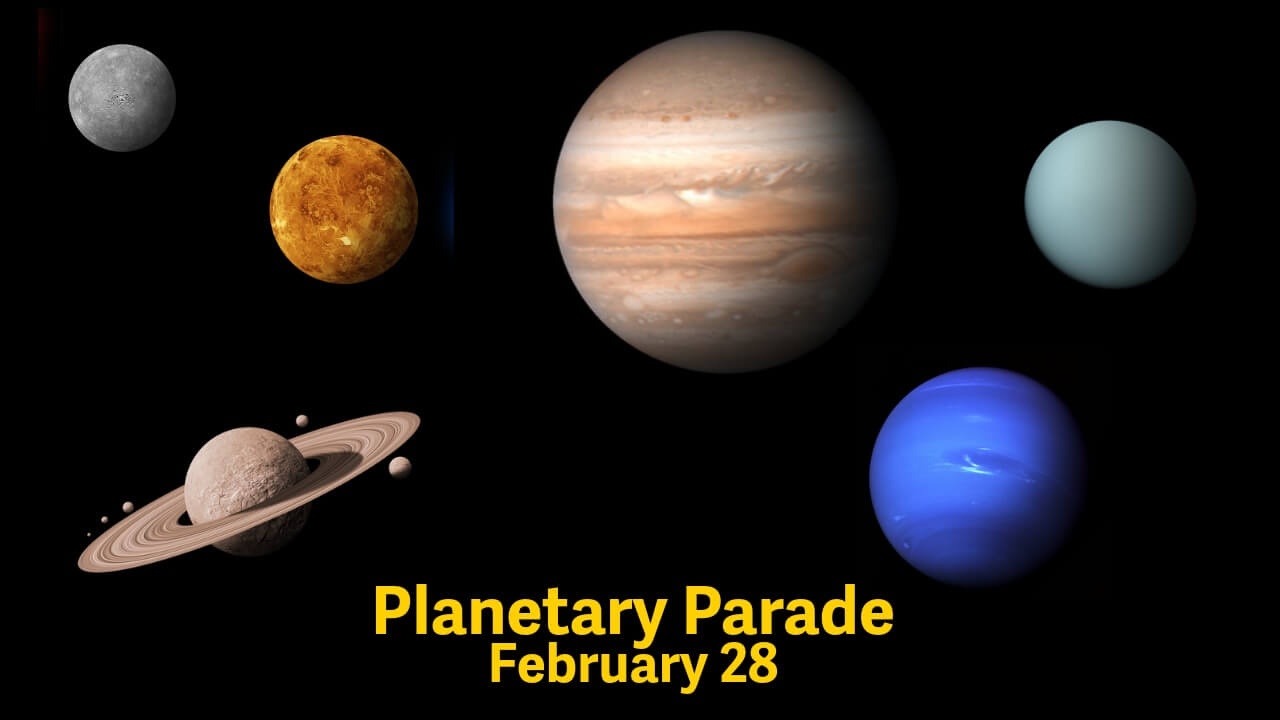
Skywatchers are in for a rare treat this February 2026, as a spectacular planetary parade lights up the evening sky. Here’s a simple guide to what it means, why it’s special, and how you can see it yourself.
🌠 What Is a Planetary Parade?
A planetary parade happens when several planets appear lined up across the sky at the same time, forming a graceful arc from one horizon to the other. This alignment is an optical effect, not a true physical line-up in space it occurs because all planets orbit the Sun on roughly the same flat plane, known as the ecliptic.
In February 2026, six planets will be visible in one sweeping view:
- Mercury
- Venus
- Saturn
- Jupiter
- Uranus
- Neptune
Four of these Mercury, Venus, Saturn, and Jupiter can be seen with the naked eye, while Uranus and Neptune require binoculars or a telescope.
📅 When Is the Best Time to Watch?
- Peak Date: February 28, 2026
- Best Time: 30–60 minutes after sunset
- Viewing Window: February 22–28, with the clearest alignment near the end of the month
During this short window, all six planets appear together in the sky an event that won’t happen again until 2040.
🔭 Where to Look in the Sky
To catch the full parade, scan both sides of the sky shortly after sunset:
🌇 Western Sky (low near horizon):
- Venus — extremely bright, easiest to spot
- Mercury — faint, very low
- Saturn — slightly higher than Venus
🌌 Eastern & Southern Sky:
- Jupiter — very bright, high in the sky
- Uranus — binoculars needed
- Neptune — telescope required
Clear skies and an unobstructed horizon are essential.
👁️ How Rare Is This Event?
Seeing six planets at once is extremely uncommon. While two or three planets often appear together, a six-planet alignment is exceptionally rare occurring only once every 10–15 years.
The next similar event is expected in late 2040.
🌠 Tips for Best Viewing
- Go to a dark location away from city lights
- Use binoculars if possible
- Ensure clear weather
- Start observing 30 minutes after sunset
- Never look toward the Sun wait until it has fully set
✨ Why It Matters
Beyond its beauty, a planetary parade offers a powerful reminder of our place in the solar system and makes astronomy accessible even to beginners. Whether you’re a casual observer or a sky enthusiast, this is one of 2026’s most exciting celestial events.
🌠 How to See the Planetary Parade from Bangladesh (Chattogram)
📅 Best Dates
February 22 – 28, 2026
⭐ Peak Night: February 28
⏰ Best Time
6:15 PM – 7:15 PM (BST)
→ Start observing 30–45 minutes after sunset
🧭 Where to Look in the Sky (Exact Directions)
🌇 West / South-West Sky (Low near horizon)
Look just above the sunset point:
- Venus → ⭐ Very bright, impossible to miss
- Mercury → Very low, faint, close to horizon
- Saturn → Slightly higher than Venus, soft yellow glow
➡ Face West–Southwest
🌌 South & East Sky (High above)
- Jupiter → ⭐ Very bright, high in the sky
- Uranus → Binocular needed
- Neptune → Telescope needed
➡ Look South → Southeast → East
🔭 What You Can See Without Equipment
With naked eye only, you can clearly see:
✅ Venus
✅ Jupiter
✅ Saturn
⚠ Mercury (hard needs clear horizon)
With binoculars:
🔍 Uranus
With telescope:
🔭 Neptune
🌟 Best Observation Tips for Chattogram
- Go to Patenga beach, Bayezid hills, Foy’s Lake area, or rooftop with open western view
- Avoid port & city light pollution
- Clear horizon is CRUCIAL for Mercury & Venus
- Use mobile sky apps:
- Stellarium
- Sky Map
- Star Walk 2
📸 Want to Photograph It?
Use:
- Tripod
- Night mode
- Wide-angle lens
- ISO 400–800
- Exposure 5–10 sec
🕌 Islamic Reflection
Such celestial harmony reminds us of:
“Indeed, in the creation of the heavens and the earth are signs for people of understanding.”
(Qur’an 3:190)




