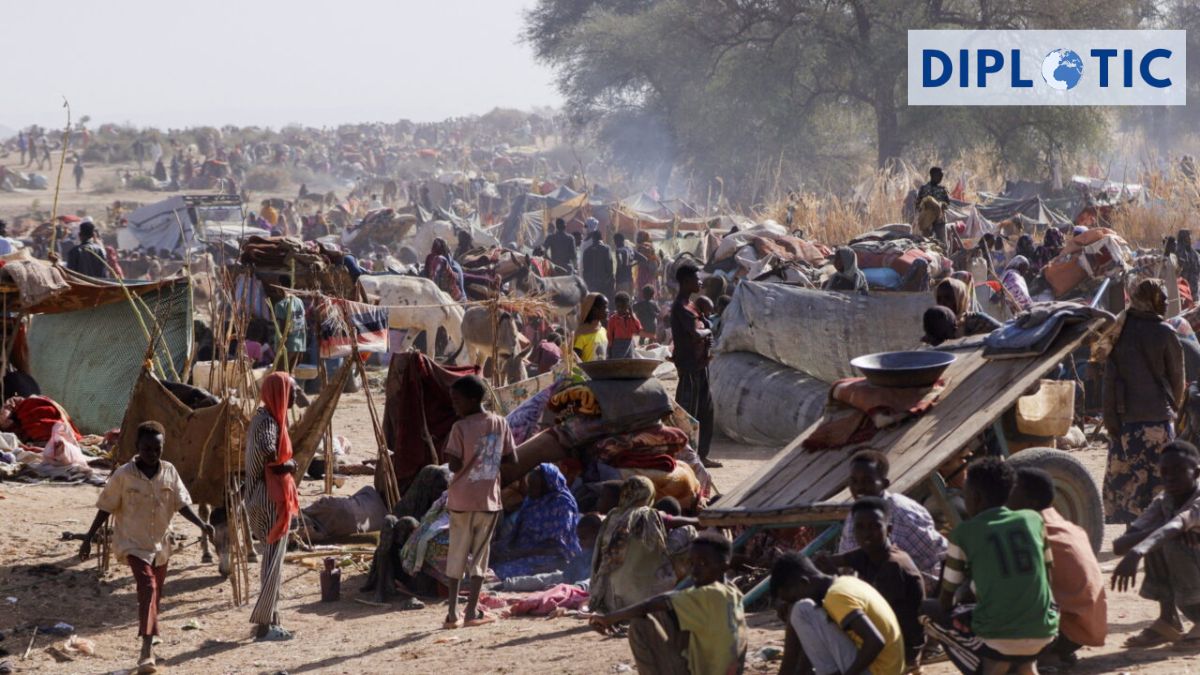
Sudan is an African country situated in Northeast Africa. It is a poor country, with a nominal per capita GDP of around 600–700 US dollars. Since April 15, 2023, Sudan has been engulfed in a civil war between the Sudanese Armed Forces (SAF) and the paramilitary Rapid Support Forces (RSF).
This civil war has created the world’s largest and fastest-growing displacement crisis. However, the situation has been largely overshadowed by conflicts and political tensions elsewhere around the globe. The U.S. government has accused the RSF of committing genocide against non-Arab ethnic groups in Darfur, while the SAF has been accused of deploying chemical weapons against civilian and military targets.
The Reasons Behind the Conflict
Before the conflict, the two forces were former allies, having joined forces in 2019 to overthrow dictator Omar al-Bashir, who ruled Sudan for three decades.
After this coup, the SAF’s leader, General Abdel Fattah al-Burhan, became the head of state, backed by RSF leader General Mohamed Hamdan Dagalo, also known as Hemedti. In 2021, Hemedti orchestrated a second coup that toppled Sudan’s interim government.
Due to intense international pressure, they were forced to hand over power to a civilian government. However, in mid-April 2023, Hemedti launched a violent revolt. Many countries attempted to mediate peace in Sudan, but these efforts failed.
According to widespread reports, the gold sector in Sudan has become deeply entangled in the civil war. It is also alleged that the RSF is acting as a proxy force for the UAE and other Western countries. Many believe that the conflict in Sudan is closely linked to control over gold mines.
The Humanitarian Situation Is Deteriorating Rapidly
Since 2023, violence has turned Sudan into the world’s fastest-growing man-made humanitarian crisis.
According to UN reports, at least 21.2 million people are facing high levels of acute food insecurity. Approximately 9.5 million people are internally displaced, while 4.35 million people have fled the country. Nearly 10 million children are out of school because classrooms have been destroyed or occupied by armed groups.
The number of people killed in the conflict remains unknown due to restricted media access, but experts estimate that between 20,000 and 150,000 people may have died. After the RSF took control of much of the Darfur region, it became involved in mass killings of civilians, although exact figures are still unavailable.
In October, UN experts warned that Sudan must not be allowed to descend further into a nightmare of violence, hunger, and despair. Much of Sudan’s infrastructure has been destroyed, and disease outbreaks are increasing due to disruptions in basic public health services.
At the same time, rising food and fuel prices have left nearly 25 million people facing acute hunger. According to the World Food Programme, if conditions do not improve, Sudan risks becoming “the world’s largest hunger crisis in recent history.”
Sudanese Refugees and Foreign Refugees
As of July 2024, about 3.2 million Sudanese had fled the country, while another half million people left to join family members in Saudi Arabia, the United Arab Emirates, Qatar, and Oman. Additionally, more than 813,000 people who were previously refugees in Sudan returned to their countries of origin, as Sudan had long served as a regional refugee hub.
Most refugees fled to neighboring countries such as Egypt, South Sudan, and Chad. About 1.5 million people sought refuge in Egypt, 1.2 million in South Sudan, and around 870,000 in Chad.
How Is the International Community Responding?
All neighboring countries are accepting refugees fleeing Sudan, with the majority going to Egypt, South Sudan, and Chad. The United Nations Country Team (UNCT), which has operated in Sudan for years, continues to coordinate humanitarian efforts.
In the first four months of 2024, the UN and its humanitarian partners provided life-saving assistance, including food, clean water, and medical services, to more than 5 million people across the country. However, after the RSF captured the city of Wad Madani in Gezira State, aid delivery was severely disrupted.
In 2024, the UN appealed for $2.7 billion in humanitarian aid for Sudan, but only 17 percent of the required funding has been secured. In April 2024, France helped mobilize over $2 billion in international aid, but experts warn that this amount is still far from sufficient